|
|
 |
Classic
Tales of Ancient Greece
THE LORD OF THE SILVER BOW
I. DELOS
|
| Long before you or I or
anybody else can remember, there lived with the Mighty Folk on the mountain
top a fair and gentle lady named Leto. So fair and gentle was she that
Jupiter loved her and made her his wife. But when Juno, the queen of earth
and sky, heard of this, she was very angry; and she drove Leto down from
the mountain and bade all things great and small refuse to help her. So
Leto fled like a wild deer from land to land and could find no place in
which to rest. She could not stop, for then the ground would quake under
her feet, and the stones would cry out, "Go on! go on!" and birds and beasts
and trees and men would join in the cry; and no one in all the wide land
took pity on her.
One day she came to the sea,
and as she fled along the beach she lifted up her hands and called aloud
to great Neptune to help her. Neptune, the king of the sea, heard her and
was kind to her. He sent a huge fish, called a dolphin, to bear her away
from the cruel land; and the fish, with Leto sitting on his broad back,
swam through the waves to Delos, a little island which lay floating on
top of the water like a boat. There the gentle lady found rest and a home;
for the place belonged to Neptune, and the words of cruel Juno were not
obeyed there. Neptune put four marble pillars under the island so that
it should rest firm upon them; and then he chained it fast, with great
chains which reached to the bottom of the sea, so that the waves might
never move it.
By and by twin babes were
born to Leto in Delos. One was a boy whom she called Apollo, the other
a girl whom she named Artemis, or Diana. When the news of their birth was
carried to Jupiter and the Mighty Folk on the mountain top, all the world
was glad. The sun danced on the waters, and singing swans flew seven times
round the island of Delos. The moon stooped to kiss the babes in their
cradle; and Juno forgot her anger, and bade all things on the earth and
in the sky be kind to Leto.
The two children grew very
fast. Apollo became tall and strong and graceful; his face was as bright
as the sunbeams; and he carried joy and gladness with him wherever he went.
Jupiter gave him a pair of swans and a golden chariot, which bore him over
sea and land wherever he wanted to go; and he gave him a lyre on which
he played the sweetest music that was ever heard, and a silver bow with
sharp arrows which never missed the mark. When Apollo went out into the
world, and men came to know about him, he was called by some the Bringer
of Light, by others the Master of Song, and by still others the Lord of
the Silver Bow.
Diana was tall and graceful,
too, and very handsome. She liked to wander in the woods with her maids,
who were called nymphs; she took kind care of the timid deer and the helpless
creatures which live among the trees; and she delighted in hunting wolves
and bears and other savage beasts. She was loved and feared in every land,
and Jupiter made her the queen of the green woods and the chase. |
|
|
|
II. DELPHI
|
| "Where is the center of
the world?"
This is the question which
some one asked Jupiter as he sat in his golden hall. Of course the mighty
ruler of earth and sky was too wise to be puzzled by so simple a thing,
but he was too busy to answer it at once. So he said:
"Come again in one year from
to-day, and I will show you the very place."
Then Jupiter took two swift
eagles which could fly faster than the storm-wind, and trained them till
the speed of the one was the same as that of the other. At the end of the
year he said to his servants:
"Take this eagle to the eastern
rim of the earth, where the sun rises out of the sea; and carry his fellow
to the far west, where the ocean is lost in darkness and nothing lies beyond.
Then, when I give you the sign, loosen both at the same moment."
The servants did as they
were bidden, and carried the eagles to the outermost edges of the world.
Then Jupiter clapped his hands. The lightning flashed, the thunder rolled,
and the two swift birds were set free. One of them flew straight back towards
the west, the other flew straight back towards the east; and no arrow ever
sped faster from the bow than did these two birds from the hands of those
who had held them.
On and on they went like
shooting stars rushing to meet each other; and Jupiter and all his mighty
company sat amid the clouds and watched their flight. Nearer and nearer
they came, but they swerved not to the right nor to the left. Nearer and
nearer-and then with a crash like the meeting of two ships at sea, the
eagles came together in mid-air and fell dead to the ground.
"Who asked where is the center
of the world?" said Jupiter. "The spot where the two eagles lie-that is
the center of the world."
They had fallen on the top
of a mountain in Greece which men have ever since called Parnassus.
"If that is the center of
the world," said young Apollo, "then I will make my home there, and I will
build a house in that place, so that my light may be seen in all lands."
So Apollo went down to Parnassus,
and looked about for a spot in which to lay the foundations of his house.
The mountain itself was savage and wild, and the valley below it was lonely
and dark. The few people who lived there kept themselves hidden among the
rocks as if in dread of some great danger. They told Apollo that near the
foot of the mountain where the steep cliff seemed to be split in two there
lived a huge serpent called the Python. This serpent often seized sheep
and cattle, and sometimes even men and women and children, and carried
them up to his dreadful den and devoured them.
"Can no one kill this beast?"
said Apollo.
And they said, "No one; and
we and our children and our flocks shall all be slain by him."
Then Apollo with his silver
bow in his hands went up towards the place where the Python lay. The monster
had worn great paths through the grass and among the rocks, and his lair
was not hard to find. When he caught sight of Apollo, he uncoiled himself,
and came out to meet him. The bright prince saw the creature's glaring
eyes and blood-red mouth, and heard the rush of his scaly body over the
stones. He fitted an arrow to his bow, and stood still. The Python saw
that his foe was no common man, and turned to flee. Then the arrow sped
from the bow-and the monster was dead.
"Here I will build my house,"
said Apollo.
Close to the foot of the
steep cliff, and beneath the spot where Jupiter's eagles had fallen, he
laid the foundations; and soon where had been the lair of the Python, the
white walls of Apollo's temple arose among the rocks. Then the poor people
of the land came and built their houses near by; and Apollo lived among
them many years, and taught them to be gentle and wise, and showed them
how to be happy. The mountain was no longer savage and wild, but was a
place of music and song; the valley was no longer dark and lonely, but
was filled with beauty and light.
"What shall we call our city?"
the people asked.
"Call it Delphi, or the Dolphin,"
said Apollo; "for it was a dolphin that carried my mother across the sea." |
III. DAPHNE
|
| In the Vale of Tempe, which
lies far north of Delphi, there lived a young girl whose name was Daphne.
She was a strange child, wild and shy as a fawn, and as fleet of foot as
the deer that feed on the plains. But she was as fair and good as a day
in June, and none could know her but to love her.
Daphne spent the most of
her time in the fields and woods, with the birds and blossoms and trees;
and she liked best of all to wander along the banks of the River Peneus,
and listen to the ripple of the water as it flowed among the reeds or over
the shining pebbles. Very often she would sing and talk to the river as
if it were a living thing, and could hear her; and she fancied that it
understood what she said, and that it whispered many a wonderful secret
to her in return. The good people who knew her best said:
"She is the child of the
river."
"Yes, dear river," she said,
"let me be your child."
The river smiled and answered
her in a way which she alone could understand; and always, after that,
she called it "Father Peneus."
One day when the sun shone
warm, and the air was filled with the perfume of flowers, Daphne wandered
farther away from the river than she had ever gone before. She passed through
a shady wood and climbed a hill, from the top of which she could see Father
Peneus lying white and clear and smiling in the valley below. Beyond her
were other hills, and then the green slopes and wooded top of great Mount
Ossa. Ah, if she could only climb to the summit of Ossa, she might have
a view of the sea, and of other mountains close by, and of the twin peaks
of Mount Parnassus, far, far to the south!
"Good-by, Father Peneus,"
she said. "I am going to climb the mountain; but I will come back soon."
The river smiled, and Daphne
ran onward, climbing one hill after another, and wondering why the great
mountain seemed still so far away. By and by she came to the foot of a
wooded slope where there was a pretty waterfall and the ground was bespangled
with thousands of beautiful flowers; and she sat down there a moment to
rest. Then from the grove on the hilltop above her, came the sound of the
loveliest music she had ever heard. She stood up and listened. Some one
was playing on a lyre, and some one was singing. She was frightened; and
still the music was so charming that she could not run away.
Then, all at once, the sound
ceased, and a young man, tall and fair and with a face as bright as the
morning sun, came down the hillside towards her.
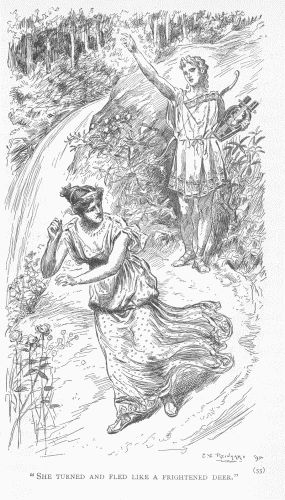
"Daphne!" he said; but she
did not stop to hear. She turned and fled like a frightened deer, back
towards the Vale of Tempe.
"Daphne!" cried the young
man. She did not know that it was Apollo, the Lord of the Silver Bow; she
only knew that the stranger was following her, and she ran as fast as her
fleet feet could carry her. No young man had ever spoken to her before,
and the sound of his voice filled her heart with fear.
"She is the fairest maiden
that I ever saw," said Apollo to himself. "If I could only look at her
face again and speak with her, how happy I should be."
Through brake, through brier,
over rocks and the trunks of fallen trees, down rugged slopes, across mountain
streams, leaping, flying, panting, Daphne ran. She looked not once behind
her, but she heard the swift footsteps of Apollo coming always nearer;
she heard the rattle of the silver bow which hung from his shoulders; she
heard his very breath, he was so close to her. At last she was in the valley
where the ground was smooth and it was easier running, but her strength
was fast leaving her. Right before her, however, lay the river, white and
smiling in the sunlight. She stretched out her arms and cried:
"O Father Peneus, save me!" |
SHE TURNED AND FLED LIKE A FRIGHTENED
DEER
|
| Then it seemed as though
the river rose up to meet her. The air was filled with a blinding mist.
For a moment Apollo lost sight of the fleeing maiden. Then he saw her close
by the river's bank, and so near to him that her long hair, streaming behind
her, brushed his cheek. He thought that she was about to leap into the
rushing, roaring waters, and he reached out his hands to save her. But
it was not the fair, timid Daphne that he caught in his arms; it was the
trunk of a laurel tree, its green leaves trembling in the breeze.
"O Daphne! Daphne!" he cried,
"is this the way in which the river saves you? Does Father Peneus turn
you into a tree to keep you from me?"
Whether Daphne had really
been turned into a tree, I know not; nor does it matter now-it was so long
ago. But Apollo believed that it was so, and hence he made a wreath of
the laurel leaves and set it on his head like a crown, and said that he
would wear it always in memory of the lovely maiden. And ever after that,
the laurel was Apollo's favorite tree, and, even to this day, poets and
musicians are crowned with its leaves. |
IV. DELUDED
|
| Apollo did not care to live
much of the time with his mighty kinsfolk on the mountain top. He liked
better to go about from place to place and from land to land, seeing people
at their work and making their lives happy. When men first saw his fair
boyish face and his soft white hands, they sneered and said he was only
an idle, good-for-nothing fellow. But when they heard him speak, they were
so charmed that they stood, spellbound, to listen; and ever after that
they made his words their law. They wondered how it was that he was so
wise; for it seemed to them that he did nothing but stroll about, playing
on his wonderful lyre and looking at the trees and blossoms and birds and
bees. But when any of them were sick they came to him, and he told them
what to find in plants or stones or brooks that would heal them and make
them strong again. They noticed that he did not grow old, as others did,
but that he was always young and fair; and, even after he had gone away,-they
knew not how, nor whither,-it seemed as though the earth were a brighter
and sweeter place to live in than it had been before his coming.
In a mountain village beyond
the Vale of Tempe, there lived a beautiful lady named Coronis. When Apollo
saw her, he loved her and made her his wife; and for a long time the two
lived together, and were happy. By and by a babe was born to them,-a boy
with the most wonderful eyes that anybody ever saw,-and they named him
AEsculapius. Then the mountains and the woods were filled with the music
of Apollo's lyre, and even the Mighty Folk on the mountain top were glad.
One day Apollo left Coronis
and her child, and went on a journey to visit his favorite home on Mount
Parnassus.
"I shall hear from you every
day," he said at parting. "The crow will fly swiftly every morning to Parnassus,
and tell me whether you and the child are well, and what you are doing
while I am away."
For Apollo had a pet crow
which was very wise, and could talk. The bird was not black, like the crows
which you have seen, but as white as snow. Men say that all crows were
white until that time, but I doubt whether anybody knows.
Apollo's crow was a great
tattler, and did not always tell the truth. It would see the beginning
of something, and then, without waiting to know anything more about it,
would hurry off and make up a great story about it. But there was no one
else to carry news from Coronis to Apollo; for, as you know, there were
no postmen in those days, and there was not a telegraph wire in the whole
world.
All went well for several
days. Every morning the white bird would wing its way over hills and plains
and rivers and forests until it found Apollo, either in the groves on the
top of Parnassus or in his own house at Delphi. Then it would alight upon
his shoulder and say, "Coronis is well! Coronis is well!"
One day, however, it had
a different story. It came much earlier than ever before, and seemed to
be in great haste.
"Cor-Cor-Cor!" it cried;
but it was so out of breath that it could not speak her whole name.
"What is the matter?" cried
Apollo, in alarm. "Has anything happened to Coronis? Speak! Tell me the
truth!"
"She does not love you! she
does not love you!" cried the crow. "I saw a man-I saw a man,-" and then,
without stopping to take breath, or to finish the story, it flew up into
the air, and hurried homeward again.
Apollo, who had always been
so wise, was now almost as foolish as his crow. He fancied that Coronis
had really deserted him for another man, and his mind was filled with grief
and rage. With his silver bow in his hands he started at once for his home.
He did not stop to speak with any one; he had made up his mind to learn
the truth for himself. His swan-team and his golden chariot were not at
hand-for, now that he was living with men, he must travel like men. The
journey had to be made on foot, and it was no short journey in those days
when there were no roads. But after a time, he came to the village where
he had lived happily for so many years, and soon he saw his own house half-hidden
among the dark-leaved olive trees. In another minute he would know whether
the crow had told him the truth.
He heard the footsteps of
some one running in the grove. He caught a glimpse of a white robe among
the trees. He felt sure that this was the man whom the crow had seen, and
that he was trying to run away. He fitted an arrow to his bow quickly.
He drew the string. Twang! And the arrow which never missed sped like a
flash of light through the air.
Apollo heard a sharp, wild
cry of pain; and he bounded forward through the grove. There, stretched
dying on the grass, he saw his dear Coronis. She had seen him coming, and
was running gladly to greet him, when the cruel arrow pierced her heart.
Apollo was overcome with grief. He took her form in his arms, and tried
to call her back to life again. But it was all in vain. She could only
whisper his name, and then she was dead.
A moment afterwards the crow
alighted on one of the trees near by. "Cor-Cor-Cor," it began; for it wanted
now to finish its story. But Apollo bade it begone.
"Cursed bird," he cried,
"you shall never say a word but 'Cor-Cor-Cor!' all your life; and the feathers
of which you are so proud shall no longer be white, but black as midnight."
And from that time to this,
as you very well know, all crows have been black; and they fly from one
dead tree to another, always crying, "Cor-cor-cor!" |
V. DISGRACED
|
| Soon after this, Apollo
took the little AEsculapius in his arms and carried him to a wise old schoolmaster
named Cheiron, who lived in a cave under the gray cliffs of a mountain
close by the sea.
"Take this child," he said,
"and teach him all the lore of the mountains, the woods, and the fields.
Teach him those things which he most needs to know in order to do great
good to his fellow-men."
And AEsculapius proved to
be a wise child, gentle and sweet and teachable; and among all the pupils
of Cheiron he was the best loved. He learned the lore of the mountains,
the woods, and the fields. He found out what virtue there is in herbs and
flowers and senseless stones; and he studied the habits of birds and beasts
and men. But above all he became skillful in dressing wounds and healing
diseases; and to this day physicians remember and honor him as the first
and greatest of their craft. When he grew up to manhood his name was heard
in every land, and people blessed him because he was the friend of life
and the foe of death.
As time went by, AEsculapius
cured so many people and saved so many lives that Pluto, the pale-faced
king of the Lower World, became alarmed.
"I shall soon have nothing
to do," he said, "if this physician does not stop keeping people away from
my kingdom."
And he sent word to his brother
Jupiter, and complained that AEsculapius was cheating him out of what was
his due. Great Jupiter listened to his complaint, and stood up among the
storm clouds, and hurled his thunderbolts at AEsculapius until the great
physician was cruelly slain. Then all the world was filled with grief,
and even the beasts and the trees and the stones wept because the friend
of life was no more.
When Apollo heard of the
death of his son, his grief and wrath were terrible. He could not do anything
against Jupiter and Pluto, for they were stronger than he; but he went
down into the smithy of Vulcan, underneath the smoking mountains, and slew
the giant smiths who had made the deadly thunderbolts.
Then Jupiter, in his turn,
was angry, and ordered Apollo to come before him and be punished for what
he had done. He took away his bow and arrows and his wonderful lyre and
all his beauty of form and feature; and after that Jupiter clothed him
in the rags of a beggar and drove him down from the mountain, and told
him that he should never come back nor be himself again until he had served
some man a whole year as a slave.
And so Apollo went out, alone
and friendless, into the world; and no one who saw him would have dreamed
that he was once the sun-bright Lord of the Silver Bow. |
|
|
|
BACK
|
 |
|
|

|
|
 uBooks
Bestsellers
uBooks
Bestsellers
uClassic
Greek Tales
uChildren's
Books
uFairy
Tales
uBrothers
Grimm
uHans
Christian Andersen
uCharles
Perrault
uAesop's
Fables
uGeorge
MacDonald
uDisney
uDr.
Seuss
uRudyard
Kipling
uJ.
K. Rowling
uKate
DiCamillo
uMary
Pope Osborne
uEric
A. Kimmel
uHistory
Books
uJ.R.R.
Tolkien
uLiterature
& Fiction
uMystery
& Thrillers
uRomance
Bestsellers
uScience
Fiction & Fantasy
uTeens
Bestsellers
|
 |