|
By Bill Hely
"How Safe is Your Success"
is a series of eight articles. Each article addresses a different aspect
of a universal problem which is of particular importance to those who do
business on-line. Most Internet users are at least aware there are dangers
"out there", but few appreciate the real extent of those dangers, the possible
(even likely) consequences, or the best, most practical and least expensive
means of countering them. This series is intended to at least provide some
useful awareness of the situation.
-------------------------
Part 8 - Safeguarding Correspondence
Many people the world over have
a very legitimate need to engage in important and sensitive correspondence
with others. But, because of the sensitivity issue, they worry about the
security of eMail and agonize over ways to ensure their correspondence
can't be intercepted. If you are one of these people, I'm sorry for this
bucket of very cold water I am now tipping over your hopes and aspirations:
*** There is no way to be
completely certain ***
***
your eMail can't be intercepted ***
But wait — don't slink off
dejected! I do have an answer for you.
What if it simply didn't
matter if someone else could look at your correspondence? What if, with
not much more effort than a couple of mouse clicks, you could turn your
very sensitive eMail contents into an unintelligible jumble of characters
that no spy could ever make sense of? And what if your addressee, and ONLY
your addressee, could turn that jumble back into the original message with
the same ease and celerity? Security against unauthorized viewing would
no longer be an issue — in fact you could post the message on your corner
store bulletin board without a care in the world.
Of course I'm talking about
encryption, but don't sigh and turn away! If you knew about this sort of
encryption you'd already be using it, because I guarantee it really is
as easy as I just described.
Everyone who understands
the effectiveness and the potential of encryption will tell you that it
is — in the personal and commercial arenas at least — an incredibly effective
resource that is largely going to waste. While this article is specifically
concerned with securing eMail, the subject has much greater implications,
even at the personal-use level. For example, we all know we shouldn't keep
sensitive information such as online banking and credit card details on
our PCs, but we do anyway. Right? Don't worry — I'm not going to
lecture you about the dangers of keeping such information on your computer.
But I am going to tell you that unless you take certain precautions you
ARE going to regret it sooner or later.
Oh, and before I get on with
the specifics … if you are wondering why on earth any honest person would
need to protect their eMail with encryption, consider this:
Any eMail you send can be
read by at least the following people:
- anyone employed
by your Internet Service Provider (ISP);
- anyone employed
by the addressees ISP;
- operators and their
employees of any of the Internet
routers (possibly
dozens of them) that your eMail data
passes through
en route to your addressee.
Also, there is an excellent
list of scenarios discussed, with many examples, at the following website.
Please do have a look at it — I think it will open your eyes wide,
as almost everyone can find some variation of one of these reasons that
applies to them.
http://HackersNightmare.com?res=WhyEncrypt
While grossly underutilized,
encryption is nevertheless a very mature technology with defined standards
but — and here's the big drawback — it has always been difficult
and complex to implement for people with little technical aptitude or training.
Fortunately, that is no longer a good reason not to implement encryption
on your PC, if only so it's at least there and readily available if/when
you need it.
When I decided that my computer
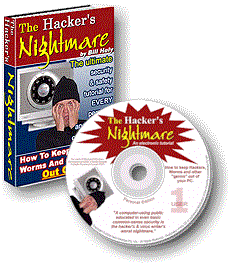
and Internet security Bible "The Hacker's Nightmare" would not be complete
without coverage of encryption, I was acutely aware of the obstacles. The
implementation difficulties concerned me greatly because this was a book
aimed squarely at educating and protecting non-experts, thus solutions
that were complex to implement and/or maintain and/or use were not acceptable.
However it did not make any
sense at all to settle for anything less than a global standard that could
be readily implemented by anyone. Proprietary implementations were out.
To cut a long story short (the long version can be found in "The Hacker's
Nightmare") I searched and tested and trialed and eventually discovered
an excellent yet inexpensive product that enforced a very high degree of
security, conformed to globally accepted standards, yet was easy to install
and use.
The encryption chapter in
The "The Hacker's Nightmare" was so well accepted by people who suddenly
became aware of the value of encryption that I decided to hive that chapter
off into a separate book for people who for some reason didn't want the
full security Bible. I called it "Code Rings & Secret Handshakes: The
Email Encryption Guide". That title is a bit of a misnomer because the
Guide tackles both eMail and File/folder encryption as well, but the initial
focus is on eMail protection.
Don't worry — I'm not going
to compel you to buy one of my books to find out what encryption software
I eventually settled on, use myself and highly recommend to everyone. Just
jump to the link below, provide your name and eMail address, select the
product you are interested in (you should choose FileAssurity OpenPGP)
and shortly thereafter you'll receive an eMail with download instructions.
Here's the link:
http://HackersNightmare.com?res=ArticsoftTrial
Please Note that I do not
recommend trialing the Lite version of the software. Lite is missing
several features that I think you'll find very useful, and the small price
difference is just not worth the sacrifice of those features. The detailed
tutorials in my books deal with features NOT found in the Lite version.
I should emphasize that you
do not need either of my books to use this software, but the less expert
you are with "computer stuff" the more valuable you will find the detailed
tutorials. Also, owners of either "The Hacker's Nightmare" or "Code Rings
& Secret Handshakes" are eligible for a $15 discount on the registered
version of the encryption software package.
Well that's the last of this
eight-part series "How Safe Is Your Success". I hope you have found the
articles informative and useful. I welcome contact from you on related
matters, suggestions for future articles, or your thoughts on how this
series might be improved. Please don't hesitate to contact me through the
form at:
http://HackersNightmare.com?res=Contact
-------------------------
Bill Hely is a technologist,
consultant and author living in Brisbane, Australia. For most of the last
two decades his professional focus has been on advising and supporting
small business operators in Information Technology and Office Productivity
issues — and rescuing them when they didn't heed his advice the first time
around. He is the author of several books on technology for the business
operator, including the Bible of Internet and computer security "The
Hacker's Nightmare". For more information on this must-read tutorial
and reference visit: http://HackersNightmare.com
|