
The Emperor's New Clothes By Hans Christian Andersen
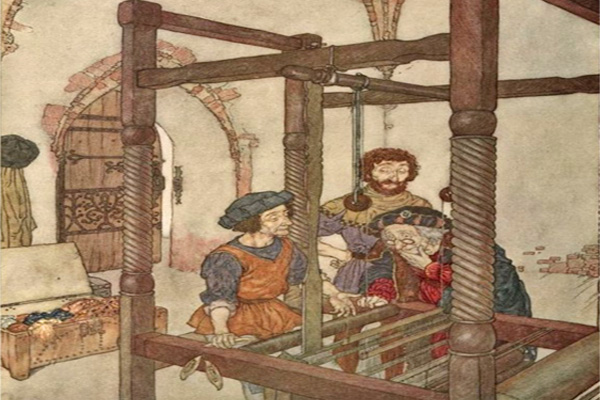
They pointed to the empty loom, and the poor old minister stared as hard as he could, but he could not see anything, for of course there was nothing to see.
Many years ago there was an Emperor, who was so excessively fond of new clothes that he spent all his money on them. He cared nothing about his soldiers, nor for the theatre, nor for driving in the woods except for the sake of showing off his new clothes. He had a costume for every hour in the day, and instead of saying, as one does about any other king or emperor, 'He is in his council chamber,' here one always said, 'The Emperor is in his dressing-room.'
Life was very gay in the great town where he lived; hosts of strangers came to visit it every day, and among them one day two swindlers. They gave themselves out as weavers, and said that they knew how to weave the most beautiful stuffs imaginable. Not only were the colours and patterns unusually fine, but the clothes that were made of the stuffs had the peculiar quality of becoming invisible to every person who was not fit for the office he held, or if he was impossibly dull.
'Those must be splendid clothes,' thought the Emperor. 'By wearing them I should be able to discover which men in my kingdom are unfitted for their posts. I shall distinguish the wise men from the fools. Yes, I certainly must order some of that stuff to be woven for me.'
He paid the two swindlers a lot of money in advance so that they might begin their work at once.
They did put up two looms and pretended to weave, but they had nothing whatever upon their shuttles. At the outset they asked for a quantity of the finest silk and the purest gold thread, all of which they put into their own bags, while they worked away at the empty looms far into the night.
'I should like to know how those weavers are getting on with the stuff,' thought the Emperor; but he felt a little queer when he reflected that any one who was stupid or unfit for his post would not be able to see it. He certainly thought that he need have no fears for himself, but still he thought he would send somebody else first to see how it was getting on. Everybody in the town knew what wonderful power the stuff possessed, and every one was anxious to see how stupid his neighbour was.
'I will send my faithful old minister to the weavers,' thought the Emperor. 'He will be best able to see how the stuff looks, for he is a clever man, and no one fulfils his duties better than he does!'
So the good old minister went into the room where the two swindlers sat working at the empty loom.
'Heaven preserve us!' thought the old minister, opening his eyes very wide. 'Why, I can't see a thing!' But he took care not to say so.
Both the swindlers begged him to be good enough to step a little nearer, and asked if he did not think it a good pattern and beautiful colouring. They pointed to the empty loom, and the poor old minister stared as hard as he could, but he could not see anything, for of course there was nothing to see.
'Good heavens!' thought he, 'is it possible that I am a fool. I have never thought so, and nobody must know it. Am I not fit for my post? It will never do to say that I cannot see the stuffs.'
'Well, sir, you don't say anything about the stuff,' said the one who was pretending to weave.
'Oh, it is beautiful! quite charming!' said the old minister, looking through his spectacles; 'this pattern and these colours! I will certainly tell the Emperor that the stuff pleases me very much.'
'We are delighted to hear you say so,' said the swindlers, and then they named all the colours and described the peculiar pattern. The old minister paid great attention to what they said, so as to be able to repeat it when he got home to the Emperor.
Then the swindlers went on to demand more money, more silk, and more gold, to be able to proceed with the weaving; but they put it all into their own pockets—not a single strand was ever put into the loom, but they went on as before weaving at the empty loom.
The Emperor soon sent another faithful official to see how the stuff was getting on, and if it would soon be ready. The same thing happened to him as to the minister; he looked and looked, but as there was only the empty loom, he could see nothing at all.
'Is not this a beautiful piece of stuff?' said both the swindlers, showing and explaining the beautiful pattern and colours which were not there to be seen.
'I know I am not a fool!' thought the man, 'so it must be that I am unfit for my good post! It is very strange, though! However, one must not let it appear!' So he praised the stuff he did not see, and assured them of his delight in the beautiful colours and the originality of the design. 'It is absolutely charming!' he said to the Emperor. Everybody in the town was talking about this splendid stuff.

Kids Corner
Early childhood is the time to awaken the imagination...Get Your Kids to Eat Healthy
Getting your kids to eat healthy food can be difficult. Serve healthy food choices with same enthusiasm as dessert. Try to serve vegetables more often and present them in a simple way. If you are serving cooked vegetables, don't overcook them.
Ask your kids to help you with the shopping and meal preparation. Try to make food shopping and preparation interesting and fun activity for the whole family. Kids like to help and have fun. Activity like that is also a good way to get them more interested in what you're serving.
Get your kids to drink more water and take a stand against carbonated drinks and fruit juices. They are among the biggest culprits behind childhood obesity and full of empty calories.