
Andersen's Fairy Tales
The Snow Queen Third Story
THE GARDEN OF THE WOMAN LEARNED IN MAGIC
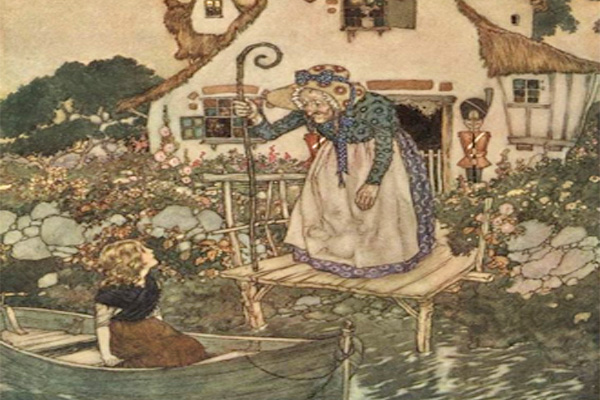
Then an old, old woman came out of the house; she was leaning upon a big, hooked stick, and she wore a big sun hat, which was covered with beautiful painted flowers.
But what became of little Gerda when Kay did not return? Where could he be? Nobody knew; nobody could give any intelligence. All the boys knew was, that they had seen him tie his sledge to another large and splendid one, which drove down the street and out of the town. Nobody knew where he was; many sad tears were shed, and little Gerda wept long and bitterly; at last she said he must be dead; that he had been drowned in the river which flowed close to the town. Oh! those were very long and dismal winter evenings! At last spring came, with its warm sunshine.
"Kay is dead and gone!" said little Gerda.
"That I don't believe," said the Sunshine.
"Kay is dead and gone!" said she to the Swallows.
"That I don't believe," said they: and at last little Gerda did not think so any longer either.
"I'll put on my red shoes," said she, one morning; "Kay has never seen them, and then I'll go down to the river and ask there." It was quite early; she kissed her old grandmother, who was still asleep, put on her red shoes, and went alone to the river.
"Is it true that you have taken my little playfellow? I will make you a present of my red shoes, if you will give him back to me." And, as it seemed to her, the blue waves nodded in a strange manner; then she took off her red shoes, the most precious things she possessed, and threw them both into the river. But they fell close to the bank, and the little waves bore them immediately to land; it was as if the stream would not take what was dearest to her; for in reality it had not got little Kay; but Gerda thought that she had not thrown the shoes out far enough, so she clambered into a boat which lay among the rushes, went to the farthest end, and threw out the shoes. But the boat was not fastened, and the motion which she occasioned, made it drift from the shore. She observed this, and hastened to get back; but before she could do so, the boat was more than a yard from the land, and was gliding quickly onward.
Little Gerda was very frightened, and began to cry; but no one heard her except the sparrows, and they could not carry her to land; but they flew along the bank, and sang as if to comfort her, "Here we are! Here we are!" The boat drifted with the stream, little Gerda sat quite still without shoes, for they were swimming behind the boat, but she could not reach them, because the boat went much faster than they did. The banks on both sides were beautiful; lovely flowers, venerable trees, and slopes with sheep and cows, but not a human being was to be seen.
"Perhaps the river will carry me to little Kay," said she; and then she grew less sad. She rose, and looked for many hours at the beautiful green banks. Presently she sailed by a large cherry-orchard, where was a little cottage with curious red and blue windows; it was thatched, and before it two wooden soldiers stood sentry, and presented arms when anyone went past. Gerda called to them, for she thought they were alive; but they, of course, did not answer. She came close to them, for the stream drifted the boat quite near the land. Gerda called still louder, and an old woman then came out of the cottage, leaning upon a crooked stick. She had a large broad-brimmed hat on, painted with the most splendid flowers.
"Poor little child!" said the old woman. "How did you get upon the large rapid river, to be driven about so in the wide world!" And then the old woman went into the water, caught hold of the boat with her crooked stick, drew it to the bank, and lifted little Gerda out. And Gerda was so glad to be on dry land again; but she was rather afraid of the strange old woman.
"But come and tell me who you are, and how you came here," said she. And Gerda told her all; and the old woman shook her head and said, "A-hem! a-hem!" and when Gerda had told her everything, and asked her if she had not seen little Kay, the woman answered that he had not passed there, but he no doubt would come; and she told her not to be cast down, but taste her cherries, and look at her flowers, which were finer than any in a picture-book, each of which could tell a whole story. She then took Gerda by the hand, led her into the little cottage, and locked the door. The windows were very high up; the glass was red, blue, and green, and the sunlight shone through quite wondrously in all sorts of colors. On the table stood the most exquisite cherries, and Gerda ate as many as she chose, for she had permission to do so. While she was eating, the old woman combed her hair with a golden comb, and her hair curled and shone with a lovely golden color around that sweet little face, which was so round and so like a rose.
"I have often longed for such a dear little girl," said the old woman. "Now you shall see how well we agree together"; and while she combed little Gerda's hair, the child forgot her foster-brother Kay more and more, for the old woman understood magic; but she was no evil being, she only practised witchcraft a little for her own private amusement, and now she wanted very much to keep little Gerda. She therefore went out in the garden, stretched out her crooked stick towards the rose-bushes, which, beautifully as they were blowing, all sank into the earth and no one could tell where they had stood. The old woman feared that if Gerda should see the roses, she would then think of her own, would remember little Kay, and run away from her. She now led Gerda into the flower-garden. Oh, what odour and what loveliness was there! Every flower that one could think of, and of every season, stood there in fullest bloom; no picture-book could be gayer or more beautiful. Gerda jumped for joy, and played till the sun set behind the tall cherry-tree; she then had a pretty bed, with a red silken coverlet filled with blue violets. She fell asleep, and had as pleasant dreams as ever a queen on her wedding-day.
The next morning she went to play with the flowers in the warm sunshine, and thus passed away a day. Gerda knew every flower; and, numerous as they were, it still seemed to Gerda that one was wanting, though she did not know which. One day while she was looking at the hat of the old woman painted with flowers, the most beautiful of them all seemed to her to be a rose. The old woman had forgotten to take it from her hat when she made the others vanish in the earth. But so it is when one's thoughts are not collected. "What!" said Gerda. "Are there no roses here?" and she ran about amongst the flowerbeds, and looked, and looked, but there was not one to be found. She then sat down and wept; but her hot tears fell just where a rose-bush had sunk; and when her warm tears watered the ground, the tree shot up suddenly as fresh and blooming as when it had been swallowed up. Gerda kissed the roses, thought of her own dear roses at home, and with them of little Kay.
"Oh, how long I have stayed!" said the little girl. "I intended to look for Kay! Don't you know where he is?" she asked of the roses. "Do you think he is dead and gone?"
"Dead he certainly is not," said the Roses. "We have been in the earth where all the dead are, but Kay was not there."
"Many thanks!" said little Gerda; and she went to the other flowers, looked into their cups, and asked, "Don't you know where little Kay is?" But every flower stood in the sunshine, and dreamed its own fairy tale or its own story: and they all told her very many things, but not one knew anything of Kay. Well, what did the Tiger-Lily say? "Hearest thou not the drum? Bum! Bum! Those are the only two tones. Always bum! Bum! Hark to the plaintive song of the old woman, to the call of the priests! The Hindoo woman in her long robe stands upon the funeral pile; the flames rise around her and her dead husband, but the Hindoo woman thinks on the living one in the surrounding circle; on him whose eyes burn hotter than the flames--on him, the fire of whose eyes pierces her heart more than the flames which soon will burn her body to ashes. Can the heart's flame die in the flame of the funeral pile?"
"I don't understand that at all," said little Gerda. "That is my story," said the Lily. What did the Convolvulus say? "Projecting over a narrow mountain-path there hangs an old feudal castle. Thick evergreens grow on the dilapidated walls, and around the altar, where a lovely maiden is standing: she bends over the railing and looks out upon the rose. No fresher rose hangs on the branches than she; no appleblossom carried away by the wind is more buoyant! How her silken robe is rustling! "'Is he not yet come?'"
"Is it Kay that you mean?" asked little Gerda. "I am speaking about my story--about my dream," answered the Convolvulus. What did the Snowdrops say? "Between the trees a long board is hanging--it is a swing. Two little girls are sitting in it, and swing themselves backwards and forwards; their frocks are as white as snow, and long green silk ribands flutter from their bonnets. Their brother, who is older than they are, stands up in the swing; he twines his arms round the cords to hold himself fast, for in one hand he has a little cup, and in the other a clay-pipe. He is blowing soap-bubbles. The swing moves, and the bubbles float in charming changing colors: the last is still hanging to the end of the pipe, and rocks in the breeze. The swing moves. The little black dog, as light as a soap-bubble, jumps up on his hind legs to try to get into the swing. It moves, the dog falls down, barks, and is angry. They tease him; the bubble bursts! A swing, a bursting bubble--such is my song!" "What you relate may be very pretty, but you tell it in so melancholy a manner, and do not mention Kay." What do the Hyacinths say? "There were once upon a time three sisters, quite transparent, and very beautiful. The robe of the one was red, that of the second blue, and that of the third white. They danced hand in hand beside the calm lake in the clear moonshine. They were not elfin maidens, but mortal children. A sweet fragrance was smelt, and the maidens vanished in the wood; the fragrance grew stronger--three coffins, and in them three lovely maidens, glided out of the forest and across the lake: the shining glow-worms flew around like little floating lights. Do the dancing maidens sleep, or are they dead? The odour of the flowers says they are corpses; the evening bell tolls for the dead!"
"You make me quite sad," said little Gerda. "I cannot help thinking of the dead maidens. Oh! is little Kay really dead? The Roses have been in the earth, and they say no." "Ding, dong!" sounded the Hyacinth bells. "We do not toll for little Kay; we do not know him. That is our way of singing, the only one we have." And Gerda went to the Ranunculuses, that looked forth from among the shining green leaves. "You are a little bright sun!" said Gerda. "Tell me if you know where I can find my playfellow." And the Ranunculus shone brightly, and looked again at Gerda. What song could the Ranunculus sing? It was one that said nothing about Kay either. "In a small court the bright sun was shining in the first days of spring. The beams glided down the white walls of a neighbor's house, and close by the fresh yellow flowers were growing, shining like gold in the warm sun-rays. An old grandmother was sitting in the air; her grand-daughter, the poor and lovely servant just come for a short visit. She knows her grandmother. There was gold, pure virgin gold in that blessed kiss. There, that is my little story," said the Ranunculus. "My poor old grandmother!" sighed Gerda. "Yes, she is longing for me, no doubt: she is sorrowing for me, as she did for little Kay. But I will soon come home, and then I will bring Kay with me. It is of no use asking the flowers; they only know their own old rhymes, and can tell me nothing." And she tucked up her frock, to enable her to run quicker; but the Narcissus gave her a knock on the leg, just as she was going to jump over it. So she stood still, looked at the long yellow flower, and asked, "You perhaps know something?" and she bent down to the Narcissus. And what did it say? "I can see myself--I can see myself! Oh, how odorous I am! Up in the little garret there stands, half-dressed, a little Dancer.
She stands now on one leg, now on both; she despises the whole world; yet she lives only in imagination. She pours water out of the teapot over a piece of stuff which she holds in her hand; it is the bodice; cleanliness is a fine thing. The white dress is hanging on the hook; it was washed in the teapot, and dried on the roof. She puts it on, ties a saffron-colored kerchief round her neck, and then the gown looks whiter. I can see myself--I can see myself!"
"That's nothing to me," said little Gerda. "That does not concern me." And then off she ran to the further end of the garden. The gate was locked, but she shook the rusted bolt till it was loosened, and the gate opened; and little Gerda ran off barefooted into the wide world. She looked round her thrice, but no one followed her. At last she could run no longer; she sat down on a large stone, and when she looked about her, she saw that the summer had passed; it was late in the autumn, but that one could not remark in the beautiful garden, where there was always sunshine, and where there were flowers the whole year round.
"Dear me, how long I have staid!" said Gerda. "Autumn is come. I must not rest any longer." And she got up to go further. Oh, how tender and wearied her little feet were! All around it looked so cold and raw: the long willow-leaves were quite yellow, and the fog dripped from them like water; one leaf fell after the other: the sloes only stood full of fruit, which set one's teeth on edge. Oh, how dark and comfortless it was in the dreary world!

Children's Health
Signs that will help you determine whether or not your child is ill...Improving Eyesight - Understanding Astigmatism
Astigmatism is normal as people age. Astigmatism happens when the eyeball loses its roundness and vision starts to become hazy. Astigmatism can also be caused by years of stress and strain on the eyes. The eye is surrounded by tiny muscles that help the eye ball elongate and contract. Years of tension, can weaken these muscles and cause problems when the eyes need to change shape.
The eyes are never ever truly round; they are constantly changing shapes depending on the situation. Everyone has astigmatism every once in awhile. In fact, you can create the illusion of astigmatism right now by pulling on the eye lids and blurring the vision. The eyes will usually fix themselves in a few hours or days; without the use of glasses. Artificial lenses mask the problem and prevent the eyes from healing themselves.
The eyes are amazing organs and they are the first line of defense against tension; we just tend to ignore those signs. If vision because blurry or distorted, your eyes are telling you to relax and take it easy.