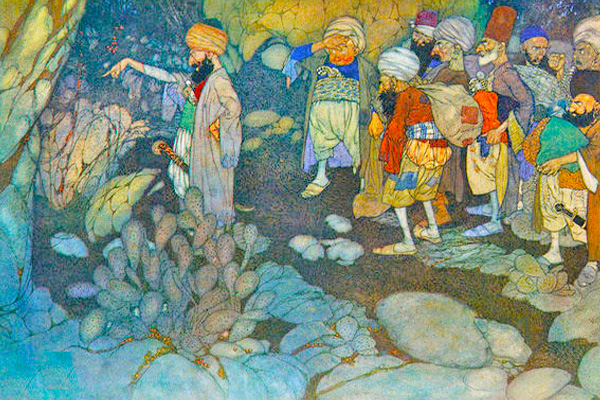
| The
robbers stayed some
time within the rock, during which Ali Baba, fearful of being caught,
remained
in the tree.
At last the
door opened again,
and as the captain went in last, so he came out first, and stood to see
them all pass by him; when Ali Baba heard him make the door close by
pronouncing
these words, "Shut, Sesame!" Every man at once went and bridled his
horse,
fastened his wallet, and mounted again. When the captain saw them all
ready,
he put himself at their head, and they returned the way they had come.
Ali Baba
followed them with
his eyes as far as he could see them; and afterward stayed a
considerable
time before he descended. Remembering the words the captain of the
robbers
used to cause the door to open and shut, he had the curiosity to try if
his pronouncing them would have the same effect. Accordingly, he went
among
the shrubs, and perceiving the door concealed behind them, stood before
it, and said, "Open, Sesame!" The door instantly flew wide open.
Ali Baba,
who expected a
dark, dismal cavern, was surprised to see a well-lighted and spacious
chamber,
which received the light from an opening at the top of the rock, and in
which were all sorts of provisions, rich bales of silk, stuff, brocade,
and valuable carpeting, piled upon one another; gold and silver ingots
in great heaps, and money in bags. The sight of all these riches made
him
suppose that this cave must have been occupied for ages by robbers, who
had succeeded one another.
Ali Baba
went boldly into
the cave, and collected as much of the gold coin, which was in bags, as
he thought his three asses could carry. When he had loaded them with
the
bags, he laid wood over them in such a manner that they could not be
seen.
When he had passed in and out as often as he wished, he stood before
the
door, and pronouncing the words, "Shut, Sesame!" the door closed of
itself.
He then made the best of his way to town.
When Ali
Baba got home, he
drove his asses into a little yard, shut the gates very carefully,
threw
off the wood that covered the panniers, carried the bags into his
house,
and ranged them in order before his wife. He then emptied the bags,
which
raised such a great heap of gold as dazzled his wife's eyes, and then
he
told her the whole adventure from beginning to end, and, above all,
recommended
her to keep it secret.
The wife
rejoiced greatly
in their good fortune, and would count all the gold piece by piece.
"Wife,"
replied Ali Baba, "you do not know what you undertake, when you pretend
to count the money; you will never have done. I will dig a hole, and
bury
it. There is no time to be lost." "You are in the right, husband,"
replied
she, "but let us know, as nigh as possible, how much we have. I will
borrow
a small measure, and measure it, while you dig the hole."
Away the
wife ran to her
brother-in-law Cassim, who lived just by, and addressing herself to his
wife, desired her to lend her a measure for a little while. Her
sister-in-law
asked her whether she would have a great or a small one. The other
asked
for a small one. She bade her stay a little, and she would readily
fetch
one,
The
sister-in-law did so,
but as she knew Ali Baba's poverty, she was curious to know what sort
of
grain his wife wanted to measure, and artfully putting some suet at the
bottom of the measure, brought it to her, with an excuse that she was
sorry
that she had made her stay so long, but that she could not find it
sooner.
Ali Baba's
wife went home,
set the measure upon the heap of gold, filled it, and emptied it often
upon the sofa, till she had done, when she was very well satisfied to
find
the number of measures amounted to so many as they did, and went to
tell
her husband, who had almost finished digging the hole. While Ali Baba
was
burying the gold, his wife, to show her exactness and diligence to her
sister-in-law, carried the measure back again, but without taking
notice
that a piece of gold had stuck to the bottom. "Sister," said she,
giving
it to her again, "you see that I have not kept your measure long. I am
obliged to you for it, and return it with thanks."
As soon as
Ali Baba's wife
was gone, Cassim's looked at the bottom of the measure, and was in
inexpressible
surprise to find a piece of gold sticking to it. Envy immediately
possessed
her breast. "What!" said she, "has Ali Baba gold so plentiful as to
measure
it? Whence has he all this wealth?"
Cassim, her
husband, was
at his counting-house. When he came home, his wife said to him,
"Cassim,
I know you think yourself rich, but Ali Baba is infinitely richer than
you. He does not count his money, but measures it." Cassim desired her
to explain the riddle, which she did, by telling him the stratagem she
had used to make the discovery, and showed him the piece of money,
which
was so old that they could not tell in what prince's reign it was
coined.
Cassim,
after he had married
the rich widow, had never treated Ali Baba as a brother, but neglected
him; and now, instead of being pleased, he conceived a base envy at his
brother's prosperity. He could not sleep all that night, and went to
him
in the morning before sunrise. "Ali Baba," said he, "I am surprised at
you; you pretend to be miserably poor, and yet you measure gold. My
wife
found this at the bottom of the measure you borrowed yesterday."
By this
discourse, Ali Baba
perceived that Cassim and his wife, through his own wife's folly, knew
what they had so much reason to conceal; but what was done, could not
be
undone. Therefore, without showing the least surprise or trouble, he
confessed
all, and offered his brother part of his treasure to keep the secret.
"I expect
as much," replied
Cassim haughtily; "but I must know exactly where this treasure is, and
how I may visit it myself when I choose; otherwise, I will go and
inform
against you, and then you will not only get no more, but will lose all
you have, and I shall have a share for my information."
Ali Baba
told him all he
desired, even to the very words he was to use to gain admission into
the
cave.

Cassim rose
the next morning
long before the sun, and set out for the forest with ten mules bearing
great chests, which he designed to fill, and followed the road which
Ali
Baba had pointed out to him. He was not long before he reached the
rock,
and found out the place, by the tree and other marks which his brother
had given him. When he reached the entrance of the cavern, he
pronounced
the words, "Open, Sesame!" The door immediately opened, and, when he
was
in, closed upon him. In examining the cave, he was in great admiration
to find much more riches than he had expected from Ali Baba's relation.
He quickly laid as many bags of gold as he could carry at the door of
the
cavern; but his thoughts were so full of the great riches he should
possess,
that he could not think of the necessary word to make it open, but
instead
of "Sesame," said, "Open, Barley!" and was much amazed to find that the
door remained fast shut. He named several sorts of grain, but still the
door would not open.
Cassim had
never expected
such an incident, and was so alarmed at the danger he was in, that the
more he endeavoured to remember the word "Sesame," the more his memory
was confounded, and he had as much forgotten it as if he had never
heard
it mentioned. He threw down the bags he had loaded himself with, and
walked
distractedly up and down the cave, without having the least regard to
the
riches that were around him.
About noon
the robbers visited
their cave. At some distance they saw Cassim's mules straggling about
the
rock, with great chests on their backs. Alarmed at this, they galloped
full speed to the cave. They drove away the mules, which strayed
through
the forest so far, that they were soon out of sight, and went directly,
with their naked sabres in their hands, to the door, which, on their
captain
pronouncing the proper words, immediately opened.
Cassim, who
heard the noise
of the horses' feet, at once guessed the arrival of the robbers, and
resolved
to make one effort for his life. He rushed to the door, and no sooner
saw
the door open, than he ran out and threw the leader down, but could not
escape the other robbers, who with their scimitars soon deprived him of
life.
The first
care of the robbers
after this was to examine the cave. They found all the bags which
Cassim
had brought to the door, to be ready to load his mules, and carried
them
again to their places, but they did not miss what Ali Baba had taken
away
before. Then holding a council, and deliberating upon this occurrence,
they guessed that Cassim, when he was in, could no get out again, but
could
not imagine how he had learned the secret words by which alone he could
enter. They could not deny the fact of his being there; and to terrify
any person or accomplice who should attempt the same thing, they agreed
to cut Cassim's body into four quarters—to hang two on one side, and
two
on the other, within the door of the cave. They had no sooner taken
this
resolution than they put it in execution; and when they had nothing
more
to detain them, left the place of their hoards well closed. They
mounted
their horses, went to beat the roads again, and to attack the caravans
they might meet.
In the mean
time, Cassim's
wife was very uneasy when night came, and her husband was not returned.
She ran to Ali Baba in great alarm, and said, "I believe,
brother-in-law,
that you know Cassim is gone to the forest, and upon what account; it
is
now night, and he has not returned; I am afraid some misfortune has
happened
to him." Ali Baba told her that she need not frighten herself, for that
certainly Cassim would not think it proper to come into the town till
the
night should be pretty far advanced.
Cassim's
wife, considering
how much it concerned her husband to keep the business secret, was the
more easily persuaded to believe her brother-in-law. She went home
again,
and waited patiently till midnight. Then her fear redoubled, and her
grief
was the more sensible because she was forced to keep it to herself. She
repented of her foolish curiosity, and cursed her desire of prying into
the affairs of her brother and sister-in-law. She spent all the night
in
weeping; and as soon as it was day went to them, telling them, by her
tears,
the cause of her coming.
Ali Baba
did not wait for
his sister-in-law to desire him to go to see what was become of Cassim,
but departed immediately with his three asses, begging of her first to
moderate her affliction. He went to the forest, and when he came near
the
rock, having seen neither his brother nor the mules in his way, was
seriously
alarmed at finding some blood spilt near the door, which he took for an
ill omen; but when he had pronounced the word, and the door had opened,
he was struck with horror at the dismal sight of his brother's body. He
was not long in determining how he should pay the last dues to his
brother;
but without adverting to the little fraternal affection he had shown
for
him, went into the cave, to find something to enshroud his remains; and
having loaded one of his asses with them, covered them over with wood.
The other two asses he loaded with bags of gold, covering them with
wood
also as before; and then bidding the door shut, came away; but was so
cautious
as to stop some time at the end of the forest, that he might not go
into
the town before night. When he came home, he drove the two asses loaded
with gold into his little yard, and left the care of unloading them to
his wife, while he led the other to his sister-in-law's house.
Ali Baba
knocked at the door,
which was opened by Morgiana, a clever, intelligent slave, who was
fruitful
in inventions to meet the most difficult circumstances. When he came
into
the court, he unloaded the ass, and taking Morgiana aside, said to her,
"You must observe an inviolable secrecy. Your master's body is
contained
in these two panniers. We must bury him as if he had died a natural
death.
Go now and tell your mistress. I leave the matter to your wit and
skilful
devices."
Ali Baba
helped to place
the body in Cassim's house, again recommended to Morgiana to act her
part
well, and then returned with his ass.
Morgiana
went out early the
next morning to a druggist, and asked for a sort of lozenge which was
considered
efficacious in the most dangerous disorders. The apothecary inquired
who
was ill? She replied, with a sigh, "Her good master Cassim himself: and
that he could neither eat nor speak." In the evening Morgiana went to
the
same druggist's again, and with tears in her eyes, asked for an essence
which they used to give to sick people only when at the last extremity.
"Alas!" said she, taking it from the apothecary, "I am afraid that this
remedy will have no better effect than the lozenges; and that I shall
lose
my good master."
On the
other hand, as Ali
Baba and his wife were often seen to go between Cassim's and their own
house all that day, and to seem melancholy, nobody was surprised in the
evening to hear the lamentable shrieks and cries of Cassim's wife and
Morgiana,
who gave out everywhere that her master was dead. The next morning at
daybreak
Morgiana went to an old cobbler whom she knew to be always early at his
stall, and bidding him good-morrow, put a piece of gold into his hand,
saying, "Baba Mustapha, you must bring with you your sewing tackle, and
come with me; but I must tell you, I shall blindfold you when you come
to such a place."
Baba
Mustapha seemed to hesitate
a little at these words. "Oh! oh!" replied he, "you would have me do
something
against my conscience, or against my honour?" "God forbid," said
Morgiana,
putting another piece of gold into his hand, "that I should ask
anything
that is contrary to your honour! only come along with me and fear
nothing."
Baba
Mustapha went with Morgiana,
who, after she had bound his eyes with a handkerchief at the place she
had mentioned, conveyed him to her deceased master's house, and never
unloosed
his eyes till he had entered the room where she had put the corpse
together.
"Baba Mustapha," said she, "you must make haste and sew the parts of
this
body together; and when you have done, I will give you another piece of
gold."
After Baba
Mustapha had finished
his task, she blindfolded him again, gave him the third piece of gold
as
she had promised, and recommending secrecy to him carried him back to
the
place where she first bound his eyes, pulled off the bandage, and let
him
go home, but watched him that he returned toward his stall, till he was
quite out of sight, for fear he should have the curiosity to return and
dodge her; she then went home. Morgiana, on her return, warmed some
water
to wash the body, and at the same time Ali Baba perfumed it with
incense,
and wrapped it in the burying clothes with the accustomed ceremonies.
Not
long after the proper officer brought the bier, and when the attendants
of the mosque, whose business it was to wash the dead, offered to
perform
their duty, she told them that it was done already. Shortly after this
the imaun and the other ministers of the mosque arrived. Four
neighbours
carried the corpse to the burying-ground, following the imaun, who
recited
some prayers. Ali Baba came after with some neighbours, who often
relieved
the others in carrying the bier to the burying-ground. Morgiana, a
slave
to the deceased, followed in the procession, weeping, beating her
breast,
and tearing her hair. Cassim's wife stayed at home mourning, uttering
lamentable
cries with the women of the neighbourhood, who came, according to
custom,
during the funeral, and joining their lamentations with hers filled the
quarter far and near with sounds of sorrow.
In this
manner Cassim's melancholy
death was concealed and hushed up between Ali Baba, his widow, and
Morgiana,
his slave, with so much contrivance that nobody in the city had the
least
knowledge or suspicion of the cause of it. Three or four days after the
funeral, Ali Baba removed his few goods openly to his sister-in-law's
house,
in which it was agreed that he should in future live; but the money he
had taken from the robbers he conveyed thither by night. As for
Cassim's
warehouse, he entrusted it entirely to the management of his eldest son.
While these
things were being
done, the forty robbers again visited their retreat in the forest.
Great,
then, was their surprise to find Cassim's body taken away, with some of
their bags of gold. "We are certainly discovered," said the captain.
"The
removal of the body, and the loss of some of our money, plainly shows
that
the man whom we killed had an accomplice: and for our own lives' sake
we
must try and find him. What say you, my lads?"
All the
robbers unanimously
approved of the captain's proposal.
"Well,"
said the captain,
"one of you, the boldest and most skilful among you, must go into the
town,
disguised as a traveller and a stranger, to try if he can hear any talk
of the man whom we have killed, and endeavour to find out who he was,
and
where he lived. This is a matter of the first importance, and for fear
of any treachery, I propose that whoever undertakes this business
without
success, even though the failure arises only from an error of judgment,
shall suffer death."
Without
waiting for the sentiments
of his companions, one of the robbers started up, and said, "I submit
to
this condition, and think it an honour to expose my life to serve the
troop."
After this
robber had received
great commendations from the captain and his comrades, he disguised
himself
so that nobody would take him for what he was; and taking his leave of
the troop that night, went into the town just at daybreak; and walked
up
and down, till accidentally he came to Baba Mustapha's stall, which was
always open before any of the shops.
Baba
Mustapha was seated
with an awl in his hand, just going to work. The robber saluted him,
bidding
him good-morrow; and perceiving that he was old, said, "Honest man, you
begin to work very early: is it possible that one of your age can see
so
well? I question, even if it were somewhat lighter, whether you could
see
to stitch."
"You do not
know me," replied
Baba Mustapha; "for old as I am, I have extraordinary good eyes; and
you
will not doubt it when I tell you that I sewed the body of a dead man
together
in a place where I had not so much light as I have now."
"A dead
body!" exclaimed
the robber, with affected amazement. "Yes, yes," answered Baba
Mustapha,
"I see you want to have me speak out, but you shall know no more."
The robber
felt sure that
he had discovered what he sought. He pulled out a piece of gold, and
putting
it into Baba Mustapha's hand, said to him, "I do not want to learn your
secret, though I can assure you you might safely trust me with it. The
only thing I desire of you is to show me the house where you stitched
up
the dead body."
"If I were
disposed to do
you that favour," replied Baba Mustapha, "I assure you I cannot. I was
taken to a certain place, whence I was led blindfold to the house, and
afterward brought back again in the same manner; you see, therefore,
the
impossibility of my doing what you desire."
"Well,"
replied the robber,
"you may, however, remember a little of the way that you were led
blindfold.
Come, let me blind your eyes at the same place. We will walk together;
perhaps you may recognise some part; and as everybody ought to be paid
for their trouble, there is another piece of gold for you; gratify me
in
what I ask you." So saying, he put another piece of gold into his hand.
The two
pieces of gold were
great temptations to Baba Mustapha. He looked at them a long time in
his
hand, without saying a word, but at last he pulled out his purse and
put
them in. "I cannot promise," said he to the robber, "that I can
remember
the way exactly; but since you desire, I will try what I can do." At
these
words Baba Mustapha rose up, to the great joy of the robber, and led
him
to the place where Morgiana had bound his eyes. "It was here," said
Baba
Mustapha, "I was blindfolded; and I turned this way." The robber tied
his
handkerchief over his eyes, and walked by him till he stopped directly
at Cassim's house, where Ali Baba then lived. The thief, before he
pulled
off the band, marked the door with a piece of chalk, which he had ready
in his hand, and then asked him if he knew whose house that was; to
which
Baba Mustapha replied that as he did not live in that neighbourhood, he
could not tell.
The robber,
finding he could
discover no more from Baba Mustapha, thanked him for the trouble he had
taken, and left him to go back to his stall, while he returned to the
forest,
persuaded that he should be very well received.
A little
after the robber
and Baba Mustapha had parted, Morgiana went out of Ali Baba's house
upon
some errand, and upon her return, seeing the mark the robber had made,
stopped to observe it. "What can be the meaning of this mark?" said she
to herself; "somebody intends my master no good: however, with whatever
intention it was done, it is advisable to guard against the worst."
Accordingly,
she fetched a piece of chalk, and marked two or three doors on each
side,
in the same manner, without saying a word to her master or mistress.
In the mean
time, the robber
rejoined his troop in the forest, and recounted to them his success;
expatiating
upon his good fortune, in meeting so soon with the only person who
could
inform him of what he wanted to know. All the robbers listened to him
with
the utmost satisfaction; when the captain, after commending his
diligence,
addressing himself to them all, said, "Comrades, we have no time to
lose:
let us set off well armed, without its appearing who we are; but that
we
may not excite any suspicion, let only one or two go into the town
together,
and join at our rendezvous, which shall be the great square. In the
mean
time, our comrade who brought us the good news and I will go and find
out
the house, that we may consult what had best be done."
This speech
and plan was
approved of by all, and they were soon ready. They filed off in parties
of two each, after some interval of time, and got into the town without
being in the least suspected. The captain, and he who had visited the
town
in the morning as spy, came in the last. He led the captain into the
street
where he had marked Ali Baba's residence; and when they came to the
first
of the houses which Morgiana had marked, he pointed it out. But the
captain
observed that the next door was chalked in the same manner and in the
same
place; and showing it to his guide, asked him which house it was, that,
or the first. The guide was so confounded, that he knew not what answer
to make; but still more puzzled, when he and the captain saw five or
six
houses similarly marked. He assured the captain, with an oath, that he
had marked but one, and could not tell who had chalked the rest, so
that
he could not distinguish the house which the cobbler had stopped at.
The
captain, finding that
their design had proved abortive, went directly to the place of
meeting,
and told his troop that they had lost their labour, and must return to
their cave. He himself set them the example, and they all returned as
they
had come.
When the
troop was all got
together, the captain told them the reason of their returning; and
presently
the conductor was declared by all worthy of death. He condemned
himself,
acknowledging that he ought to have taken better precaution, and
prepared
to receive the stroke from him who was appointed to cut off his head.
But as the
safety of the
troop required the discovery of the second intruder into the cave,
another
of the gang, who promised himself that he should succeed better,
presented
himself, and his offer being accepted, he went and corrupted Baba
Mustapha,
as the other had done; and being shown the house, marked it in a place
more remote from sight, with red chalk.
Not long
after, Morgiana,
whose eyes nothing could escape, went out, and seeing the red chalk,
and
arguing with herself as she had done before, marked the other
neighbours'
houses in the same place and manner.
The robber,
at his return
to his company, valued himself much on the precaution he had taken,
which
he looked upon as an infallible way of distinguishing Ali Baba's house
from the others; and the captain and all of them thought it must
succeed.
They conveyed themselves into the town with the same precaution as
before;
but when the robber and his captain came to the street, they found the
same difficulty; at which the captain was enraged, and the robber in as
great confusion as his predecessor.
Thus the
captain and his
troop were forced to retire a second time, and much more dissatisfied;
while the robber who had been the author of the mistake underwent the
same
punishment, to which he willingly submitted.
The
captain, having lost
two brave fellows of his troop, was afraid of diminishing it too much
by
pursuing this plan to get information of the residence of their
plunderer.
He found by their example that their heads were not so good as their
hands
on such occasions; and therefore resolved to take upon himself the
important
commission.
Accordingly,
he went and
addressed himself to Baba Mustapha, who did him the same service he had
done to the other robbers. He did not set any particular mark on the
house,
but examined and observed it so carefully, by passing often by it, that
it was impossible for him to mistake it.
The
captain, well satisfied
with his attempt, and informed of what he wanted to know, returned to
the
forest; and when he came into the cave, where the troop waited for him,
said, "Now, comrades, nothing can prevent our full revenge, as I am
certain
of the house; and in my way hither I have thought how to put it into
execution,
but if any one can form a better expedient, let him communicate it." He
then told them his contrivance; and as they approved of it, ordered
them
to go into the villages about, and buy nineteen mules, with
thirty-eight
large leather jars, one full of oil, and the others empty.
In two or
three days' time
the robbers had purchased the mules and jars, and as the mouths of the
jars were rather too narrow for his purpose, the captain caused them to
be widened, and after having put one of his men into each, with the
weapons
which he thought fit, leaving open the seam which had been undone to
leave
them room to breathe, he rubbed the jars on the outside with oil from
the
full vessel.
Things
being thus prepared,
when the nineteen mules were loaded with thirty-seven robbers in jars,
and the jar of oil, the captain, as their driver, set out with them,
and
reached the town by the dusk of the evening, as he had intended. He led
them through the streets, till he came to Ali Baba's, at whose door he
designed to have knocked; but was prevented by his sitting there after
supper to take a little fresh air. He stopped his mules, addressed
himself
to him, and said, "I have brought some oil a great way, to sell at
tomorrow's
market; and it is now so late that I do not know where to lodge. If I
should
not be troublesome to you, do me the favour to let me pass the night
with
you, and I shall be very much obliged by your hospitality."
Though Ali
Baba had seen
the captain of the robbers in the forest, and had heard him speak, it
was
impossible to know him in the disguise of an oil merchant. He told him
he should be welcome, and immediately opened his gates for the mules to
go into the yard. At the same time he called to a slave, and ordered
him,
when the mules were unloaded, to put them into the stable, and to feed
them; and then went to Morgiana, to bid her get a good supper for his
guest.
After they had finished supper, Ali Baba, charging Morgiana afresh to
take
care of his guest, said to her, "To-morrow morning I design to go to
the
bath before day; take care my bathing linen be ready, give them to
Abdalla
(which was the slave's name), and make me some good broth against my
return."
After this he went to bed.
In the mean
time the captain
of the robbers went into the yard, and took off the lid of each jar,
and
gave his people orders what to do. Beginning at the first jar, and so
on
to the last, he said to each man: "As soon as I throw some stones out
of
the chamber window where I lie, do not fail to come out, and I will
immediately
join you." After this he returned into the house, when Morgiana, taking
up a light, conducted him to his chamber, where she left him; and he,
to
avoid any suspicion, put the light out soon after, and laid himself
down
in his clothes, that he might be the more ready to rise.
Morgiana,
remembering Ali
Baba's orders, got his bathing linen ready, and ordered Abdalla to set
on the pot for the broth; but while she was preparing it the lamp went
out, and there was no more oil in the house, nor any candles. What to
do
she did not know, for the broth must be made. Abdalla, seeing her very
uneasy, said, "Do not fret and tease yourself, but go into the yard,
and
take some oil out of one of the jars."
Morgiana
thanked Abdalla
for his advice, took the oil-pot, and went into the yard; when, as she
came nigh the first jar, the robber within said softly, "Is it time?"
Though
naturally much surprised
at finding a man in the jar instead of the oil she wanted, she
immediately
felt the importance of keeping silence, as Ali Baba, his family, and
herself
were in great danger; and collecting herself, without showing the least
emotion, she answered, "Not yet, but presently." She went quietly in
this
manner to all the jars, giving the same answer, till she came to the
jar
of oil.
By this
means Morgiana found
that her master Ali Baba had admitted thirty-eight robbers into his
house,
and that this pretended oil merchant was their captain. She made what
haste
she could to fill her oil-pot, and returned into her kitchen, where, as
soon as she had lighted her lamp, she took a great kettle, went again
to
the oil-jar, filled the kettle, set it on a large wood fire, and as
soon
as it boiled went and poured enough into every jar to stifle and
destroy
the robber within.
When this
action, worthy
of the courage of Morgiana, was executed without any noise, as she had
projected, she returned into the kitchen with the empty kettle; and
having
put out the great fire she had made to boil the oil, and leaving just
enough
to make the broth, put out the lamp also, and remained silent,
resolving
not to go to rest till she had observed what might follow through a
window
of the kitchen, which opened into the yard.
She had not
waited long before
the captain of the robbers got up, opened the window, and finding no
light,
and hearing no noise, or any one stirring in the house, gave the
appointed
signal, by throwing little stones, several of which hit the jars, as he
doubted not by the sound they gave. He then listened, but not hearing
or
perceiving anything whereby he could judge that his companions stirred,
he began to grow very uneasy, threw stones again a second and also a
third
time, and could not comprehend the reason that none of them should
answer
his signal. Much alarmed, he went softly down into the yard, and going
to the first jar, while asking the robber, whom he thought alive, if he
was in readiness, smelt the hot boiled oil, which sent forth a steam
out
of the jar. Hence he suspected that his plot to murder Ali Baba, and
plunder
his house, was discovered. Examining all the jars, one after another,
he
found that all his gang were dead; and, enraged to despair at having
failed
in his design, he forced the lock of a door that led from the yard to
the
garden, and climbing over the walls made his escape.
When
Morgiana saw him depart,
she went to bed, satisfied and pleased to have succeeded so well in
saving
her master and family.
Ali Baba
rose before day,
and, followed by his slave, went to the baths, entirely ignorant of the
important event which had happened at home.
When he
returned from the
baths, he was very much surprised to see the oil-jars, and that the
merchant
was not gone with the mules. He asked Morgiana, who opened the door,
the
reason of it. "My good master," answered she, "God preserve you and all
your family. You will be better informed of what you wish to know when
you have seen what I have to show you, if you will follow me."
As soon as
Morgiana had shut
the door, Ali Baba followed her, when she requested him to look into
the
first jar, and see if there was any oil. Ali Baba did so, and seeing a
man, started back in alarm, and cried out. "Do not be afraid," said
Morgiana
"the man you see there can neither do you nor anybody else any harm. He
is dead." "Ah, Morgiana," said Ali Baba, "what is it you show me?
Explain
yourself." "I will," replied Morgiana. "Moderate your astonishment, and
do not excite the curiosity of your neighbours; for it is of great
importance
to keep this affair secret. Look into all the other jars."
Ali Baba
examined all the
other jars, one after another; and when he came to that which had the
oil
in it, found it prodigiously sunk, and stood for some time motionless,
sometimes looking at the jars, and sometimes at Morgiana, without
saying
a word, so great was his surprise. At last, when he had recovered
himself,
he said, "And what is become of the merchant?"
"Merchant!"
answered she;
"he is as much one as I am. I will tell you who he is, and what is
become
of him; but you had better hear the story in your own chamber; for it
is
time for your health that you had your broth after your bathing."
Morgiana
then told him all
she had done, from the first observing the mark upon the house, to the
destruction of the robbers, and the flight of their captain.
On hearing
of these brave
deeds from the lips of Morgiana, Ali Baba said to her—"God, by your
means,
has delivered me from the snares these robbers laid for my destruction.
I owe, therefore, my life to you; and, for the first token of my
acknowledgment,
give you your liberty from this moment, till I can complete your
recompense
as I intend."
Ali Baba's
garden was very
long, and shaded at the further end by a great number of large trees.
Near
these he and the slave Abdalla dug a trench, long and wide enough to
hold
the bodies of the robbers; and as the earth was light, they were not
long
in doing it. When this was done, Ali Baba hid the jars and weapons; and
as he had no occasion for the mules, he sent them at different times to
be sold in the market by his slave.
While Ali
Baba took these
measures, the captain of the forty robbers returned to the forest with
inconceivable mortification. He did not stay long; the loneliness of
the
gloomy cavern became frightful to him. He determined, however, to
avenge
the fate of his companions, and to accomplish the death of Ali Baba.
For
this purpose he returned to the town, and took a lodging in a khan, and
disguised himself as a merchant in silks. Under this assumed character,
he gradually conveyed a great many sorts of rich stuffs and fine linen
to his lodging from the cavern, but with all the necessary precautions
to conceal the place whence he brought them. In order to dispose of the
merchandise, when he had thus amassed them together, he took a
warehouse,
which happened to be opposite to Cassim's, which Ali Baba's son had
occupied
since the death of his uncle.
He took the
name of Cogia
Houssain, and, as a new-comer, was, according to custom, extremely
civil
and complaisant to all the merchants his neighbours. Ali Baba's son
was,
from his vicinity, one of the first to converse with Cogia Houssain,
who
strove to cultivate his friendship more particularly. Two or three days
after he was settled, Ali Baba came to see his son, and the captain of
the robbers recognised him at once, and soon learned from his son who
he
was. After this he increased his assiduities, caressed him in the most
engaging manner, made him some small presents, and often asked him to
dine
and sup with him, when he treated him very handsomely.
Ali Baba's
son did not choose
to lie under such obligation to Cogia Houssain; but was so much
straitened
for want of room in his house, that he could not entertain him. He
therefore
acquainted his father, Ali Baba, with his wish to invite him in return.
Ali Baba
with great pleasure
took the treat upon himself. "Son," said he, "to-morrow being Friday,
which
is a day that the shops of such great merchants as Cogia Houssain and
yourself
are shut, get him to accompany you, and as you pass by my door, call
in.
I will go and order Morgiana to provide a supper."
The next
day Ali Baba's son
and Cogia Houssain met by appointment, took their walk, and as they
returned,
Ali Baba's son led Cogia Houssain through the street where his father
lived,
and when they came to the house, stopped and knocked at the door.
"This,
sir," said he, "is my father's house, who, from the account I have
given
him of your friendship, charged me to procure him the honour of your
acquaintance;
and I desire you to add this pleasure to those for which I am already
indebted
to you."
Though it
was the sole aim
of Cogia Houssain to introduce himself into Ali Baba's house, that he
might
kill him, without hazarding his own life or making any noise, yet he
excused
himself, and offered to take his leave; but a slave having opened the
door,
Ali Baba's son took him obligingly by the hand, and, in a manner,
forced
him in.
Ali Baba
received Cogia Houssain
with a smiling countenance, and in the most obliging manner he could
wish.
He thanked him for all the favours he had done his son; adding withal,
the obligation was the greater, as he was a young man, not much
acquainted
with the world, and that he might contribute to his information.
Cogia
Houssain returned the
compliment by assuring Ali Baba that though his son might not have
acquired
the experience of older men, he had good sense equal to the experience
of many others. After a little more conversation on different subjects,
he offered again to take his leave, when Ali Baba, stopping him, said,
"Where are you going, sir, in so much haste? I beg you would do me the
honour to sup with me, though my entertainment may not be worthy your
acceptance;
such as it is, I heartily offer it." "Sir," replied Cogia Houssain, "I
am thoroughly persuaded of your good-will; but the truth is, I can eat
no victuals that have any salt in them; therefore judge how I should
feel
at your table." "If that is the only reason," said Ali Baba, "it ought
not to deprive me of the honour of your company; for, in the first
place,
there is no salt ever put into my bread, and as to the meat we shall
have
to-night, I promise you there shall be none in that. Therefore you must
do me the favour to stay. I will return immediately."
Ali Baba
went into the kitchen,
and ordered Morgiana to put no salt to the meat that was to be dressed
that night; and to make quickly two or three ragouts besides what he
had
ordered, but be sure to put no salt in them.
Morgiana,
who was always
ready to obey her master, could not help being surprised at his strange
order. "Who is this strange man," said she, "who eats no salt with his
meat? Your supper will be spoiled, if I keep it back so long." "Do not
be angry, Morgiana," replied Ali Baba; "he is an honest man, therefore
do as I bid you."
Morgiana
obeyed, though with
no little reluctance, and had a curiosity to see this man who ate no
salt.
To this end, when she had finished what she had to do in the kitchen,
she
helped Abdalla to carry up the dishes; and looking at Cogia Houssain,
knew
him at first sight, notwithstanding his disguise, to be the captain of
the robbers, and examining him very carefully, perceived that he had a
dagger under his garment. "I am not in the least amazed," said she to
herself,
"that this wicked man, who is my master's greatest enemy, would eat no
salt with him, since he intends to assassinate him; but I will prevent
him."
Morgiana,
while they were
at supper, determined in her own mind to execute one of the boldest
acts
ever meditated. When Abdalla came for the dessert of fruit, and had put
it with the wine and glasses before Ali Baba, Morgiana retired, dressed
herself neatly, with a suitable head-dress like a dancer, girded her
waist
with a silver-gilt girdle, to which there hung a poniard with a hilt
and
guard of the same metal, and put a handsome mask on her face. When she
had thus disguised herself, she said to Abdalla, "Take your tabour, and
let us go and divert our master and his son's friend, as we do
sometimes
when he is alone."
Abdalla
took his tabour and
played all the way into the hall before Morgiana, who, when she came to
the door, made a low obeisance by way of asking leave to exhibit her
skill,
while Abdalla left off playing. "Come in, Morgiana," said Ali Baba,
"and
let Cogia Houssain see what you can do, that he may tell us what he
thinks
of your performance."
Cogia
Houssain, who did not
expect this diversion after supper, began to fear he should not be able
to take advantage of the opportunity he thought he had found; but
hoped,
if he now missed his aim, to secure it another time, by keeping up a
friendly
correspondence with the father and son; therefore, though he could have
wished Ali Baba would have declined the dance, he pretended to be
obliged
to him for it, and had the complaisance to express his satisfaction at
what he said, which pleased his host.
As soon as
Abdalla saw that
Ali Baba and Cogia Houssain had done talking, he began to play on the
tabour,
and accompanied it with an air, to which Morgiana, who was an excellent
performer, danced in such a manner as would have created admiration in
any company.
After she
had danced several
dances with much grace, she drew the poniard, and holding it in her
hand,
began a dance, in which she outdid herself by the many different
figures,
light movements, and the surprising leaps and wonderful exertions with
which she accompanied it. Sometimes she presented the poniard to one
breast,
sometimes to another, and oftentimes seemed to strike her own. At last,
she snatched the tabour from Abdalla with her left hand, and holding
the
dagger in her right presented the other side of the tabour, after the
manner
of those who get a livelihood by dancing, and solicit the liberality of
the spectators.
Ali Baba
put a piece of gold
into the tabour, as did also his son; and Cogia Houssain seeing that
she
was coming to him, had pulled his purse out of his bosom to make her a
present; but while he was putting his hand into it, Morgiana, with a
courage
and resolution worthy of herself, plunged the poniard into his heart.
Ali Baba
and his son, shocked
at this action, cried out aloud. "Unhappy woman!" exclaimed Ali Baba,
"what
have you done to ruin me and my family?" "It was to preserve, not to
ruin
you," answered Morgiana; "for see here," continued she, opening the
pretended
Cogia Houssain's garment, and showing the dagger, "what an enemy you
had
entertained? Look well at him, and you will find him to be both the
fictitious
oil merchant, and the captain of the gang of forty robbers. Remember,
too,
that he would eat no salt with you; and what would you have more to
persuade
you of his wicked design? Before I saw him, I suspected him as soon as
you told me you had such a guest. I knew him, and you now find that my
suspicion was not groundless."
Ali Baba,
who immediately
felt the new obligation he had to Morgiana for saving his life a second
time, embraced her: "Morgiana," said he, "I gave you your liberty, and
then promised you that my gratitude should not stop there, but that I
would
soon give you higher proofs of its sincerity, which I now do by making
you my daughter-in-law." Then addressing himself to his son, he said,
"I
believe you, son, to be so dutiful a child, that you will not refuse
Morgiana
for your wife. You see that Cogia Houssain sought your friendship with
a treacherous design to take away my life; and if he had succeeded,
there
is no doubt but he would have sacrificed you also to his revenge.
Consider,
that by marrying Morgiana you marry the preserver of my family and your
own,"
The son,
far from showing
any dislike, readily consented to the marriage; not only because he
would
not disobey his father, but also because it was agreeable to his
inclination.
After this they thought of burying the captain of the robbers with his
comrades, and did it so privately that nobody discovered their bones
till
many years after, when no one had any concern in the publication of
this
remarkable history. A few days afterward, Ali Baba celebrated the
nuptials
of his son and Morgiana with great solemnity, a sumptuous feast, and
the
usual dancing and spectacles; and had the satisfaction to see that his
friends and neighbours, whom he invited, had no knowledge of the true
motives
of the marriage; but that those who were not unacquainted with
Morgiana's
good qualities commended his generosity and goodness of heart Ali Baba
did not visit the robbers' cave for a whole year, as he supposed the
other
two, whom he could get no account of, might be alive.
At the
year's end, when he
found they had not made any attempt to disturb him, he had the
curiosity
to make another journey. He mounted his horse, and when he came to the
cave he alighted, tied his horse to a tree, then approaching the
entrance,
and pronouncing the words, "Open, Sesame!" the door opened. He entered
the cavern, and by the condition he found things in, judged that nobody
had been there since the captain had fetched the goods for his shop.
From
this time he believed he was the only person in the world who had the
secret
of opening the cave, and that all the treasure was at his sole
disposal.
He put as much gold into his saddle-bag as his horse would carry, and
returned
to town. Some years later he carried his son to the cave and taught him
the secret, which he handed down to his posterity, who, using their
good
fortune with moderation, lived in great honour and splendour.
[1]
"Sesame" is a small grain
|