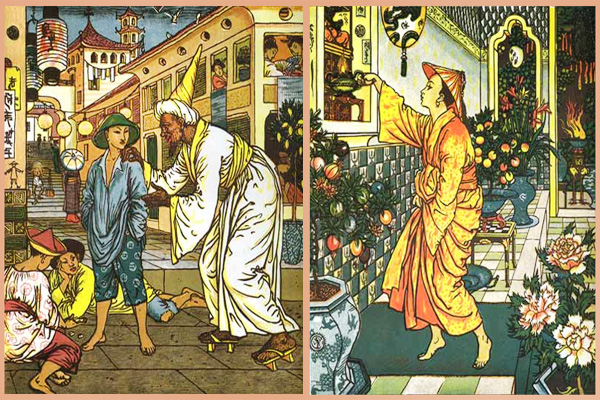
| In one of
the large and
rich cities of China, there once lived a tailor named Mustapha. He was
very poor. He could hardly, by his daily labour, maintain himself and
his
family, which consisted only of his wife and a son.
His son,
who was called Aladdin,
was a very careless and idle fellow. He was disobedient to his father
and
mother, and would go out early in the morning and stay out all day,
playing
in the streets and public places with idle children of his own age.
When he was
old enough to
learn a trade, his father took him into his own shop, and taught him
how
to use his needle; but all his father's endeavours to keep him to his
work
were vain, for no sooner was his back turned, than he was gone for that
day, Mustapha chastised him, but Aladdin was incorrigible, and his
father,
to his great grief, was forced to abandon him to his idleness; and was
so much troubled about him, that he fell sick and died in a few months.
Aladdin,
who was now no longer
restrained by the fear of a father, gave himself entirely over to his
idle
habits, and was never out of the streets from his companions. This
course
he followed till he was fifteen years old, without giving his mind to
any
useful pursuit, or the least reflection on what would become of him. As
he was one day playing, according to custom, in the street, with his
evil
associates, a stranger passing by stood to observe him.
This
stranger was a sorcerer,
known as the African magician, as he had been but two days arrived from
Africa, his native country.
The African
magician, observing
in Aladdin's countenance something which assured him that he was a fit
boy for his purpose, inquired his name and history of some of his
companions,
and when he had learnt all he desired to know, went up to him, and
taking
him aside from his comrades, said, "Child, was not your father called
Mustapha
the tailor?" "Yes, sir," answered the boy, "but he has been dead a long
time."
At these
words the African
magician threw his arms about Aladdin's neck, and kissed him several
times,
with tears in his eyes, and said, "I am your uncle. Your worthy father
was my own brother. I knew you at first sight, you are so like him."
Then
he gave Aladdin a handful of small money, saying, "Go, my son, to your
mother, give my love to her, and tell her that I will visit her
to-morrow,
that I may see where my good brother lived so long, and ended his days."
Aladdin ran
to his mother,
overjoyed at the money his uncle had given him. "Mother," said he,
"have
I an uncle?" "No, child," replied his mother, "you have no uncle by
your
father's side or mine." "I am just now come," said Aladdin, "from a man
who says he is my uncle and my father's brother. He cried and kissed me
when I told him my father was dead, and gave me money, sending his love
to you, and promising to come and pay you a visit, that he may see the
house my father lived and died in." "Indeed, child," replied the
mother,
"your father had no brother, nor have you an uncle."
The next
day the magician
found Aladdin playing in another part of the town, and embracing him as
before, put two pieces of gold into his hand, and said to him, "Carry
this,
child, to your mother; tell her that I will come and see her to-night,
and bid her get us something for supper; but first show ms the house
where
you live."
Aladdin
showed the African
magician the house, and carried the two pieces of gold to his mother,
who
went out and bought provisions; and considering she wanted various
utensils,
borrowed them of her neighbours. She spent the whole day in preparing
the
supper; and at night, when it was ready, said to her son, "Perhaps the
stranger knows not how to find our house; go and bring him, if you meet
with him."
Aladdin was
just ready to
go, when the magician knocked at the door, and came in loaded with wine
and all sorts of fruits, which he brought for a dessert. After he had
given
what he brought into Aladdin's hands, he saluted his mother, and
desired
her to show him the place where his brother Mustapha used to sit on the
sofa; and when she had so done, he fell down and kissed it several
times,
crying out, with tears in his eyes, "My poor brother! how unhappy am I,
not to have come soon enough to give you one last embrace." Aladdin's
mother
desired him to sit down in the same place, but he declined. "No," said
he, "I shall not do that; but give me leave to sit opposite to it, that
although I see not the master of a family so dear to me, I may at least
behold the place where he used to sit."
When the
magician had made
choice of a place, and sat down, he began to enter into discourse with
Aladdin's mother. "My good sister," said he, "do not be surprised at
your
never having seen me all the time you have been married to my brother
Mustapha
of happy memory. I have been forty years absent from this country,
which
is my native place, as well as my late brother's; and during that time
have travelled into the Indies, Persia, Arabia, Syria, and Egypt, and
afterward
crossed over into Africa, where I took up my abode. At last, as it is
natural
for a man, I was desirous to see my native country again, and to
embrace
my dear brother; and finding I had strength enough to undertake so long
a journey, I made the necessary preparations, and set out. Nothing ever
afflicted me so much as hearing of my brother's death. But God be
praised
for all things! It is a comfort for me to find, as it were, my brother
in a son, who has his most remarkable features."
The African
magician perceiving
that the widow wept at the remembrance of her husband, changed the
conversation,
and turning toward her son, asked him, "What business do you follow?
Are
you of any trade?"
At this
question the youth
hung down his head, and was not a little abashed when his mother
answered
"Aladdin is an idle fellow. His father, when alive, strove all he could
to teach him his trade, but could not succeed; and since his death,
notwithstanding
all I can say to him, he does nothing but idle away his time in the
streets,
as you saw him, without considering he is no longer a child; and if you
do not make him ashamed of it, I despair of his ever coming to any
good.
For my part, I am resolved, one of these days, to turn him out of
doors,
and let him provide for himself."
After these
words, Aladdin's
mother burst into tears; and the magician said, "This is not well,
nephew;
you must think of helping yourself, and getting your livelihood. There
are many sorts of trades; perhaps you do not like your father's, and
would
prefer another; I will endeavour to help you. If you have no mind to
learn
any handicraft, I will take a shop for you, furnish it with all sorts
of
fine stuffs and linens; and then with the money you make of them you
can
lay in fresh goods, and live in an honourable way. Tell me freely what
you think of my proposal; you shall always find me ready to keep my
word."
This plan
just suited Aladdin,
who hated work. He told the magician he had a greater inclination to
that
business than to any other, and that he should be much obliged to him
for
his kindness. "Well then," said the African magician, "I will carry you
with me to-morrow, clothe you as handsomely as the best merchants in
the
city, and afterward we will open a shop as I mentioned."
The widow,
after his promises
of kindness to her son, no longer doubted that the magician was her
husband's
brother. She thanked him for his good intentions; and after having
exhorted
Aladdin to render himself worthy of his uncle's favour, served up
supper,
at which they talked of several indifferent matters; and then the
magician
took his leave and retired.
He came
again the next day,
as he had promised, and took Aladdin with him to a merchant, who sold
all
sorts of clothes for different ages and ranks, ready made, and a
variety
of fine stuffs, and bade Aladdin choose those he preferred, which he
paid
for.
When
Aladdin found himself
so handsomely equipped, he returned his uncle thanks, who thus
addressed
him: "As you are soon to be a merchant, it is proper you should
frequent
these shops, and be acquainted with them." He then showed him the
largest
and finest mosques, carried him to the khans or inns where the
merchants
and travellers lodged, and afterward to the sultan's palace, where he
had
free access; and at last brought him to his own khan, where, meeting
with
some merchants he had become acquainted with since his arrival, he gave
them a treat, to bring them and his pretended nephew acquainted.
This
entertainment lasted
till night, when Aladdin would have taken leave of his uncle to go
home;
the magician would not let him go by himself, but conducted him to his
mother, who, as soon as she saw him so well dressed, was transported
with
joy, and bestowed a thousand blessings upon the magician.
Early the
next morning the
magician called again for Aladdin, and said he would take him to spend
that day in the country, and on the next he would purchase the shop. He
then led him out at one of the gates of the city, to some magnificent
palaces,
to each of which belonged beautiful gardens, into which anybody might
enter.
At every building he came to, he asked Aladdin if he did not think it
fine;
and the youth was ready to answer when any one presented itself, crying
out, "Here is a finer house, uncle, than any we have yet seen," By this
artifice, the cunning magician led Aladdin some way into the country;
and
as he meant to carry him farther, to execute his design, he took an
opportunity
to sit down in one of the gardens, on the brink of a fountain of clear
water, which discharged itself by a lion's mouth of bronze into a
basin,
pretending to be tired: "Come, nephew," said he, "you must be weary as
well as I; let us rest ourselves, and we shall be better able to pursue
our walk."
The
magician next pulled
from his girdle a handkerchief with cakes and fruit, and during this
short
repast he exhorted his nephew to leave off bad company, and to seek
that
of wise and prudent men, to improve by their conversation; "for," said
he, "you will soon be at man's estate, and you cannot too early begin
to
imitate their example." When they had eaten as much as they liked, they
got up, and pursued their walk through gardens separated from one
another
only by small ditches, which marked out the limits without interrupting
the communication; so great was the confidence the inhabitants reposed
in each other. By this means the African magician drew Aladdin
insensibly
beyond the gardens, and crossed the country, till they nearly reached
the
mountains.
At last
they arrived between
two mountains of moderate height and equal size, divided by a narrow
valley,
which was the place where the magician intended to execute the design
that
had brought him from Africa to China. "We will go no farther now," said
he to Aladdin; "I will show you here some extraordinary things, which,
when you have seen, you will thank me for: but while I strike a light,
gather up all the loose dry sticks you can see, to kindle a fire with."
Aladdin
found so many dried
sticks, that he soon collected a great heap. The magician presently set
them on fire; and when they were in a blaze, threw in some incense,
pronouncing
several magical words, which Aladdin did not understand.
He had
scarcely done so when
the earth opened just before the magician, and discovered a stone with
a brass ring fixed in it. Aladdin was so frightened that he would have
run away, but the magician caught hold of him, and gave him such a box
on the ear that he knocked him down. Aladdin got up trembling, and with
tears in his eyes said to the magician, "What have I done, uncle, to be
treated in this severe manner?" "I am your uncle," answered the
magician;
"I supply the place of your father, and you ought to make no reply. But
child," added he, softening, "do not be afraid; for I shall not ask
anything
of you, but that you obey me punctually, if you would reap the
advantages
which I intend you. Know, then, that under this stone there is hidden a
treasure, destined to be yours, and which will make you richer than the
greatest monarch in the world. No person but yourself is permitted to
lift
this stone, or enter the cave; so you must punctually execute what I
may
command, for it is a matter of great consequence both to you and me."
Aladdin,
amazed at all he
saw and heard, forgot what was past, and rising said, "Well, uncle,
what
is to be done? Command me, I am ready to obey." "I am overjoyed,
child,"
said the African magician, embracing him, "Take hold of the ring, and
lift
up that stone." "Indeed, uncle," replied Aladdin, "I am not strong
enough;
you must help me." "You have no occasion for my assistance," answered
the
magician; "if I help you, we shall be able to do nothing. Take hold of
the ring, and lift it up; you will find it will come easily." Aladdin
did
as the magician bade him, raised the stone with ease, and laid it on
one
side.
When the
stone was pulled
up, there appeared a staircase about three or four feet deep, leading
to
a door. "Descend, my son," said the African magician, "those steps, and
open that door. It will lead you into a palace, divided into three
great
halls. In each of these you will see four large brass cisterns placed
on
each side, full of gold and silver; but take care you do not meddle
with
them. Before you enter the first hall, be sure to tuck up your robe,
wrap
it about you, and then pass through the second into the third without
stopping.
Above all things, have a care that you do not touch the walls so much
as
with your clothes; for if you do, you will die instantly. At the end of
the third hall, you will find a door which opens into a garden, planted
with fine trees loaded with fruit. Walk directly across the garden to a
terrace, where you will see a niche before you, and in that niche a
lighted
lamp. Take the lamp down and put it out. When you have thrown away the
wick and poured out the liquor, put it in your waistband and bring it
to
me. Do not be afraid that the liquor will spoil your clothes, for it is
not oil, and the lamp will be dry as soon as it is thrown out."
After these
words the magician
drew a ring off his finger, and put it on one of Aladdin's, saying, "It
is a talisman against all evil, so long as you obey me. Go, therefore,
boldly, and we shall both be rich all our lives."
Aladdin
descended the steps,
and, opening the door, found the three halls just as the African
magician
had described. He went through them with all the precaution the fear of
death could inspire, crossed the garden without stopping, took down the
lamp from the niche, threw out the wick and the liquor, and, as the
magician
had desired, put it in his waistband. But as he came down from the
terrace,
seeing it was perfectly dry, he stopped in the garden to observe the
trees,
which were loaded with extraordinary fruit of different colours on each
tree. Some bore fruit entirely white, and some clear and transparent as
crystal; some pale red, and others deeper; some green, blue, and
purple,
and others yellow; in short, there was fruit of all colours. The white
were pearls; the clear and transparent, diamonds; the deep red, rubies;
the paler, balas rubies; the green, emeralds; the blue, turquoises; the
purple, amethysts; and the yellow, sapphires. Aladdin, ignorant of
their
value, would have preferred figs, or grapes, or pomegranates; but as he
had his uncle's permission, he resolved to gather some of every sort.
Having
filled the two new purses his uncle had bought for him with his
clothes,
he wrapped some up in the skirts of his vest, and crammed his bosom as
full as it could hold.
Aladdin,
having thus loaded
himself with riches of which he knew not the value, returned through
the
three halls with the utmost precaution, and soon arrived at the mouth
of
the cave, where the African magician awaited him with the utmost
impatience.
As soon as Aladdin saw him, he cried out, "Pray, uncle, lend me your
hand,
to help me out." "Give me the lamp first," replied the magician; "it
will
be troublesome to you," "Indeed, uncle," answered Aladdin, "I cannot
now,
but I will as soon as I am up." The African magician was determined
that
he would have the lamp before he would help him up; and Aladdin, who
had
encumbered himself so much with his fruit that he could not well get at
it, refused to give it to him till he was out of the cave. The African
magician, provoked at this obstinate refusal, flew into a passion,
threw
a little of his incense into the fire, and pronounced two magical
words,
when the stone which had closed the mouth of the staircase moved into
its
place, with the earth over it in the same manner as it lay at the
arrival
of the magician and Aladdin.
This action
of the magician
plainly revealed to Aladdin that he was no uncle of his, but one who
designed
him evil. The truth was that he had learnt from his magic books the
secret
and the value of this wonderful lamp, the owner of which would be made
richer than any earthly ruler, and hence his journey to China. His art
had also told him that he was not permitted to take it himself, but
must
receive it as a voluntary gift from the hands of another person. Hence
he employed young Aladdin, and hoped by a mixture of kindness and
authority
to make him obedient to his word and will. When he found that his
attempt
had failed, he set out to return to Africa, but avoided the town, lest
any person who had seen him leave in company with Aladdin should make
inquiries
after the youth. Aladdin being suddenly enveloped in darkness, cried,
and
called out to his uncle to tell him he was ready to give him the lamp;
but in vain, since his cries could not be heard. He descended to the
bottom
of the steps, with a design to get into the palace, but the door, which
was opened before by enchantment, was now shut by the same means. He
then
redoubled his cries and tears, sat down on the steps without any hopes
of ever seeing light again, and in an expectation of passing from the
present
darkness to a speedy death. In this great emergency he said, "There is
no strength or power but in the great and high God"; and in joining his
hands to pray he rubbed the ring which the magician had put on his
finger.
Immediately a genie of frightful aspect appeared, and said, "What
wouldst
thou have? I am ready to obey thee. I serve him who possesses the ring
on thy finger; I, and the other slaves of that ring."
At another
time Aladdin would
have been frightened at the sight of so extraordinary a figure, but the
danger he was in made him answer without hesitation, "Whoever thou art,
deliver me from this place." He had no sooner spoken these words, than
he found himself on the very spot where the magician had last left him,
and no sign of cave or opening, nor disturbance of the earth. Returning
God thanks to find himself once more in the world, he made the best of
his way home. When he got within his mother's door, the joy to see her
and his weakness for want of sustenance made him so faint that he
remained
for a long time as dead. As soon as he recovered, he related to his
mother
all that had happened to him, and they were both very vehement in their
complaints of the cruel magician. Aladdin slept very soundly till late
the next morning, when the first thing he said to his mother was, that
he wanted something to eat, and wished she would give him his
breakfast.
"Alas! child," said she, "I have not a bit of bread to give you; you
ate
up all the provisions I had in the house yesterday; but I have a little
cotton which I have spun; I will go and sell it, and buy bread and
something
for our dinner." "Mother," replied Aladdin, "keep your cotton for
another
time, and give me the lamp I brought home with me yesterday; I will go
and sell it, and the money I shall get for it will serve both for
breakfast
and dinner, and perhaps supper too."
Aladdin's
mother took the
lamp and said to her son, "Here it is, but it is very dirty; if it were
a little cleaner I believe it would bring something more." She took
some
fine sand and water to clean it; but had no sooner begun to rub it,
than
in an instant a hideous genie of gigantic size appeared before her, and
said to her in a voice of thunder, "What wouldst thou have? I am ready
to obey thee as thy slave, and the slave of all those who have that
lamp
in their hands; I and the other slaves of the lamp."
Aladdin's
mother, terrified
at the sight of the genie, fainted; when Aladdin, who had seen such a
phantom
in the cavern, snatched the lamp out of his mother's hand, and said to
the genie boldly, "I am hungry, bring me something to eat." The genie
disappeared
immediately, and in an instant returned with a large silver tray,
holding
twelve covered dishes of the same metal, which contained the most
delicious
viands; six large white bread cakes on two plates, two flagons of wine,
and two silver cups. All these he placed upon a carpet and disappeared;
this was done before Aladdin's mother recovered from her swoon.
Aladdin had
fetched some
water, and sprinkled it in her face to recover her. Whether that or the
smell of the meat effected her cure, it was not long before she came to
herself. "Mother," said Aladdin, "be not afraid: get up and eat; here
is
what will put you in heart, and at the same time satisfy my extreme
hunger."
His mother
was much surprised
to see the great tray, twelve dishes, six loaves, the two flagons and
cups,
and to smell the savoury odour which exhaled from the dishes. "Child,"
said she, "to whom are we obliged for this great plenty and liberality?
Has the sultan been made acquainted with our poverty, and had
compassion
on us?" "It is no matter, mother," said Aladdin, "let us sit down and
eat;
for you have almost as much need of a good breakfast as myself; when we
have done, I will tell you." Accordingly, both mother and son sat down
and ate with the better relish as the table was so well furnished. But
all the time Aladdin's mother could not forbear looking at and admiring
the tray and dishes, though she could not judge whether they were
silver
or any other metal, and the novelty more than the value attracted her
attention.
The mother
and son sat at
breakfast till it was dinner-time, and then they thought it would be
best
to put the two meals together; yet, after this they found they should
have
enough left for supper, and two meals for the next day.
When
Aladdin's mother had
taken away and set by what was left, she went and sat down by her son
on
the sofa, saying, "I expect now that you should satisfy my impatience,
and tell me exactly what passed between the genie and you while I was
in
a swoon"; which he readily complied with.
She was in
as great amazement
at what her son told her, as at the appearance of the genie; and said
to
him, "But, son, what have we to do with genies? I never heard that any
of my acquaintance had ever seen one. How came that vile genie to
address
himself to me, and not to you, to whom he had appeared before in the
cave?"
"Mother," answered Aladdin, "the genie you saw is not the one who
appeared
to me. If you remember, he that I first saw called himself the slave of
the ring on my finger; and this you saw, called himself the slave of
the
lamp you had in your hand; but I believe you did not hear him, for I
think
you fainted as soon as he began to speak."
"What!"
cried the mother,
"was your lamp then the occasion of that cursed genie's addressing
himself
rather to me than to you? Ah! my son, take it out of my sight, and put
it where you please. I had rather you would sell it than run the hazard
of being frightened to death again by touching it; and if you would
take
my advice, you would part also with the ring, and not have anything to
do with genies, who, as our prophet has told us, are only devils."
"With your
leave, mother,"
replied Aladdin, "I shall now take care how I sell a lamp which may be
so serviceable both to you and me. That false and wicked magician would
not have undertaken so long a journey to secure this wonderful lamp if
he had not known its value to exceed that of gold and silver. And since
we have honestly come by it, let us make a profitable use of it,
without
making any great show, and exciting the envy and jealousy of our
neighbours.
However, since the genies frighten you so much, I will take it out of
your
sight, and put it where I may find it when I want it. The ring I cannot
resolve to part with; for without that you had never seen me again; and
though I am alive now, perhaps, if it were gone, I might not be so some
moments hence; therefore, I hope you will give me leave to keep it, and
to wear it always on my finger." Aladdin's mother replied that he might
do what he pleased; for her part, she would have nothing to do with
genies,
and never say anything more about them.
By the next
night they had
eaten all the provisions the genie had brought; and the next day
Aladdin,
who could not bear the thoughts of hunger, putting one of the silver
dishes
tinder his vest, went out early to sell it, and addressing himself to a
Jew whom he met in the streets, took him aside, and pulling out the
plate,
asked him if he would buy it. The cunning Jew took the dish, examined
it,
and as soon as he found that it was good silver, asked Aladdin at how
much
he valued it. Aladdin, who had never been used to such traffic, told
him
he would trust to his judgment and honour. The Jew was somewhat
confounded
at this plain dealing; and doubting whether Aladdin understood the
material
or the full value of what he offered to sell, took a piece of gold out
of his purse and gave it him, though it was but the sixtieth part of
the
worth of the plate. Aladdin, taking the money very eagerly, retired
with
so much haste, that the Jew, not content with the exorbitancy of his
profit,
was vexed he had not penetrated into his ignorance, and was going to
run
after him, to endeavour to get some change out of the piece of gold;
but
he ran so fast, and had got so far, that it would have been impossible
for him to overtake him.
Before
Aladdin went home,
he called at a baker's, bought some cakes of bread, changed his money,
and on his return gave the rest to his mother, who went and purchased
provisions
enough to last them some time. After this manner they lived, till
Aladdin
had sold the twelve dishes singly, as necessity pressed, to the Jew,
for
the same money; who, after the first time, durst not offer him less,
for
fear of losing so good a bargain. When he had sold the last dish, he
had
recourse to the tray, which weighed ten times as much as the dishes,
and
would have carried it to his old purchaser, but that it was too large
and
cumbersome; therefore he was obliged to bring him home with him to his
mother's, where, after the Jew had examined the weight of the tray, he
laid down ten pieces of gold, with which Aladdin was very well
satisfied.
When all
the money was spent,
Aladdin had recourse again to the lamp. He took it in his hands, looked
for the part where his mother had rubbed it with the sand, rubbed it
also,
when the genie immediately appeared, and said, "What wouldst thou have?
I am ready to obey thee as thy slave, and the slave of all those who
have
that lamp in their hands; I, and the other slaves of the lamp." "I am
hungry,"
said Aladdin, "bring me something to eat." The genie disappeared, and
presently
returned with a tray, the same number of covered dishes as before, set
them down, and vanished.
As soon as
Aladdin found
that their provisions were again expended, he took one of the dishes,
and
went to look for his Jew chapman; but passing by a goldsmith's shop,
the
goldsmith perceiving him, called to him, and said, "My lad, I imagine
that
you have something to sell to the Jew, whom I often see you visit; but
perhaps you do not know that he is the greatest rogue even among the
Jews.
I will give you the full worth of what you have to sell, or I will
direct
you to other merchants who will not cheat you."
This offer
induced Aladdin
to pull his plate from tinder his vest and show it to the goldsmith;
who
at first sight saw that it was made of the finest silver, and asked him
if he had sold such as that to the Jew; when Aladdin told him that he
had
sold him twelve such, for a piece of gold each. "What a villain!" cried
the goldsmith. "But," added he, "my son, what is past cannot be
recalled.
By showing you the value of this plate, which is of the finest silver
we
use in our shops, I will let you see how much the Jew has cheated you."
The
goldsmith took a pair
of scales, weighed the dish, and assured him that his plate would fetch
by weight sixty pieces of gold, which he offered to pay down
immediately.
Aladdin
thanked him for his
fair dealing, and never after went to any other person.
Though
Aladdin and his mother
had an inexhaustible treasure in their lamp, and might have had
whatever
they wished for, yet they lived with the same frugality as before, and
it may easily be supposed that the money for which Aladdin had sold the
dishes and tray was sufficient to maintain them some time.
During this
interval, Aladdin
frequented the shops of the principal merchants, where they sold cloth
of gold and silver, linens, silk stuffs, and jewellery, and, oftentimes
joining in their conversation, acquired a knowledge of the world, and a
desire to improve himself. By his acquaintance among the jewellers, he
came to know that the fruits which he had gathered when he took the
lamp
were, instead of coloured glass, stones of inestimable value; but he
had
the prudence not to mention this to any one, not even to his mother.
One day as
Aladdin was walking
about the town, he heard an order proclaimed, commanding the people to
shut up their shops and houses, and keep within doors while the
Princess
Buddir al Buddoor, the sultan's daughter, went to the bath and returned.
This
proclamation inspired
Aladdin with eager desire to see the princess's face, which he
determined
to gratify, by placing himself behind the door of the bath, so that he
could not fail to see her face.
Aladdin had
not long concealed
himself before the princess came. She was attended by a great crowd of
ladies, slaves, and mutes, who walked on each side and behind her. When
she came within three or four paces of the door of the bath, she took
off
her veil, and gave Aladdin an opportunity of a full view of her face.
The
princess was a noted
beauty: her eyes were large, lively, and sparkling; her smile
bewitching;
her nose faultless; her mouth small; her lips vermilion. It is not
therefore
surprising that Aladdin, who had never before seen such a blaze of
charms,
was dazzled and enchanted.
After the
princess had passed
by, and entered the bath, Aladdin quitted his hiding-place, and went
home.
His mother perceived him to be more thoughtful and melancholy than
usual;
and asked what had happened to make him so, or if he was ill. He then
told
his mother all his adventure, and concluded by declaring, "I love the
princess
more than I can express, and am resolved that I will ask her in
marriage
of the sultan."
Aladdin's
mother listened
with surprise to what her son told her; but when he talked of asking
the
princess in marriage, she laughed aloud. "Alas! child," said she, "what
are you thinking of? You must be mad to talk thus."
"I assure
you, mother," replied
Aladdin, "that I am not mad, but in my right senses. I foresaw that you
would reproach me with folly and extravagance; but I must tell you once
more, that I am resolved to demand the princess of the sultan in
marriage;
nor do I despair of success. I have the slaves of the lamp and of the
ring
to help me, and you know how powerful their aid is. And I have another
secret to tell you: those pieces of glass, which I got from the trees
in
the garden of the subterranean palace, are jewels of inestimable value,
and fit fit for the greatest monarchs. All the precious stones the
jewellers
have in Bagdad are not to be compared to mine for size or beauty; and I
am sure that the offer of them will secure the favour of the sultan.
You
have a large porcelain dish fit to hold them; fetch it, and let us see
how they will look, when we have arranged them according to their
different
colours."
Aladdin's
mother brought
the china dish, when he took the jewels out of the two purses in which
he had kept them, and placed them in order, according to his fancy. But
the brightness and lustre they emitted in the daytime, and the variety
of the colours, so dazzled the eyes both of mother and son, that they
were
astonished beyond measure. Aladdin's mother, emboldened by the sight of
these rich jewels, and fearful lest her son should be guilty of greater
extravagance, complied with his request, and promised to go early in
the
next morning to the palace of the sultan. Aladdin rose before daybreak,
awakened his mother, pressing her to go to the sultan's palace, and to
get admittance, if possible, before the grand vizier, the other
viziers,
and the great officers of state went in to take their seats in the
divan,
where the sultan always attended in person.
Aladdin's
mother took the
china dish, in which they had put the jewels the day before, wrapped it
in two fine napkins, and set forward for the sultan's palace. When she
came to the gates, the grand vizier, the other viziers, and most
distinguished
lords of the court were just gone in; but notwithstanding the crowd of
people was great, she got into the divan, a spacious hall, the entrance
into which was very magnificent. She placed herself just before the
sultan,
grand vizier, and the great lords, who sat in council, on his right and
left hand. Several causes were called, according to their order,
pleaded
and adjudged, until the time the divan generally broke up, when the
sultan,
rising, returned to his apartment, attended by the grand vizier; the
other
viziers and ministers of state then retired, as also did all those
whose
business had called them thither.
Aladdin's
mother, seeing
the sultan retire, and all the people depart, judged rightly that he
would
not sit again that day, and resolved to go home; and on her arrival
said,
with much simplicity, "Son, I have seen the sultan, and am very well
persuaded
he has seen me, too, for I placed myself just before him; but he was so
much taken up with those who attended on all sides of him that I pitied
him, and wondered at his patience. At last I believe he was heartily
tired,
for he rose up suddenly, and would not hear a great many who were ready
prepared to speak to him, but went away, at which I was well pleased,
for
indeed I began to lose all patience, and was extremely fatigued with
staying
so long. But there is no harm done; I will go again to-morrow; perhaps
the sultan may not be so busy."
The next
morning she repaired
to the sultan's palace with the present, as early as the day before;
but
when she came there, she found the gates of the divan shut. She went
six
times afterward on the days appointed, placed herself always directly
before
the sultan, but with as little success as the first morning.
On the
sixth day, however,
after the divan was broken up, when the sultan returned to his own
apartment,
he said to his grand vizier; "I have for some time observed a certain
woman,
who attends constantly every day that I give audience, with something
wrapped
up in a napkin; she always stands up from the beginning to the breaking
up of the audience, and affects to place herself just before me. If
this
woman comes to our next audience, do not fail to call her, that I may
hear
what she has to say." The grand vizier made answer by lowering his
hand,
and then lifting it up above his head, signifying his willingness to
lose
it if he failed.
On the next
audience day,
when Aladdin's mother went to the divan, and placed herself in front of
the sultan as usual, the grand vizier immediately called the chief of
the
mace-bearers, and pointing to her bade him bring her before the sultan.
The old woman at once followed the mace-bearer, and when she reached
the
sultan bowed her head down to the carpet which covered the platform of
the throne, and remained in that posture until he bade her rise, which
she had no sooner done, than he said to her, "Good woman, I have
observed
you to stand many days from the beginning to the rising of the divan;
what
business brings you here?"
After these
words, Aladdin's
mother prostrated herself a second time; and when she arose, said,
"Monarch
of monarchs, I beg of you to pardon the boldness of my petition, and to
assure me of your pardon and forgiveness." "Well," replied the sultan,
"I will forgive you, be it what it may, and no hurt shall come to you;
speak boldly."
When
Aladdin's mother had
taken all these precautions, for fear of the sultan's anger, she told
him
faithfully the errand on which her son had sent her, and the event
which
led to his making so bold a request in spite of all her remonstrances.
The sultan
hearkened to this
discourse without showing the least anger; but before he gave her any
answer,
asked her what she had brought tied up in the napkin. She took the
china
dish which she had set down at the foot of the throne, untied it, and
presented
it to the sultan.
The
sultan's amazement and
surprise were inexpressible, when he saw so many large, beautiful and
valuable
jewels collected in the dish. He remained for some time lost in
admiration.
At last, when he had recovered himself, he received the present from
Aladdin's
mother's hand; saying, "How rich, how beautiful!" After he had admired
and handled all the jewels one after another, he turned to his grand
vizier,
and showing him the dish, said, "Behold, admire, wonder! and confess
that
your eyes never beheld jewels so rich and beautiful before." The vizier
was charmed. "Well," continued the sultan, "what sayest thou to such a
present? Is it not worthy of the princess my daughter? And ought I not
to bestow her on one who values her at so great a price?" "I cannot but
own," replied the grand vizier, "that the present is worthy of the
princess;
but I beg of your majesty to grant me three months before you come to a
final resolution. I hope, before that time, my son, whom you have
regarded
with your favour, will be able to make a nobler present than this
Aladdin,
who is an entire stranger to your majesty."
The sultan
granted his request,
and he said to the old woman, "Good woman, go home, and tell your son
that
I agree to the proposal you have made me; but I cannot marry the
princess
my daughter for three months; at the expiration of that time come
again."
Aladdin's
mother returned
home much more gratified than she had expected, and told her son with
much
joy the condescending answer she had received from the sultan's own
mouth;
and that she was to come to the divan again that day three months.
Aladdin
thought himself the
most happy of all men at hearing this news, and thanked his mother for
the pains she had taken in the affair, the good success of which was of
so great importance to his peace, that he counted every day, week, and
even hour as it passed. When two of the three months were passed, his
mother
one evening, having no oil in the house, went out to buy some, and
found
a general rejoicing—the houses dressed with foliage, silks, and
carpeting,
and every one striving to show their joy according to their ability.
The
streets were crowded with officers in habits of ceremony, mounted on
horses
richly caparisoned, each attended by a great many footmen. Aladdin's
mother
asked the oil merchant what was the meaning of all this preparation of
public festivity. "Whence came you, good woman," said he, "that you
don't
know that the grand vizier's son is to marry the Princess Buddir al
Buddoor,
the sultan's daughter, to-night? She will presently return from the
bath;
and these officers whom you see are to assist at the cavalcade to the
palace,
where the ceremony is to be solemnised."
Aladdin's
mother, on hearing
these news, ran home very quickly. "Child," cried she, "you are undone!
the sultan's fine promises will come to nought. This night the grand
vizier's
son is to marry the Princess Buddir al Buddoor."
At this
account, Aladdin
was thunderstruck, and he bethought himself of the lamp, and of the
genie
who had promised to obey him; and without indulging in idle words
against
the sultan, the vizier, or his son, he determined, if possible, to
prevent
the marriage.
When
Aladdin had got into
his chamber, he took the lamp, rubbed it in the same place as before,
when
immediately the genie appeared, and said to him, "What wouldst thou
have?
I am ready to obey thee as thy slave; I, and the other slaves of the
lamp."
"Hear me," said Aladdin; "thou hast hitherto obeyed me, but now I am
about
to impose on thee a harder task. The sultan's daughter, who was
promised
me as my bride, is this night married to the son of the grand vizier.
Bring
them both hither to me immediately they retire to their bedchamber."
"Master,"
replied the genie,
"I obey you."
Aladdin
supped with his mother
as was their wont, and then went to his own apartment, and sat up to
await
the return of the genie, according to his commands.
In the mean
time the festivities
in honour of the princess's marriage were conducted in the sultan's
palace
with great magnificence. The ceremonies were at last brought to a
conclusion,
and the princess and the son of the vizier retired to the bedchamber
prepared
for them. No sooner had they entered it, and dismissed their
attendants,
than the genie, the faithful slave of the lamp, to the great amazement
and alarm of the bride and bridegroom, took up the bed, and by an
agency
invisible to them, transported it in an instant into Aladdin's chamber,
where he set it down. "Remove the bridegroom," said Aladdin to the
genie,
"and keep him a prisoner till to-morrow dawn, and then return with him
here." On Aladdin being left alone with the princess, he endeavoured to
assuage her fears, and explained to her the treachery practiced upon
him
by the sultan her father. He then laid himself down beside her, putting
a drawn scimitar between them, to show that he was determined to secure
her safety, and to treat her with the utmost possible respect. At break
of day, the genie appeared at the appointed hour, bringing back the
bridegroom,
whom by breathing upon he had left motionless and entranced at the door
of Aladdin's chamber during the night, and at Aladdin's command
transported
the couch with the bride and bridegroom on it, by the same invisible
agency,
into the palace of the sultan.
At the
instant that the genie
had set down the couch with the bride and bridegroom in their own
chamber,
the sultan came to the door to offer his good wishes to his daughter.
The
grand vizier's son, who was almost perished with cold, by standing in
his
thin under-garment all night, no sooner heard the knocking at the door
than he got out of bed, and ran into the robing-chamber, where he had
undressed
himself the night before.
The sultan
having opened
the door, went to the bedside, kissed the princess on the forehead, but
was extremely surprised to see her look so melancholy. She only cast at
him a sorrowful look, expressive of great affliction. He suspected
there
was something extraordinary in this silence, and thereupon went
immediately
to the sultaness's apartment, told her in what a state he found the
princess,
and how she had received him. "Sire," said the sultaness, "I will go
and
see her; she will not receive me in the same manner."
The
princess received her
mother with sighs and tears, and signs of deep dejection. At last, upon
her pressing on her the duty of telling her all her thoughts, she gave
to the sultaness a precise description of all that happened to her
during
the night; on which the sultaness enjoined on her the necessity of
silence
and discretion, as no one would give credence to so strange a tale. The
grand vizier's son, elated with the honour of being the sultan's
son-in-law,
kept silence on his part, and the events of the night were not allowed
to cast the least gloom on the festivities on the following day, in
continued
celebration of the royal marriage.
When night
came, the bride
and bridegroom were again attended to their chamber with the same
ceremonies
as on the preceding evening. Aladdin, knowing that this would be so,
had
already given his commands to the genie of the lamp; and no sooner were
they alone than their bed was removed in the same mysterious manner as
on the preceding evening; and having passed the night in the same
unpleasant
way, they were in the morning conveyed to the palace of the sultan.
Scarcely
had they been replaced in their apartment, when the sultan came to make
his compliments to his daughter, when the princess could no longer
conceal
from him the unhappy treatment she had been subject to, and told him
all
that had happened as she had already related it to her mother. The
sultan,
on hearing these strange tidings, consulted with the grand vizier; and
finding from him that his son had been subjected to even worse
treatment
by an invisible agency, he determined to declare the marriage to be
cancelled,
and all the festivities, which were yet to last for several days, to be
countermanded and terminated.
This sudden
change in the
mind of the sultan gave rise to various speculations and reports.
Nobody
but Aladdin knew the secret, and he kept it with the most scrupulous
silence;
and neither the sultan nor the grand vizier, who had forgotten Aladdin
and his request, had the least thought that he had any hand in the
strange
adventures that befell the bride and bridegroom.
On the very
day that the
three months contained in the sultan's promise expired, the mother of
Aladdin
again went to the palace, and stood in the same place in the divan. The
sultan knew her again, and directed his vizier to have her brought
before
him.
After
having prostrated herself,
she made answer, in reply to the sultan: "Sire, I come at the end of
three
months to ask of you the fulfillment of the promise you made to my
son."
The sultan little thought the request of Aladdin's mother was made to
him
in earnest, or that he would hear any more of the matter. He therefore
took counsel with his vizier, who suggested that the sultan should
attach
such conditions to the marriage that no one of the humble condition of
Aladdin could possibly fulfill. In accordance with this suggestion of
the
vizier, the sultan replied to the mother of Aladdin: "Good woman, it is
true sultans ought to abide by their word, and I am ready to keep mine,
by making your son happy in marriage with the princess my daughter. But
as I cannot marry her without some further proof of your son being able
to support her in royal state, you may tell him I will fulfill my
promise
as soon as he shall send me forty trays of massy gold, full of the same
sort of jewels you have already made me a present of, and carried by
the
like number of black slaves, who shall be led by as many young and
handsome
white slaves, all dressed magnificently. On these conditions I am ready
to bestow the princess my daughter upon him; therefore, good woman, go
and tell him so, and I will wait till you bring me his answer."
Aladdin's
mother prostrated
herself a second time before the sultan's throne, and retired. On her
way
home, she laughed within herself at her son's foolish imagination.
"Where,"
said she, "can he get so many large gold trays, and such precious
stones
to fill them? It is altogether out of his power, and I believe he will
not be much pleased with my embassy this time." When she came home,
full
of these thoughts, she told Aladdin all the circumstances of her
interview
with the sultan, and the conditions on which he consented to the
marriage.
"The sultan expects your answer immediately," said she; and then added,
laughing, "I believe he may wait long enough!"
"Not so
long, mother, as
you imagine," replied Aladdin, "This demand is a mere trifle, and will
prove no bar to my marriage with the princess. I will prepare at once
to
satisfy his request."
Aladdin
retired to his own
apartment and summoned the genie of the lamp, and required him to
prepare
and present the gift immediately, before the sultan closed his morning
audience, according to the terms in which it had been prescribed. The
genie
professed his obedience to the owner of the lamp, and disappeared.
Within
a very short time, a train of forty black slaves, led by the same
number
of white slaves, appeared opposite the house in which Aladdin lived.
Each
black slave carried on his head a basin of massy gold, full of pearls,
diamonds, rubies, and emeralds. Aladdin then addressed his mother:
"Madam,
pray lose no time; before the sultan and the divan rise, I would have
you
return to the palace with this present as the dowry demanded for the
princess,
that he may judge by my diligence and exactness of the ardent and
sincere
desire I have to procure myself the honour of this alliance."
As soon as
this magnificent
procession, with Aladdin's mother at its head, had begun to march from
Aladdin's house, the whole city was filled with the crowds of people
desirous
to see so grand a sight. The graceful bearing, elegant form, and
wonderful
likeness of each slave; their grave walk at an equal distance from each
other, the lustre of their jewelled girdles, and the brilliancy of the
aigrettes of precious stones in their turbans, excited the greatest
admiration
in the spectators. As they had to pass through several streets to the
palace,
the whole length of the way was lined with files of spectators.
Nothing,
indeed, was ever seen so beautiful and brilliant in the sultan's
palace,
and the richest robes of the emirs of his court were not to be compared
to the costly dresses of these slaves, whom they supposed to be kings.
As the
sultan, who had been
informed of their approach, had given orders for them to be admitted,
they
met with no obstacle, but went into the divan in regular order, one
part
turning to the right and the other to the left. After they were all
entered,
and had formed a semicircle before the sultan's throne, the black
slaves
laid the golden trays on the carpet, prostrated themselves, touching
the
carpet with their foreheads, and at the same time the white slaves did
the same. When they rose, the black slaves uncovered the trays, and
then
all stood with their arms crossed over their breasts.
In the mean
time, Aladdin's
mother advanced to the foot of the throne, and having prostrated
herself,
said to the sultan, "Sire, my son knows this present is much below the
notice of Princess Buddir al Buddoor; but hopes, nevertheless, that
your
majesty will accept of it, and make it agreeable to the princess, and
with
the greater confidence since he has endeavoured to conform to the
conditions
you were pleased to impose."
The sultan,
overpowered at
the sight of such more than royal magnificence, replied without
hesitation
to the words of Aladdin's mother: "Go and tell your son that I wait
with
open arms to embrace him; and the more haste he makes to come and
receive
the princess my daughter from my hands, the greater pleasure he will do
me." As soon as Aladdin's mother had retired, the sultan put an end to
the audience; and rising from his throne ordered that the princess's
attendants
should come and carry the trays into their mistress's apartment,
whither
he went himself to examine them with her at his leisure. The fourscore
slaves were conducted into the palace; and the sultan, telling the
princess
of their magnificent apparel, ordered them to be brought before her
apartment,
that she might see through the lattices he had not exaggerated in his
account
of them.
In the
meantime Aladdin's
mother reached home, and showed in her air and countenance the good
news
she brought to her son. "My son," said she, "you may rejoice you are
arrived
at the height of your desires. The sultan has declared that you shall
marry
the Princess Buddir al Buddoor. He waits for you with impatience."
Aladdin,
enraptured with
this news, made his mother very little reply, but retired to his
chamber.
There he rubbed his lamp, and the obedient genie appeared. "Genie,"
said
Aladdin, "convey me at once to a bath, and supply me with the richest
and
most magnificent robe ever worn by a monarch." No sooner were the words
out of his mouth than the genie rendered him, as well as himself,
invisible,
and transported him into a bath of the finest marble of all sorts of
colours;
where he was undressed, without seeing by whom, in a magnificent and
spacious
hall. He was then well rubbed and washed with various scented waters.
After
he had passed through several degrees of heat, he came out quite a
different
man from what he was before. His skin was clear as that of a child, his
body lightsome and free; and when he returned into the hall, he found,
instead of his own poor raiment, a robe, the magnificence of which
astonished
him. The genie helped him to dress, and when he had done, transported
him
back to his own chamber, where he asked him if he had any other
commands.
"Yes," answered Aladdin, "bring me a charger that surpasses in beauty
and
goodness the best in the sultan's stables; with a saddle, bridle, and
other
caparisons to correspond with his value. Furnish also twenty slaves, as
richly clothed as those who carried the present to the sultan, to walk
by my side and follow me, and twenty more to go before me in two ranks.
Besides these, bring my mother six women slaves to attend her, as
richly
dressed at least as any of the Princess Buddir al Buddoor's, each
carrying
a complete dress fit for any sultaness. I want also ten thousand pieces
of gold in ten purses; go, and make haste."
As soon as
Aladdin had given
these orders, the genie disappeared, but presently returned with the
horse,
the forty slaves, ten of whom carried each a purse containing ten
thousand
pieces of gold, and six women slaves, each carrying on her head a
different
dress for Aladdin's mother, wrapt up in a piece of silver tissue, and
presented
them all to Aladdin.
He
presented the six women
slaves to his mother, telling her they were her slaves, and that the
dresses
they had brought were for her use. Of the ten purses Aladdin took four,
which he gave to his mother, telling her, those were to supply her with
necessaries; the other six he left in the hands of the slaves who
brought
them, with an order to throw them by handfuls among the people as they
went to the sultan's palace. The six slaves who carried the purses he
ordered
likewise to march before him, three on the right hand and three on the
left.
When
Aladdin had thus prepared
himself for his first interview with the sultan, he dismissed the
genie,
and immediately mounting his charger, began his march, and though he
never
was on horseback before, appeared with a grace the most experienced
horseman
might envy. The innumerable concourse of people through whom he passed
made the air echo with their acclamations, especially every time the
six
slaves who carried the purses threw handfuls of gold among the populace.
On
Aladdin's arrival at the
palace, the sultan was surprised to find him more richly and
magnificently
robed than he had ever been himself, and was impressed with his good
looks
and dignity of manner, which were so different from what he expected in
the son of one so humble as Aladdin's mother. He embraced him with all
the demonstrations of joy, and when he would have fallen at his feet,
held
him by the hand, and made him sit near his throne. He shortly after led
him amidst the sounds of trumpets, hautboys, and all kinds of music, to
a magnificent entertainment, at which the sultan and Aladdin ate by
themselves,
and the great lords of the court, according to their rank and dignity,
sat at different tables. After the feast, the sultan sent for the chief
cadi, and commanded him to draw up a contract of marriage between the
Princess
Buddir al Buddoor and Aladdin. When the contract had been drawn, the
sultan
asked Aladdin if he would stay in the palace and complete the
ceremonies
of the marriage that day. "Sire," said Aladdin, "though great is my
impatience
to enter on the honour granted me by your majesty, yet I beg you to
permit
me first to build a palace worthy to receive the princess your
daughter.
I pray you to grant me sufficient ground near your palace, and I will
have
it completed with the utmost expedition." The sultan granted Aladdin
his
request, and again embraced him. After which he took his leave with as
much politeness as if he had been bred up and had always lived at court.
Aladdin
returned home in
the order he had come, amidst the acclamations of the people, who
wished
him all happiness and prosperity. As soon as he dismounted, he retired
to his own chamber, took the lamp, and summoned the genie as usual, who
professed his allegiance. "Genie," said Aladdin, "build me a palace fit
to receive the Princess Buddir al Buddoor. Let its materials be made of
nothing less than porphyry, jasper, agate, lapis lazuli, and the finest
marble. Let its walls be massive gold and silver bricks laid
alternately.
Let each front contain six windows, and let the lattices of these
(except
one, which must be left unfinished) be enriched with diamonds, rubies,
and emeralds, so that they shall exceed everything of the kind ever
seen
in the world. Let there be an inner and outer court in front of the
palace,
and a spacious garden; but above all things, provide a safe
treasure-house,
and fill it with gold and silver. Let there be also kitchens and
storehouses,
stables full of the finest horses, with their equerries and grooms, and
hunting equipage, officers, attendants, and slaves, both men and women,
to form a retinue for the princess and myself. Go and execute my
wishes."
When
Aladdin gave these commands
to the genie, the sun was set. The next morning at daybreak the genie
presented
himself, and, having obtained Aladdin's consent, transported him in a
moment
to the palace he had made. The genie led him through all the
apartments,
where he found officers and slaves, habited according to their rank and
the services to which they were appointed. The genie then showed him
the
treasury, which was opened by a treasurer, where Aladdin saw large
vases
of different sizes, piled up to the top with money, ranged all round
the
chamber. The genie thence led him to the stables, where were some of
the
finest horses in the world, and the grooms busy in dressing them; from
thence they went to the storehouses, which were filled with all things
necessary, both for food and ornament.
When
Aladdin had examined
every portion of the palace, and particularly the hall with the
four-and-twenty
windows, and found it far to exceed his fondest expectations, he said,
"Genie, there is one thing wanting, a fine carpet for the princess to
walk
upon from the sultan's palace to mine. Lay one down immediately." The
genie
disappeared, and Aladdin saw what he desired executed in an instant.
The
genie then returned, and carried him to his own home.
When the
sultan's porters
came to open the gates, they were amazed to find what had been an
unoccupied
garden filled up with a magnificent palace, and a splendid carpet
extending
to it all the way from the sultan's palace. They told the strange
tidings
to the grand vizier, who informed the sultan, who exclaimed, "It must
be
Aladdin's palace, which I gave him leave to build for my daughter. He
has
wished to surprise us, and let us see what wonders can be done in only
one night."
Aladdin, on
his being conveyed
by the genie to his own home, requested his mother to go to the
Princess
Buddir al Buddoor, and tell her that the palace would be ready for her
reception in the evening. She went, attended by her women slaves, in
the
same order as on the preceding day. Shortly after her arrival at the
princess's
apartment, the sultan himself came in, and was surprised to find her,
whom
he knew as his suppliant at his divan in such humble guise, to be now
more
richly and sumptuously attired than his own daughter. This gave him a
higher
opinion of Aladdin, who took such care of his mother, and made her
share
his wealth and honours. Shortly after her departure, Aladdin, mounting
his horse, and attended by his retinue of magnificent attendants, left
his paternal home forever, and went to the palace in the same pomp as
on
the day before. Nor did he forget to take with him the Wonderful Lamp,
to which he owed all his good fortune, nor to wear the Ring which was
given
him as a talisman. The sultan entertained Aladdin with the utmost
magnificence,
and at night, on the conclusion of the marriage ceremonies, the
princess
took leave of the sultan her father. Bands of music led the procession,
followed by a hundred state ushers, and the like number of black mutes,
in two files, with their officers at their head. Four hundred of the
sultan's
young pages carried flambeaux on each side, which, together with the
illuminations
of the sultan's and Aladdin's palaces, made it as light as day. In this
order the princess, conveyed in her litter, and accompanied also by
Aladdin's
mother, carried in a superb litter and attended by her women slaves,
proceeded
on the carpet which was spread from the sultan's palace to that of
Aladdin.
On her arrival Aladdin was ready to receive her at the entrance, and
led
her into a large hall, illuminated with an infinite number of wax
candles,
where a noble feast was served up. The dishes were of massy gold, and
contained
the most delicate viands. The vases, basins, and goblets were gold
also,
and of exquisite workmanship, and all the other ornaments and
embellishments
of the hall were answerable to this display. The princess, dazzled to
see
so much riches collected in one place, said to Aladdin, "I thought,
prince,
that nothing in the world was so beautiful as the sultan my father's
palace,
but the sight of this hall alone is sufficient to show I was deceived."
When the
supper was ended,
there entered a company of female dancers, who performed, according to
the custom of the country, singing at the same time verses in praise of
the bride and bridegroom. About midnight Aladdin's mother conducted the
bride to the nuptial apartment, and he soon after retired.
The next
morning the attendants
of Aladdin presented themselves to dress him, and brought him another
habit,
as rich and magnificent as that worn the day before. He then ordered
one
of the horses to be got ready, mounted him, and went in the midst of a
large troop of slaves to the sultan's palace to entreat him to take a
repast
in the princess's palace, attended by his grand vizier and all the
lords
of his court. The sultan consented with pleasure, rose up immediately,
and, preceded by the principal officers of his palace, and followed by
all the great lords of his court, accompanied Aladdin.
The nearer
the sultan approached
Aladdin's palace, the more he was struck with its beauty; but when he
entered
it, came into the hall, and saw the windows, enriched with diamonds,
rubies,
emeralds, all large perfect stones, he was completely surprised, and
said
to his son-in-law, "This palace is one of the wonders of the world; for
where in all the world besides shall we find walls built of massy gold
and silver, and diamonds, rubies, and emeralds composing the windows?
But
what most surprises me is, that a hall of this magnificence should be
left
with one of its windows incomplete and unfinished." "Sire," answered
Aladdin,
"the omission was by design, since I wished that you should have the
glory
of finishing this hall." "I take your intention kindly," said the
sultan,
"and will give orders about it immediately."
After the
sultan had finished
this magnificent entertainment, provided for him and for his court by
Aladdin,
he was informed that the jewellers and goldsmiths attended; upon which
he returned to the hall, and showed them the window which was
unfinished.
"I sent for you," said he, "to fit up this window in as great
perfection
as the rest. Examine them well, and make all the dispatch you can."
The
jewellers and goldsmiths
examined the three-and-twenty windows with great attention, and after
they
had consulted together, to know what each could furnish, they returned,
and presented themselves before the sultan, whose principal jeweller
undertaking
to speak for the rest, said, "Sire, we are all willing to exert our
utmost
care and industry to obey you; but among us all we cannot furnish
jewels
enough for so great a work." "I have more than are necessary," said the
sultan; "come to my palace, and you shall choose what may answer your
purpose."
When the
sultan returned
to his palace, he ordered his jewels to be brought out, and the
jewellers
took a great quantity, particularly those Aladdin had made him a
present
of, which they soon used, without making any great advance in their
work.
They came again several times for more, and in a month's time had not
finished
half their work. In short, they used all the jewels the sultan had, and
borrowed of the vizier, but yet the work was not half done.
Aladdin,
who knew that all
the sultan's endeavours to make this window like the rest were in vain,
sent for the jewellers and goldsmiths, and not only commanded them to
desist
from their work, but ordered them to undo what they had begun, and to
carry
all their jewels back to the sultan and to the vizier. They undid in a
few hours what they had been six weeks about, and retired, leaving
Aladdin
alone in the hall. He took the lamp, which he carried about him, rubbed
it, and presently the genie appeared. "Genie," said Aladdin, "I ordered
thee to leave one of the four-and-twenty windows of this hall
imperfect,
and thou hast executed my commands punctually; now I would have thee
make
it like the rest." The genie immediately disappeared. Aladdin went out
of the hall, and returning soon after, found the window, as he wished
it
to be, like the others.
In the mean
time, the jewellers
and goldsmiths repaired to the palace, and were introduced into the
sultan's
presence; where the chief jeweller presented the precious stones which
he had brought back. The sultan asked them if Aladdin had given them
any
reason for so doing, and they answering that he had given them none, he
ordered a horse to be brought, which he mounted, and rode to his
son-in-law's
palace, with some few attendants on foot, to inquire why he had ordered
the completion of the window to be stopped. Aladdin met him at the
gate,
and without giving any reply to his inquiries conducted him to the
grand
saloon, where the sultan, to his great surprise, found the window,
which
was left imperfect, to correspond exactly with the others. He fancied
at
first that he was mistaken, and examined the two windows on each side,
and afterward all the four-and-twenty; but when he was convinced that
the
window which several workmen had been so long about was finished in so
short a time, he embraced Aladdin and kissed him between his eyes. "My
son," said he, "what a man you are to do such surprising things always
in the twinkling of an eye! there is not your fellow in the world; the
more I know, the more I admire you."
The sultan
returned to the
palace, and after this went frequently to the window to contemplate and
admire the wonderful palace of his son-in-law.
Aladdin did
not confine himself
in his palace, but went with much state, sometimes to one mosque, and
sometimes
to another, to prayers, or to visit the grand vizier or the principal
lords
of the court. Every time he went out, he caused two slaves, who walked
by the side of his horse, to throw handfuls of money among the people
as
he passed through the streets and squares. This generosity gained him
the
love and blessings of the people, and it was common for them to swear
by
his head. Thus Aladdin, while he paid all respect to the sultan, won by
his affable behaviour and liberality the affections of the people.
Aladdin had
conducted himself
in this manner several years, when the African magician, who had for
some
years dismissed him from his recollection, determined to inform himself
with certainty whether he perished, as he supposed, in the subterranean
cave or not. After he had resorted to a long course of magic
ceremonies,
and had formed a horoscope by which to ascertain Aladdin's fate, what
was
his surprise to find the appearances to declare that Aladdin, instead
of
dying in the cave, had made his escape, and was living in royal
splendour,
by the aid of the genie of the wonderful lamp!
On the very
next day, the
magician set out and travelled with the utmost haste to the capital of
China, where, on his arrival, he took up his lodgings in a khan.
He then
quickly learnt about
the wealth, charities, happiness, and splendid palace of Prince
Aladdin.
Directly he saw the wonderful fabric, he knew that none but the genies,
the slaves of the lamp, could have performed such wonders, and, piqued
to the quick at Aladdin's high estate, he returned to the khan.
On his
return he had recourse
to an operation of geomancy to find out where the lamp was—whether
Aladdin
carried it about with him, or where he left it. The result of his
consultation
informed him, to his great joy, that the lamp was in the palace.
"Well,"
said he, rubbing his hands in glee, "I shall have the lamp, and I shall
make Aladdin return to his original mean condition."
The next
day the magician
learnt, from the chief superintendent of the khan where he lodged, that
Aladdin had gone on a hunting expedition, which was to last for eight
days,
of which only three had expired. The magician wanted to know no more,
He
resolved at once on his plans. He went to a coppersmith, and asked for
a dozen copper lamps: the master of the shop told him he had not so
many
by him, but if he would have patience till the next day, he would have
them ready. The magician appointed his time, and desired him to take
care
that they should be handsome and well polished.
The next
day the magician
called for the twelve lamps, paid the man his full price, put them into
a basket hanging on his arm, and went directly to Aladdin's palace. As
he approached, he began crying, "Who will exchange old lamps for new
ones?"
As he went along, a crowd of children collected, who hooted, and
thought
him, as did all who chanced to be passing by, a madman or a fool, to
offer
to change new lamps for old ones.
The African
magician regarded
not their scoffs, hootings, or all they could say to him, but still
continued
crying, "Who will change old lamps for new ones?" He repeated this so
often,
walking backward and forward in front of the palace, that the princess,
who was then in the hall with the four-and-twenty windows, hearing a
man
cry something, and seeing a great mob crowding about him, sent one of
her
women slaves to know what he cried.
The slave
returned, laughing
so heartily that the princess rebuked her. "Madam," answered the slave,
laughing still, "who can forbear laughing, to see an old man with a
basket
on his arm, full of fine new lamps, asking to change them for old ones?
the children and mob crowding about him, so that he can hardly stir,
make
all the noise they can in derision of him."
Another
female slave hearing
this, said, "Now you speak of lamps, I know not whether the princess
may
have observed it, but there is an old one upon a shelf of the Prince
Aladdin's
robing room, and whoever owns it will not be sorry to find a new one in
its stead. If the princess chooses, she may have the pleasure of trying
if this old man is so silly as to give a new lamp for an old one,
without
taking anything for the exchange."
The
princess, who knew not
the value of this lamp, and the interest that Aladdin had to keep it
safe,
entered into the pleasantry, and commanded a slave to take it and make
the exchange. The slave obeyed, went out of the hall, and no sooner got
to the palace gates than he saw the African magician, called to him,
and
showing him the old lamp, said, "Give me a new lamp for this."
The
magician never doubted
but this was the lamp he wanted. There could be no other such in this
palace,
where every utensil was gold or silver. He snatched it eagerly out of
the
slave's hand, and thrusting it as far as he could into his breast,
offered
him his basket, and bade him choose which he liked best. The slave
picked
out one and carried it to the princess; but the change was no sooner
made
than the place rung with the shouts of the children, deriding the
magician's
folly.
The African
magician stayed
no longer near the palace, nor cried any more, "New lamps for old
ones,"
but made the best of his way to his khan. His end was answered, and by
his silence he got rid of the children and the mob.
As soon as
he was out of
sight of the two palaces, he hastened down the least-frequented
streets;
and having no more occasion for his lamps or basket, set all down in a
spot where nobody saw him; then going down another street or two, he
walked
till he came to one of the city gates, and pursuing his way through the
suburbs, which were very extensive, at length reached a lonely spot,
where
he stopped till the darkness of the night, as the most suitable time
for
the design he had in contemplation. When it became quite dark, he
pulled
the lamp out of his breast and rubbed it. At that summons the genie
appeared,
and said, "What wouldst thou have? I am ready to obey thee as thy
slave,
and the slave of all those who have that lamp in their hands, both I
and
the other slaves of the lamp." "I command thee," replied the magician,
"to transport me immediately, and the palace which thou and the other
slaves
of the lamp have built in this city, with all the people in it, to
Africa."
The genie made no reply, but with the assistance of the other genies,
the
slaves of the lamp, immediately transported him and the palace, entire,
to the spot whither he had been desired to convey it.
Early the
next morning, when
the sultan, according to custom, went to contemplate and admire
Aladdin's
place, his amazement was unbounded to find that it could nowhere be
seen.
He could not comprehend how so large a palace which he had seen plainly
every day for some years, should vanish so soon, and not leave the
least
remains behind. In his perplexity he ordered the grand vizier to be
sent
for with expedition.
The grand
vizier, who, in
secret, bore no good will to Aladdin, intimated his suspicion that the
palace was built by magic, and that Aladdin had made his hunting
excursion
an excuse for the removal of his palace with the same suddenness with
which
it had been erected. He induced the sultan to send a detachment of his
guard, and to have Aladdin seized as a prisoner of state. On his
son-in-law
being brought before him, he would not hear a word from him, but
ordered
him to be put to death. The decree caused so much discontent among the
people, whose affection Aladdin had secured by his largesses and
charities,
that the sultan, fearful of an insurrection, was obliged to grant him
his
life. When Aladdin found himself at liberty, he again addressed the
sultan:
"Sire, I pray you to let me know the crime by which I have thus lost
the
favour of thy countenance." "Your crime!" answered the sultan,
"wretched
man! do you not know it? Follow me, and I will show you." The sultan
then
took Aladdin into the apartment from whence he was wont to look at and
admire his palace, and said, "You ought to know where your palace
stood;
look, mind, and tell me what has become of it." Aladdin did so, and
being
utterly amazed at the loss of his palace, was speechless. At last
recovering
himself, he said, "It is true, I do not see the palace. It is vanished;
but I had no concern in its removal. I beg you to give me forty days,
and
if in that time I cannot restore it, I will offer my head to be
disposed
of at your pleasure." "I give you the time you ask, but at the end of
the
forty days, forget not to present yourself before me."
Aladdin
went out of the sultan's
palace in a condition of exceeding humiliation. The lords who had
courted
him in the days of his splendour, now declined to have any
communication
with him. For three days he wandered about the city, exciting the
wonder
and compassion of the multitude by asking everybody he met if they had
seen his palace, or could tell him anything of it. On the third day he
wandered into the country, and as he was approaching a river, he fell
down
the bank with so much violence that he rubbed the ring which the
magician
had given him so hard by holding on the rock to save himself, that
immediately
the same genie appeared whom he had seen in the cave where the magician
had left him. "What wouldst thou have?" said the genie, "I am ready to
obey thee as thy slave, and the slave of all those that have that ring
on their finger; both I and the other slaves of the ring."
Aladdin,
agreeably surprised
at an offer of help so little expected, replied, "Genie, show me where
the palace I caused to be built now stands, or transport it back where
it first stood." "Your command," answered the genie, "is not wholly in
my power; I am only the slave of the ring, and not of the lamp." "I
command
thee, then," replied Aladdin, "by the power of the ring, to transport
me
to the spot where my palace stands, in what part of the world soever it
may be." These words were no sooner out of his mouth, than the genie
transported
him into Africa, to the midst of a large plain, where his palace stood,
at no great distance from a city, and placing him exactly under the
window
of the princess's apartment, left him.
Now it so
happened that shortly
after Aladdin had been transported by the slave of the ring to the
neighbourhood
of his palace, that one of the attendants of the Princess Buddir al
Buddoor,
looking through the window, perceived him and instantly told her
mistress.
The princess, who could not believe the joyful tidings, hastened
herself
to the window, and seeing Aladdin, immediately opened it. The noise of
opening the window made Aladdin turn his head that way, and perceiving
the princess, he saluted her with an air that expressed his joy. "To
lose
no time," said she to him, "I have sent to have the private door opened
for you; enter and come up."
The private
door, which was
just under the princess's apartment, was soon opened, and Aladdin
conducted
up into the chamber. It is impossible to express the joy of both at
seeing
each other, after so cruel a separation. After embracing and shedding
tears
of joy, they sat down, and Aladdin said, "I beg of you, princess, to
tell
me what is become of an old lamp which stood upon a shelf in my
robing-chamber."
"Alas!"
answered the princess,
"I was afraid our misfortune might be owing to that lamp; and what
grieves
me most is, that I have been the cause of it. I was foolish enough to
change
the old lamp for a new one, and the next morning I found myself in this
unknown country, which I am told is Africa."
"Princess,"
said Aladdin,
interrupting her, "you have explained all by telling me we are in
Africa
I desire you only to tell me if you know where the old lamp now is."
"The
African magician carries it carefully wrapt up in his bosom," said the
princess; "and this I can assure you, because he pulled it out before
me,
and showed it to me in triumph."
"Princess,"
said Aladdin,
"I think I have found the means to deliver you and to regain possession
of the lamp, on which all my prosperity depends; to execute this design
it is necessary for me to go to the town. I shall return by noon, and
will
then tell you what must be done by you to insure success. In the mean
time,
I shall disguise myself, and beg that the private door may be opened at
the first knock."
When
Aladdin was out of the
palace, he looked round him on all sides, and perceiving a peasant
going
into the country, hastened after him; and when he had overtaken him,
made
a proposal to him to change clothes, which the man agreed to. When they
had made the exchange, the countryman went about his business, and
Aladdin
entered the neighbouring city. After traversing several streets, he
came
to that part of the town where the merchants and artisans had their
particular
streets according to their trades. He went into that of the druggists;
and entering one of the largest and best furnished shops, asked the
druggist
if he had a certain powder, which he named.
The
druggist, judging Aladdin
by his habit to be very poor, told him he had it, but that it was very
dear; upon which Aladdin, penetrating his thoughts, pulled out his
purse,
and showing him some gold, asked for half a dram of the powder; which
the
druggist weighed and gave him, telling him the price was a piece of
gold.
Aladdin put the money into his hand, and hastened to the palace, which
he entered at once by the private door. When he came into the
princess's
apartments, he said to her, "Princess, you must take your part in the
scheme
which I propose for our deliverance. You must overcome your aversion to
the magician, and assume a most friendly manner toward him, and ask him
to oblige you by partaking of an entertainment in your apartments.
Before
he leaves, ask him to exchange cups with you, which he, gratified at
the
honour you do him, will gladly do, when you must give him the cup
containing
this powder. On drinking it he will instantly fall asleep, and we will
obtain the lamp, whose slaves will do all our bidding, and restore us
and
the palace to the capital of China."
The
princess obeyed to the
utmost her husband's instructions. She assumed a look of pleasure on
the
next visit of the magician, and asked him to an entertainment, which he
most willingly accepted. At the close of the evening, during which the
princess had tried all she could to please him, she asked him to
exchange
cups with her, and giving the signal, had the drugged cup brought to
her,
which she gave to the magician. He drank it out of compliment to the
princess
to the very last drop, when he fell backward lifeless on the sofa.
The
princess, in anticipation
of the success of her scheme, had so placed her women from the great
hall
to the foot of the staircase, that the word was no sooner given that
the
African magician was fallen backward, than the door was opened, and
Aladdin
admitted to the hall. The princess rose from her seat, and ran,
overjoyed,
to embrace him; but he stopped her, and said, "Princess, retire to your
apartment; and let me be left alone, while I endeavour to transport you
back to China as speedily as you were brought from thence."
When the
princess, her women,
and slaves were gone out of the hall, Aladdin shut the door, and going
directly to the dead body of the magician, opened his vest, took out
the
lamp which was carefully wrapped up, and rubbing it, the genie
immediately
appeared. "Genie," said Aladdin, "I command thee to transport this
palace
instantly to the place from whence it was brought hither." The genie
bowed
his head in token of obedience, and disappeared. Immediately the palace
was transported into China, and its removal was only felt by two little
shocks, the one when it was lifted up, the other when it was set down,
and both in a very short interval of time.
On the
morning after the
restoration of Aladdin's palace, the sultan was looking out of his
window,
and mourning over the fate of his daughter, when he thought that he saw
the vacancy created by the disappearance of the palace to be again
filled
up.
On looking
more attentively,
he was convinced beyond the power of doubt that it was his son-in-law's
palace. Joy and gladness succeeded to sorrow and grief. He at once
ordered
a horse to be saddled, which he mounted that instant, thinking he could
not make haste enough to the place.
Aladdin
rose that morning
by daybreak, put on one of the most magnificent habits his wardrobe
afforded,
and went up into the hall of twenty-four windows, from whence he
perceived
the sultan approaching, and received him at the foot of the great
staircase,
helping him to dismount.
He led the
sultan into the
princess's apartment. The happy father embraced her with tears of joy;
and the princess, on her side, afforded similar testimonies of her
extreme
pleasure. After a short interval, devoted to mutual explanations of all
that had happened, the sultan restored Aladdin to his favour, and
expressed
his regret for the apparent harshness with which he had treated him.
"My
son," said he, "be not displeased at my proceedings against you; they
arose
from my paternal love, and therefore you ought to forgive the excesses
to which it hurried me." "Sire," replied Aladdin, "I have not the least
reason to complain of your conduct, since you did nothing but what your
duty required. This infamous magician, the basest of men, was the sole
cause of my misfortune."
The African
magician, who
was thus twice foiled in his endeavour to ruin Aladdin, had a younger
brother,
who was as skilful a magician as himself, and exceeded him in
wickedness
and hatred of mankind. By mutual agreement they communicated with each
other once a year, however widely separate might be their place of
residence
from each other. The younger brother not having received as usual his
annual
communication, prepared to take a horoscope and ascertain his brother's
proceedings. He, as well as his brother, always carried a geomantic
square
instrument about him; he prepared the sand, cast the points, and drew
the
figures. On examining the planetary crystal, he found that his brother
was no longer living, but had been poisoned; and by another
observation,
that he was in the capital of the kingdom of China; also, that the
person
who had poisoned him was of mean birth, though married to a princess, a
sultan's daughter.
When the
magician had informed
himself of his brother's fate, he resolved immediately to revenge his
death,
and at once departed for China; where, after crossing plains, rivers,
mountains,
deserts, and a long tract of country without delay, he arrived after
incredible
fatigues. When he came to the capital of China, he took a lodging at a
khan. His magic art soon revealed to him that Aladdin was the person
who
had been the cause of the death of his brother. He had heard, too, all
the persons of repute in the city talking of a woman called Fatima, who
was retired from the world, and of the miracles she wrought. As he
fancied
that this woman might be serviceable to him in the project he had
conceived,
he made more minute inquiries, and requested to be informed more
particularly
who that holy woman was, and what sort of miracles she performed.
"What!"
said the person whom
he addressed, "have you never seen or heard of her? She is the
admiration
of the whole town, for her fasting, her austerities, and her exemplary
life. Except Mondays and Fridays, she never stirs out of her little
cell;
and on those days on which she comes into the town she does an infinite
deal of good; for there is not a person who is diseased but she puts
her
hand on them and cures them."
Having
ascertained the place
where the hermitage of this holy woman was, the magician went at night,
and, plunging a poniard into her heart, killed this good woman. In the
morning he dyed his face of the same hue as hers, and arraying himself
in her garb, taking her veil, the large necklace she wore round her
waist,
and her stick, went straight to the palace of Aladdin.
As soon as
the people saw
the holy woman, as they imagined him to be, they presently gathered
about
him in a great crowd. Some begged his blessing, others kissed his hand,
and others, more reserved, only the hem of his garment; while others,
suffering
from disease, stooped for him to lay his hands upon them; which he did,
muttering some words in form of prayer, and, in short, counterfeiting
so
well, that everybody took him for the holy woman. He came at last to
the
square before Aladdin's palace. The crowd and the noise were so great
that
the princess, who was in the hall of four-and-twenty windows, heard it,
and asked what was the matter. One of her women told her it was a great
crowd of people collected about the holy woman to be cured of diseases
by the imposition of her hands.
The
princess, who had long
heard of this holy woman, but had never seen her, was very desirous to
have some conversation with her; which the chief officer perceiving,
told
her it was an easy matter to bring her to her, if she desired and
commanded
it; and the princess expressing her wishes, he immediately sent four
slaves
for the pretended holy woman.
As soon as
the crowd saw
the attendants from the palace, they made way; and the magician,
perceiving
also that they were coming for him, advanced to meet them, overjoyed to
find his plot succeed so well. "Holy woman," said one of the slaves,
"the
princess wants to see you, and has sent us for you." "The princess does
me too great an honour," replied the false Fatima; "I am ready to obey
her command," and at the same time followed the slaves to the palace.
When the
pretended Fatima
had made her obeisance, the princess said, "My good mother, I have one
thing to request, which you must not refuse me; it is, to stay with me,
that you may edify me with your way of living, and that I may learn
from
your good example." "Princess," said the counterfeit Fatima, "I beg of
you not to ask what I cannot consent to without neglecting my prayers
and
devotion." "That shall be no hindrance to you," answered the princess;
"I have a great many apartments unoccupied; you shall choose which you
like best, and have as much liberty to perform your devotions as if you
were in your own cell."
The
magician, who really
desired nothing more than to introduce himself into the palace, where
it
would be a much easier matter for him to execute his designs, did not
long
excuse himself from accepting the obliging offer which the princess
made
him. "Princess," said he, "whatever resolution a poor wretched woman as
I am may have made to renounce the pomp and grandeur of this world, I
dare
not presume to oppose the will and commands of so pious and charitable
a princess."
Upon this
the princess, rising
up, said, "Come with me, I will show you what vacant apartments I have,
that you may make choice of that you like best." The magician followed
the princess, and of all the apartments she showed him, made choice of
that which was the worst, saying that it was too good for him, and that
he only accepted it to please her.
Afterward
the princess would
have brought him back into the great hall to make him dine with her;
but
he, considering that he should then be obliged to show his face, which
he had always taken care to conceal with Fatima's veil, and fearing
that
the princess should find out that he was not Fatima, begged of her
earnestly
to excuse him, telling her that he never ate anything but bread and
dried
fruits, and desiring to eat that slight repast in his own apartment.
The
princess granted his request, saying, "You may be as free here, good
mother,
as if you were in your own cell: I will order you a dinner, but
remember
I expect you as soon as you have finished your repast."
After the
princess had dined,
and the false Fatima had been sent for by one of the attendants, he
again
waited upon her. "My good mother," said the princess, "I am overjoyed
to
see so holy a woman as yourself, who will confer a blessing upon this
palace.
But now I am speaking of the palace, pray how do you like it? And
before
I show it all to you, tell me first what you think of this hall."
Upon this
question, the counterfeit
Fatima surveyed the hall from one end to the other. When he had
examined
it well, he said to the princess, "As far as such a solitary being as I
am, who am unacquainted with what the world calls beautiful, can judge,
this hall is truly admirable; there wants but one thing." "What is
that,
good mother?" demanded the princess; "tell me, I conjure you. For my
part,
I always believed, and have heard say, it wanted nothing; but if it
does,
it shall be supplied."
"Princess,"
said the false
Fatima, with great dissimulation, "forgive me the liberty I have taken;
but my opinion is, if it can be of any importance, that if a roc's egg
were hung up in the middle of the dome, this hall would have no
parallel
in the four quarters of the world, and your palace would be the wonder
of the universe."
"My good
mother," said the
princess, "what is a roc, and where may one get an egg?" "Princess,"
replied
the pretended Fatima, "it is a bird of prodigious size, which inhabits
the summit of Mount Caucasus; the architect who built your palace can
get
you one."
After the
princess had thanked
the false Fatima for what she believed her good advice, she conversed
with
her upon other matters; but could not forget the roc's egg, which she
resolved
to request of Aladdin when next he should visit his apartments. He did
so in the course of that evening, and shortly after he entered, the
princess
thus addressed him: "I always believed that our palace was the most
superb,
magnificent, and complete in the world: but I will tell you now what it
wants, and that is a roc's egg hung up in the midst of the dome."
"Princess,"
replied Aladdin, "it is enough that you think it wants such an
ornament;
you shall see by the diligence which I use in obtaining it, that there
is nothing which I would not do for your sake."
Aladdin
left the Princess
Buddir al Buddoor that moment, and went up into the hall of
four-and-twenty
windows, where, pulling out of his bosom the lamp, which after the
danger
he had been exposed to be always carried about him, he rubbed it; upon
which the genie immediately appeared. "Genie," said Aladdin, "I command
thee, in the name of this lamp, bring a roc's egg to be hung up in the
middle of the dome of the hall of the palace." Aladdin had no sooner
pronounced
these words, than the hall shook as if ready to fall; and the genie
said
in a loud and terrible voice, "Is it not enough that I and the other
slaves
of the lamp have done everything for you, but you, by an unheard-of
ingratitude,
must command me to bring my master, and hang him up in the midst of
this
dome? This attempt deserves that you, the princess, and the palace,
should
be immediately reduced to ashes; but you are spared because this
request
does not come from yourself. Its true author is the brother of the
African
magician, your enemy whom you have destroyed. He is now in your palace,
disguised in the habit of the holy woman Fatima, whom he has murdered;
at his suggestion your wife makes this pernicious demand. His design is
to kill you, therefore take care of yourself." After these words the
genie
disappeared.
Aladdin
resolved at once
what to do. He returned to the princess's apartment, and without
mentioning
a word of what had happened, sat down, and complained of a great pain
which
had suddenly seized his head. On hearing this, the princess told him
how
she had invited the holy Fatima to stay with her, and that she was now
in the palace; and at the request of the prince, ordered her to be
summoned
to her at once.
When the
pretended Fatima
came, Aladdin said, "Come hither, good mother; I am glad to see you
here
at so fortunate a time. I am tormented with a violent pain in my head,
and request your assistance, and hope you will not refuse me that cure
which you impart to afflicted persons." So saying, he arose, but held
down
his head. The counterfeit Fatima advanced toward him, with his hand all
the time on a dagger concealed in his girdle under his gown; which
Aladdin,
observing, he snatched the weapon from his hand, pierced him to the
heart
with his own dagger, and then pushed him down on the floor.
"My dear
prince, what have
you done?" cried the princess, in surprise. "You have killed the holy
woman!"
"No, my princess," answered Aladdin with emotion, "I have not killed
Fatima,
but a villain, who would have assassinated me, if I had not prevented
him.
This wicked man," added he, uncovering his face, "is the brother of the
magician who attempted our ruin. He has strangled the true Fatima, and
disguised himself in her clothes with intent to murder me." Aladdin
then
informed her how the genie had told him these facts, and how narrowly
she
and the palace had escaped destruction through his treacherous
suggestion
which had led to her request.
Thus was
Aladdin delivered
from the persecution of the two brothers, who were magicians. Within a
few years afterward, the sultan died in a good old age, and as he left
no male children, the Princess Buddir al Buddoor succeeded him, and she
and Aladdin reigned together many years, and left a numerous and
illustrious
posterity.
|