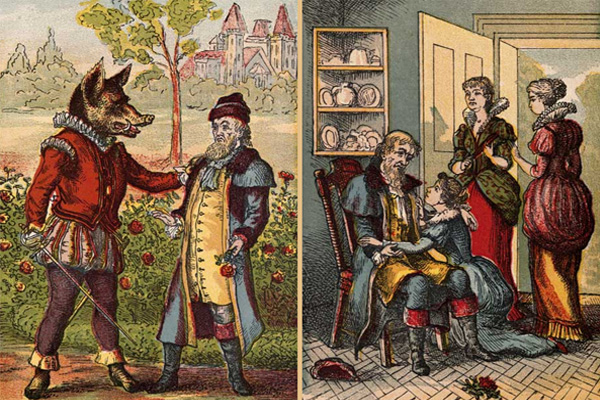
| There was once a very rich
merchant, who had six children, three boys and three girls. As he was himself
a man of great sense, he spared no expense for their education, but provided
them with all sorts of masters for their improvement. The three daughters
were all handsome, but particularly the youngest: indeed she was so very
beautiful that in her childhood every one called her the Little Beauty,
and being still the same when she was grown up, nobody called her by any
other name, which made her sisters very jealous of her. This youngest daughter
was not only more handsome than her sisters, but was also better tempered.
The two eldest were vain of being rich, and spoke with pride to those they
thought below them. They gave themselves a thousand airs, and would not
visit other merchants' daughters; nor would they indeed be seen with any
but persons of quality. They went every day to balls, plays, and public
walks, and always made game of their youngest sister for spending her time
in reading, or other useful employments. As it was well known that these
young ladies would have large fortunes, many great merchants wished to
get them for wives; but the two eldest always answered that, for their
parts, they had no thoughts of marrying any one below a duke, or an earl
at least. Beauty had quite as many offers as her sisters, but she always
answered with the greatest civility, that she was much obliged to her lovers,
but would rather live some years longer with her father, as she thought
herself too young to marry.
It happened that by some
unlucky accident the merchant suddenly lost all his fortune, and had nothing
left but a small cottage in the country. Upon this, he said to his daughters,
while the tears ran down his cheeks all the time, "My children, we must
now go and dwell in the cottage, and try to get a living by labour, for
we have no other means of support." The two eldest replied that, for their
parts, they did not know how to work, and would not leave town; for they
had lovers enough who would be glad to marry them, though they had no longer
any fortune. But in this they were mistaken; for when the lovers heard
what had happened, they said, "The girls were so proud and ill-tempered,
that all we wanted was their fortune; we are not sorry at all to see their
pride brought down. Let them give themselves airs to their cows and sheep."
But every body pitied poor Beauty, because she was so sweet-tempered and
kind to all that knew her; and several gentlemen offered to marry her,
though she had not a penny; but Beauty still refused, and said she could
not think of leaving her poor father in this trouble and would go and help
him in his labours in the country. At first Beauty could not help sometimes
crying in secret for the hardships she was now obliged to suffer; but in
a very short time she said to herself, "All the crying in the world will
do me no good, so I will try to be happy without a fortune."
When they had removed to
their cottage, the merchant and his three sons employed themselves in ploughing
and sowing the fields, and working in the garden. Beauty also did her part,
for she got up by four o'clock every morning, lighted the fires, cleaned
the house, and got the breakfast for the whole family. At first she found
all this very hard; but she soon grew quite used to it, and thought it
no hardship at all; and indeed the work greatly amended her health. When
she had done, she used to amuse herself with reading, playing on her music,
or singing while she spun. But her two sisters were at a loss what to do
to pass the time away: they had their breakfast in bed, and did not rise
till ten o'clock. Then they commonly walked out; but always found themselves
very soon tired; when they would often sit down under a shady tree, and
grieve for the loss of their carriage and fine clothes, and say to each
other, "What a mean-spirited poor stupid creature our young sister is,
to be so content with our low way of life!" But their father thought in
quite another way: he admired the patience of this sweet young creature;
for her sisters not only left her to do the whole work of the house, but
made game of her every moment.
After they had lived in this
manner about a year, the merchant received a letter, which informed him
that one of the richest ships, which he thought was lost, had just come
into port. This news made the two eldest sisters almost mad with joy; for
they thought they should now leave the cottage, and have all their finery
again. When they found that their father must take a journey to the ship,
the two eldest begged he would not fail to bring them back some new gowns,
caps, rings, and all sorts of trinkets. But Beauty asked for nothing; for
she thought in herself that all the ship was worth would hardly buy every
thing her sisters wished for. "Beauty," said the merchant, "how comes it
about that you ask for nothing; what can I bring you, my child?" "Since
you are so kind as to think of me, dear father," she answered, "I should
be glad if you would bring me a rose, for we have none in our garden."
Now Beauty did not indeed wish for a rose, nor any thing else, but she
only said this, that she might not affront her sisters, for else they would
have said she wanted her father to praise her for not asking him for any
thing. The merchant took his leave of them and set out on his journey;
but when he got to the ship, some persons went to law with him about the
cargo, and after a deal of trouble, he came back to his cottage as poor
as he had gone away. When he was within thirty miles of his home, and thinking
of the joy he should have in again meeting his children, his road lay through
a thick forest, and he quite lost himself. It rained and snowed very hard,
and besides, the wind was so high as to throw him twice from his horse.
Night came on, and he thought to be sure he should die of cold and hunger,
or be torn to pieces by the wolves that he heard howling round him. All
at once, he now cast his eyes towards a long row of trees, and saw a light
at the end of them, but it seemed a great way off. He made the best of
his way towards it, and found that it came from a fine palace, lighted
all over. He walked faster, and soon reached the gates, which he opened,
and was very much surprised that he did not see a single person or creature
in any of the yards. His horse had followed him, and finding a stable with
the door open, went into it at once; and here the poor beast, being nearly
starved, helped himself to a good meal of oats and hay. His master then
tied him up, and walked towards the house, which he entered, but still
without seeing a living creature. He went on to a large hall, where he
found a good fire, and a table covered with some very nice dishes, and
only one plate with a knife and fork. As the snow and rain had wetted him
to the skin, he went up to the fire to dry himself. "I hope," said he,
"the master of the house or his servants will excuse me, for to be sure
it will not be long now before I see them." He waited a good time, but
still nobody came: at last the clock struck eleven, and the merchant, being
quite faint for the want of food, helped himself to a chicken, which he
made but two mouthfuls of, and then to a few glasses of wine, yet all the
time trembling with fear. He sat till the clock struck twelve, but did
not see a single creature. He now took courage, and began to think of looking
a little more about him; so he opened a door at the end of the hall, and
went through it into a very grand room, In which there was a fine bed;
and as he was quite weak and tired, he shut the door, took off his clothes,
and got into it.
It was ten o'clock in the
morning before he thought of getting up, when he was amazed to see a handsome
new suit of clothes laid ready for him, instead of his own, which he had
spoiled. "To be sure," said he to himself, "this place belongs to some
good fairy, who has taken pity on my ill luck." He looked out of the window,
and, instead of snow, he saw the most charming arbours covered with all
kinds of flowers. He returned to the hall, where he had supped, and found
a breakfast table, with some chocolate got ready for him. "Indeed, my good
fairy," said the merchant aloud, "I am vastly obliged to you for your kind
care of me." He then made a hearty breakfast, took his hat, and was going
to the stable to pay his horse a visit; but as he passed under one of the
arbours, which was loaded with roses, he thought of what Beauty had asked
him to bring back to her, and so he took a bunch of roses to carry home.
At the same moment he heard a most shocking noise, and saw such a frightful
beast coming towards him, that he was ready to drop with fear. "Ungrateful
man!" said the beast, in a terrible voice, "I have saved your life by letting
you into my palace, and in return you steal my roses, which I value more
than any thing else that belongs to me. But you shall make amends for your
fault with your life. You shall die in a quarter of an hour." The merchant
fell on his knees to the beast, and clasping his hands, said, "My lord,
I humbly beg your pardon. I did not think it would offend you to gather
a rose for one of my daughters, who wished to have one." "I am not a lord,
but a beast," replied the monster; "I do not like false compliments, but
that people should say what they think: so do not fancy that you can coax
me by any such ways. You tell me that you have daughters; now I will pardon
you, if one of them will agree to come and die instead of you. Go; and
if your daughters should refuse, promise me that you yourself will return
in three months."
The tender-hearted merchant
had no thought of letting any one of his daughters die instead of him;
but he knew that if he seemed to accept the beast's terms, he should at
least have the pleasure of seeing them once again. So he gave the beast
his promise; and the beast told him he might then set off as soon as he
liked. "But," said the beast, "I do not wish you to go back empty-handed.
Go to the room you slept in, and you will find a chest there; fill it with
just what you like best, and I will get it taken to your own house for
you," When the beast had said this, he went away; and the good merchant
said to himself, "If I must die, yet I shall now have the comfort of leaving
my children some riches," He returned to the room he had slept in, and
found a great many pieces of gold. He filled the chest with them to the
very brim, locked it, and mounting his horse, left the palace as sorry
as he had been glad when he first found it. The horse took a path across
the forest of his own accord, and in a few hours they reached the merchant's
house. His children came running round him as he got off his horse; but
the merchant, instead of kissing them with joy, could not help crying as
he looked at them. He held in his hand the bunch of roses, which he gave
to Beauty, saying: "Take these roses, Beauty; but little do you think how
dear they have cost your poor father;" and then he gave them an account
of all that he had seen or heard in the palace of the beast. The two eldest
sisters now began to shed tears, and to lay the blame upon Beauty, who
they said would be the cause of her father's death "See," said they, "what
happens from the pride of the little wretch. Why did not she ask for fine
things as we did? But, to be sure, miss must not be like other people;
and though she will be the cause of her father's death, yet she does not
shed a tear." "It would be of no use," replied Beauty, "to weep for the
death of my father, for he shall not die now. As the beast will accept
of one of his daughters, I will give myself up to him; and think myself
happy in being able at once to save his life, and prove my love for the
best of fathers." "No, sister," said the three brothers, "you shall not
die; we will go in search for this monster, and either he or we will perish."
"Do not hope to kill him," said the merchant, "for his power is far too
great for you to be able to do any such thing. I am charmed with the kindness
of Beauty, but I will not suffer her life to be lost. I myself am old,
and cannot expect to live much longer; so I shall but give up a few years
of my life, and shall only grieve for the sake of my children." "Never,
father," cried Beauty, "shall you go to the palace without me; for you
cannot hinder my going after you. Though young, I am not over fond of life;
and I would much rather be eaten up by the monster, than die of the grief
your loss would give me." The merchant tried in vain to reason with Beauty,
for she would go; which, in truth, made her two sisters glad, for they
were jealous of her, because everybody loved her.

The merchant was so grieved
at the thoughts of losing his child, that he never once thought of the
chest filled with gold; but at night, to his great surprise, he found it
standing by his bedside. He said nothing about his riches to his eldest
daughters, for he knew very well it would at once make them want to return
to town; but he told Beauty his secret, and she then said, that while he
was away, two gentlemen had been on a visit to their cottage, who had fallen
in love with her two sisters. She then begged her father to marry them
without delay; for she was so sweet-tempered, that she loved them for all
they had used her so ill, and forgave them with all her heart. When the
three months were past, the merchant and Beauty got ready to set out for
the palace of the beast. Upon this, the two sisters rubbed their eyes with
an onion, to make believe they shed a great many tears; but both the merchant
and his sons cried in earnest. There was only Beauty who did not, for she
thought that this would only make the matter worse. They reached the palace
in a very few hours, and the horse, without bidding, went into the same
stable as before. The merchant and Beauty walked towards the large hall,
where they found a table covered with every dainty, and two plates laid
ready. The merchant had very little appetite; but Beauty, that she might
the better hide her grief, placed herself at the table, and helped her
father; she then began herself to eat, and thought all the time that to
be sure the beast had a mind to fatten her before he eat her up, as he
had got such good cheer for her. When they had done their supper, they
heard a great noise, and the good old man began to bid his poor child farewell,
for he knew it was the beast coming to them. When Beauty first saw his
frightful form, she could not help being afraid; but she tried to hide
her fear as much as she could. The beast asked her if she had come quite
of her own accord, and though she was now still more afraid than before,
she made shift to say, "Y-e-s." "You are a good girl, and I think myself
very much obliged to you." He then turned towards her father, and said
to him, "Good man, you may leave the palace to-morrow morning, and take
care never to come back to it again. Good night, Beauty." "Good night,
beast," said she; and then the monster went out of the room.
"Ah! my dear child," said
the merchant, kissing his daughter, "I am half dead already, at the thoughts
of leaving you with this dreadful beast; you had better go back, and let
me stay in your place." "No," said Beauty boldly, "I will never agree to
that; you must go home to-morrow morning." They then wished each other
good night, and went to bed, both of them thinking they should not be able
to close their eyes; but as soon as ever they had laid down, they fell
into a deep sleep, and did not wake till morning. Beauty dreamed that a
lady came up to her, who said, "I am very much pleased, Beauty, with the
goodness you have shown, in being willing to give your life to save that
of your father; and it shall not go without a reward." As soon as Beauty
awoke, she told her father this dream; but though it gave him some comfort,
he could not take leave of his darling child without shedding many tears.
When the merchant got out of sight, Beauty sat down in the large hall,
and began to cry also; yet she had a great deal of courage, and so she
soon resolved not to make her sad case still worse by sorrow, which she
knew could not be of any use to her, but to wait as well as she could till
night, when she thought the beast would not fail to come and eat her up.
She walked about to take a view of all the palace, and the beauty of every
part of it much charmed her.
But what was her surprise,
when she came to a door on which was written, Beauty's room! She opened
it in haste, and her eyes were all at once dazzled at the grandeur of the
inside of the room. What made her wonder more than all the rest was a large
library filled with books, a harpsichord, and many other pieces of music.
"The beast takes care I shall not be at a loss how to amuse myself," said
she. She then thought that it was not likely such things would have been
got ready for her, if she had but one day to live; and began to hope all
would not turn out so bad as she and her father had feared. She opened
the library, and saw these verses written in letters of gold on the back
of one of the books:
"Beauteous lady, dry your
tears,
Here's no cause for sighs
or fears;
Command as freely as you
may,
Enjoyment still shall mark
your sway."
"Alas!" said she, sighing,
"there is nothing I so much desire as to see my poor father and to know
what he is doing at this moment," She said this to herself; but just then
by chance, she cast her eyes on a looking-glass that stood near her, and
in the glass she saw her home, and her father riding up to the cottage
in the deepest sorrow. Her sisters came out to meet him, but for all they
tried to look sorry, it was easy to see that in their hearts they were
very glad. In a short time all this picture went away out of the glass:
but Beauty began to think that the beast was very kind to her, and that
she had no need to be afraid of him. About the middle of the day, she found
a table laid ready for her; and a sweet concert of music played all the
time she was eating her dinner without her seeing a single creature. But
at supper, when she was going to seat herself at table, she heard the noise
of the beast, and could not help trembling with fear. "Beauty," said he,
"will you give me leave to see you sup?" "That is as you please," answered
she, very much afraid. "Not in the least," said the beast; "you alone command
in this place. If you should not like my company, you need only to say
so, and I will leave you that moment. But tell me, Beauty, do you not think
me very ugly?" "Why, yes," said she, "for I cannot tell a story; but then
I think you are very good." "You are right," replied the beast; "and, besides
being ugly, I am also very stupid: I know very well enough that I am but
a beast."
"I should think you cannot
be very stupid," said Beauty, "if you yourself know this." "Pray do not
let me hinder you from eating," said he; "and be sure you do not want for
any thing; for all you see is yours, and I shall be vastly grieved if you
are not happy." "You are very kind," said Beauty: "I must needs own that
I think very well of your good nature, and then I almost forget how ugly
you are." "Yes, yes, I hope I am good-tempered," said he, "but still I
am a monster." "There are many men who are worse monsters than you are,"
replied Beauty; "and I am better pleased with you in that form, though
it is so ugly, than with those who carry wicked hearts under the form of
a man." "If I had any sense," said the beast, "I would thank you for what
you have said; but I am too stupid to say any thing that would give you
pleasure." Beauty ate her supper with a very good appetite, and almost
lost all her dread of the monster; but she was ready to sink with fright,
when he said to her, "Beauty, will you be my wife?" For a few minutes she
was not able to speak a word, for she was afraid of putting him in a passion,
by refusing. At length she said, "No, beast." The beast made no reply,
but sighed deeply, and went away. When Beauty found herself alone, she
began to feel pity for the poor beast. "Dear!" said she, "what a sad thing
it is that he should be so very frightful, since he is so good-tempered!"
Beauty lived three months
in this palace, very well pleased. The beast came to see her every night,
and talked with her while she supped; and though what he said was not very
clever, yet as she saw in him every day some new mark of his goodness,
so instead of dreading the time of his coming, she was always looking at
her watch, to see if it was almost nine o'clock; for that was the time
when he never failed to visit her. There was but one thing that vexed her;
which was that every night, before the beast went away from her, he always
made it a rule to ask her if she would be his wife, and seemed very much
grieved at her saying no. At last, one night, she said to him, "You vex
me greatly, beast, by forcing me to refuse you so often; I wish I could
take such a liking to you as to agree to marry you, but I must tell you
plainly, that I do not think it will ever happen. I shall always be your
friend; so try to let that make you easy." "I must needs do so then," said
the beast, "for I know well enough how frightful I am; but I love you better
than myself. Yet I think I am very lucky in your being pleased to stay
with me; now promise me, Beauty, that you will never leave me." Beauty
was quite struck when he said this, for that very day she had seen in her
glass that her father had fallen sick of grief for her sake, and was very
ill for the want of seeing her again. "I would promise you, with all my
heart," said she, "never to leave you quite; but I long so much to see
my father, that if you do not give me leave to visit him I shall die with
grief." "I would rather die myself, Beauty," answered the beast, "than
make you fret; I will send you to your father's cottage, you shall stay
there, and your poor beast shall die of sorrow." "No," said Beauty, crying,
"I love you too well to be the cause of your death; I promise to return
in a week. You have shown me that my sisters are married, and my brothers
are gone for soldiers, so that my father is left all alone. Let me stay
a week with him." "You shall find yourself with him to-morrow morning,"
replied the beast; "but mind, do not forget your promise. When you wish
to return you have nothing to do but to put your ring on a table when you
go to bed. Good-bye, Beauty!" The beast then sighed as he said these words,
and Beauty went to bed very sorry to see him so much grieved. When she
awoke in the morning, she found herself in her father's cottage. She rung
a bell that was at her bedside, and a servant entered; but as soon as she
saw Beauty, the woman gave a loud shriek; upon which the merchant ran up
stairs, and when he beheld his daughter he was ready to die of joy. He
ran to the bedside, and kissed her a hundred times. At last Beauty began
to remember that she had brought no clothes with her to put on; but the
servant told her she had just found in the next room a large chest full
of dresses, trimmed all over with gold, and adorned with pearls and diamonds.
Beauty in her own mind thanked
the beast for his kindness, and put on the plainest gown she could find
among them all. She then told the servant to put the rest away with a great
deal of care, for she intended to give them to her sisters; but as soon
as she had spoken these words the chest was gone out of sight in a moment.
Her father then said, perhaps the beast chose for her to keep them all
for herself; and as soon as he had said this, they saw the chest standing
again in the same place. While Beauty was dressing herself, a servant brought
word to her that her sisters were come with their husbands to pay her a
visit. They both lived unhappily with the gentlemen they had married. The
husband of the eldest was very handsome; but was so very proud of this,
that he thought of nothing else from morning till night, and did not attend
to the beauty of his wife. The second had married a man of great learning;
but he made no use of it, only to torment and affront all his friends,
and his wife more than any of them. The two sisters were ready to burst
with spite when they saw Beauty dressed like a princess, and look so very
charming. All the kindness that she showed them was of no use; for they
were vexed more than ever, when she told them how happy she lived at the
palace of the beast. The spiteful creatures went by themselves into the
garden, where they cried to think of her good fortune. "Why should the
little wretch be better off than we?" said they. "We are much handsomer
than she is." "Sister," said the eldest, "a thought has just come into
my head: let us try to keep her here longer than the week that the beast
gave her leave for: and then he will be so angry, that perhaps he will
eat her up in a moment." "That is well thought of," answered the other,
"but to do this we must seem very kind to her." They then made up their
minds to be so, and went to join her in the cottage where they showed her
so much false love, that Beauty could not help crying for joy.
When the week was ended,
the two sisters began to pretend so much grief at the thoughts of her leaving
them, that she agreed to stay a week more; but all that time Beauty could
not help fretting for the sorrow that she knew her staying would give her
poor beast; for she tenderly loved him, and much wished for his company
again. The tenth night of her being at the cottage she dreamed she was
in the garden of the palace, and that the beast lay dying on a grass plot,
and, with his last breath, put her in mind of her promise, and laid his
death to her keeping away from him; Beauty awoke in a great fright, and
burst into tears. "Am not I wicked," said she, "to behave so ill to a beast
who has shown me so much kindness; why will I not marry him? I am sure
I should be more happy with him than my sisters are with their husbands.
He shall not be wretched any longer on my account; for I should do nothing
but blame myself all the rest of my life,"
She then rose, put her ring
on the table, got into bed again, and soon fell asleep. In the morning
she with joy found herself in the palace of the beast. She dressed herself
very finely, that she might please him the better, and thought she had
never known a day pass away so slow. At last the clock struck nine, but
the beast did not come. Beauty then thought to be sure she had been the
cause of his death in earnest. She ran from room to room all over the palace,
calling out his name, but still she saw nothing of him. After looking for
him a long time, she thought of her dream, and ran directly towards the
grass plot; and there she found the poor beast lying senseless and seeming
dead. She threw herself upon his body, thinking nothing at all of his ugliness;
and finding his heart still beat, she ran and fetched some water from a
pond in the garden, and threw it on his face. The beast then opened his
eyes, and said: "You have forgot your promise, Beauty. My grief for the
loss of you has made me resolve to starve myself to death; but I shall
die content, since I have had the pleasure of seeing you once more." "No,
dear beast," replied Beauty, "you shall not die; you shall live to be my
husband: from this moment I offer to marry you, and will be only yours.
Oh! I thought I felt only friendship for you; but the pain I now feel,
shows me that I could not live without seeing you."
The moment Beauty had spoken
these words, the palace was suddenly lighted up, and music, fireworks,
and all kinds of rejoicings, appeared round about them. Yet Beauty took
no notice of all this, but watched over her dear beast with the greatest
tenderness. But now she was all at once amazed to see at her feet, instead
of her poor beast, the handsomest prince that ever was seen, who thanked
her most warmly for having broken his enchantment. Though this young prince
deserved all her notice, she could not help asking him what was become
of the beast. "You see him at your feet, Beauty," answered the prince,
"for I am he. A wicked fairy had condemned me to keep the form of a beast
till a beautiful young lady should agree to marry me, and ordered me, on
pain of death, not to show that I had any sense. You, alone, dearest Beauty,
have kindly judged of me by the goodness of my heart; and in return I offer
you my hand and my crown, though I know the reward is much less than what
I owe you." Beauty, in the most pleasing surprise, helped the prince to
rise, and they walked along to the palace, when her wonder was very great
to find her father and sisters there, who had been brought by the lady
Beauty had seen in her dream. "Beauty," said the lady (for she was a fairy),
"receive the reward of the choice you have made. You have chosen goodness
of heart rather than sense and beauty; therefore you deserve to find them
all three joined in the same person. You are going to be a great Queen:
I hope a crown will not destroy your virtue."
"As for you, ladies," said
the fairy to the other two sisters, "I have long known the malice of your
hearts, and the wrongs you have done. You shall become two statues; but
under that form you shall still keep your reason, and shall be fixed at
the gates of your sister's palace; and I will not pass any worse sentence
on you than to see her happy. You will never appear in your own persons
again till you are fully cured of your faults; and to tell the truth, I
am very much afraid you will remain statues for ever."
At the same moment, the fairy,
with a stroke of her wand, removed all who were present to the young prince's
country, where he was received with the greatest joy by his subjects. He
married Beauty, and passed a long and happy life with her, because they
still kept in the same course of goodness from which they had never departed. |