
Tales by Charles Perrault
The Sleeping Beauty in the Wood
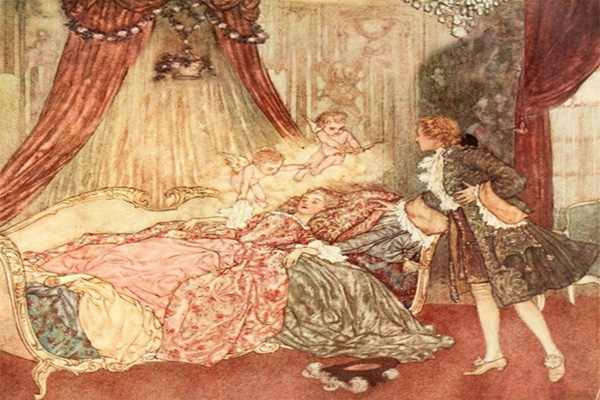
Once upon a time there was a king and a queen who grieved sorely that they had no children. When at last the queen gave birth to a daughter the king was so overjoyed that he gave a great christening feast, the like of which had never before been known. He asked all the fairies in the land—there were seven all told—to stand godmothers to the little princess, hoping that each might give her a gift, and so she should have all imaginable perfections.
After the christening, all the company returned to the palace, where a great feast had been spread for the fairy godmothers. Before each was set a magnificent plate, with a gold knife and a gold fork studded with diamonds and rubies. Just as they were seating themselves, however, there entered an old fairy who had not been invited because more than fifty years ago she had shut herself up in a tower and it was supposed that she was either dead or enchanted.
The king ordered a cover to be laid for her, but it could not be a massive gold one like the others, for only seven had been ordered made.
The old fairy thought herself ill-used and muttered between her teeth. One of the young fairies, overhearing her, and fancying she might work some mischief to the little baby, went and hid herself behind the hangings in the hall, so as to be able to have the last word and undo any harm the old fairy might wish to work. The fairies now began to endow the princess. The youngest, for her gift, decreed that she should be the most beautiful person in the world; the next that she should have the mind of an angel; the third that she should be perfectly graceful; the fourth that she should dance admirably well; the fifth, that she should sing like a nightingale; the sixth, that she should play charmingly upon every musical instrument. The turn of the old fairy had now come, and she declared, while her head shook with malice, that the princess should pierce her hand with a spindle and die of the wound. This dreadful fate threw all the company into tears of dismay, when the young fairy who had hidden herself came forward and said:
"Be of good cheer, king and queen; your daughter shall not so die. It is true I cannot entirely undo what my elder has done. The princess will pierce her hand with a spindle, but, instead of dying, she will only fall into a deep sleep. The sleep will last a hundred years, and at the end of that time a king's son will come to wake her."
The king, in hopes of preventing what the old fairy had foretold, immediately issued an edict by which he forbade all persons in his dominion from spinning or even having spindles in their houses under pain of instant death.
Now fifteen years after the princess was born she was with the king and queen at one of their castles, and as she was running about by herself she came to a little chamber at the top of a tower, and there sat an honest old woman spinning, for she had never heard of the king's edict.
"What are you doing?" asked the princess.
"I am spinning, my fair child," said the old woman, who did not know her.
"How pretty it is!" exclaimed the princess. "How do you do it? Give it to me that I may see if I can do it." She had no sooner taken up the spindle, than, being hasty and careless, she pierced her hand with the point of it, and fainted away. The old woman, in great alarm, called for help. People came running in from all sides; they threw water in the princess's face and did all they could to restore her, but nothing would bring her to. The king, who had heard the noise and confusion, came up also, and remembering what the fairy had said, he had the princess carried to the finest apartment and laid upon a richly embroidered bed. She lay there in all her loveliness, for the swoon had not made her pale; her lips were cherry-ripe and her cheeks ruddy and fair; her eyes were closed, but they could hear her breathing quietly; she could not be dead. The king looked sorrowfully upon her. He knew that she would not awake for a hundred years.
The good fairy who had saved her life and turned her death into sleep was in the kingdom of Mataquin, twelve thousand leagues away, when this happened, but she learned of it from a dwarf who had a pair of seven-league boots, and instantly set out for the castle, where she arrived in an hour, drawn by dragons in a fiery chariot. The king came forward to receive her and showed his grief. The good fairy was very wise and saw that the princess when she woke would find herself all alone in that great castle and everything about her would be strange. So this is what she did. She touched with her wand everybody that was in the castle, except the king and queen. She touched the governesses, maids of honour, women of the bed-chamber, gentlemen, officers, stewards, cooks, scullions, boys, guards, porters, pages, footmen; she touched the horses in the stable with their grooms, the great mastiffs in the court-yard, and even little Pouste, the tiny lap-dog of the princess that was on the bed beside her. As soon as she had touched them they all fell asleep, not to wake again until the time arrived for their mistress to do so, when they would be ready to wait upon her. Even the spits before the fire, laden with partridges and pheasants, went to sleep, and the fire itself went to sleep also.
It was the work of a moment. The king and queen kissed their daughter farewell and left the castle, issuing a proclamation that no person whatsoever was to approach it. That was needless, for in a quarter of an hour there had grown up about it a wood so thick and filled with thorns that nothing could get at the castle, and the castle top itself could only be seen from a great distance.
A hundred years went by, and the kingdom was in the hands of another royal family. The son of the king was hunting one day when he discovered the towers of the castle above the tops of the trees, and asked what castle that was. All manner of answers were given to him. One said it was an enchanted castle, another that witches lived there, but most believed that it was occupied by a great ogre which carried thither all the children he could catch and ate them up one at a time, for nobody could get at him through the wood. The prince did not know what to believe, when finally an old peasant said:
"Prince, it is more than fifty years since I heard my father say that there was in that castle the most beautiful princess that ever was seen; that she was to sleep for a hundred years, and to be awakened at last by the king's son, who was to marry her."
The young prince at these words felt himself on fire. He had not a moment's doubt that he was destined to this great adventure, and full of ardour he determined at once to set out for the castle. Scarcely had he come to the wood when all the trees and thorns which had made such an impenetrable thicket opened on one side and the other to offer him a path. He walked toward the castle, which appeared now at the end of a long avenue, but when he turned to, look for his followers not one was to be seen; the woods had closed instantly upon him as he had passed through. He was entirely alone, and utter silence was about him. He entered a large forecourt and stood still with amazement and awe. On every side were stretched the bodies of men and animals apparently lifeless. But the faces of the men were rosy, and the goblets by them had a few drops of wine left. The men had plainly fallen asleep. His steps resounded as he passed over the marble pavement and up the marble staircase. He entered the guard-room; there the guards stood drawn up in line with carbines at their shoulders, but they were sound asleep. He passed through one apartment after another, where were ladies and gentlemen asleep in their chairs or standing. He entered a chamber covered with gold, and saw on a bed, the curtains of which were drawn, the most lovely sight he had ever looked upon—a princess, who appeared to be about fifteen or sixteen, and so fair that she seemed to belong to another world. He drew near, trembling and wondering, and knelt beside her. Her hand lay upon her breast, and he touched his lips to it. At that moment, the enchantment being ended, the princess awoke, and, looking drowsily and tenderly at the young man, said:
"Have you come, my prince? I have waited long for you." The prince was overjoyed at the words, and at the tender voice and look, and scarcely knew how to speak. But he managed to assure her of his love, and they soon forgot all else as they talked and talked. They talked for four hours, and had not then said half that was in their heads to say.
Meanwhile all the rest of the people in the castle had been wakened at the same moment as the princess, and they were now extremely hungry. The lady-in-waiting became very impatient, and at length announced to the princess that they all waited for her. Then the prince took the princess by the hand; she was dressed in great splendour, but he did not hint that she looked as he had seen pictures of his great-grandmother look; he thought her all the more charming for that. They passed into a hall of mirrors, where they supped, attended by the officers of the princess. The violins and haut-boys played old but excellent pieces of music, and after supper, to lose no time, the grand almoner married the royal lovers in the chapel of the castle.
When they left the castle the next day to return to the prince's home, they were followed by all the retinue of the princess. They marched down the long avenue, and the wood opened again to let them pass. Outside they met the prince's followers, who were overjoyed to see their master. He turned to show them the castle, but behold! there was no castle to be seen, and no wood; castle and wood had vanished, but the prince and princess went gayly away, and when the old king and queen died they reigned in their stead.

Children's Health
Signs that will help you determine whether or not your child is ill...MAKE HALLOWEEN TREATS SAFE TREATS
Enjoy a safe and happy Halloween with your kids and family by following these guidelines to avoid injuries that can haunt you and your family long after Halloween.
Halloween treats may be high health risks to children with food allergies. If your child have a food allergy, you must read the full product label every time and make sure treats are safe for your child. If an item does not have a product label, do not let your child eat it even if it's brand your child previously ate without problems.
Sometimes holiday treats are re-packaged by other companies to make assortment packs. Re-packaged treats may have different labels than the products made and sold directly by the company. Also, seasonal or holiday varieties of candies and miniature candies may have different ingredients or be made on different equipment than the regular size candies, meaning that something your child previously ate without problems could cause an allergic reaction.