
What You Should Know About Education
Education in general is the voluntary training of one human being who is undeveloped, by another who is developed.
The great value of education, in a moral aspect, is the development of the power to resist temptation.
The most rapid and vital progress we make in our development is accomplished in the years before we have reached the age to go to school.
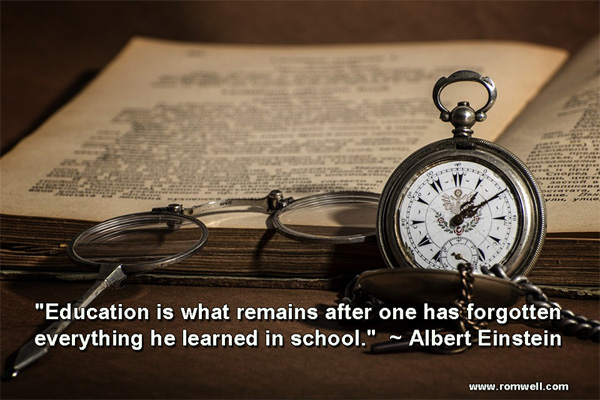
"Education is what remains after one has forgotten everything he learned in school."
~ Albert Einstein
It is the business of education to see that we do not lack any essential opportunity, to make sure that necessary lines of stimuli or of motor training have not been omitted from our development.
Education needs special type of people, the passionate people who never lose their illusions, some men and women who are always young, who are always interested in forming positive habits, and who never lose their interest in moral guidance and instruction upon intellectual matters.
The business of the good educator (whether parent or teacher) is to see to it that the greatest possible number of ideas acquired by students are acquired in such a vital way that they become moving ideas, motive-forces in the guidance of conduct.
The basic education of a student is finished when the student has achieved a completely fashioned Will, which will know how to control and direct him or her among the exigencies of life, intellectual power to judge and care for herself in every way, and a properly developed body. However true it may be, that life itself, by means of daily exigencies, will shape the Will into habits, will develop to some extent the intelligence, and that the forces of nature will fashion the body into maturity.
But we know practically that the kind of character we hope to build up through our education is one that not only has good intentions, but that insists upon carrying them out. Any other character is wishy-washy; it is goody, not good. The individual must have the power to stand up and count for something in the actual conflicts of life. He must have initiative, insistence, persistence, courage, and industry. He must, in a word, have all that goes under the name “force of character.” Undoubtedly, individuals differ greatly in their native endowment in this respect. None the less, each has a certain primary equipment of impulse, of tendency forward, of innate urgency to do. The problem of education on this side is that of discovering what this native fund of power is, and then of utilizing it in such a way (affording conditions which both stimulate and control) as to organize it into definite conserved modes of action—habits.
The lecture and the book may tell us what to look for when we are learning, and how to understand what we find. But, in order to accept any presented lecture as a vital truth in our own mind, it must be verified by our own observation and experience.

Computing
A lot of bad stuff has happened to a lot of people online...Did You Know?
All computer users are exposed to more security risks than they can possibly imagine. Deadbeats, crims, hackers and swindlers prey on unsuspecting victims every second of every day.
Be cautious about opening any attachments! Opening attachments or downloading any files from emails you receive, regardless of who sent them, may contain unexpected files with viruses or malware that your friends or family members didn’t know were there.
Be cautious about Peer-to-peer (P2P) file-sharing! P2P file-sharing allows people to share these kinds of files through an informal network of computers running the same software. Sometimes spyware, malware, or pornography can be hidden in a shared file. If you or your kids download copyrighted material, you could be subject to legal action. It’s important to know and talk to your kids about the security and other risks involved with file-sharing.