
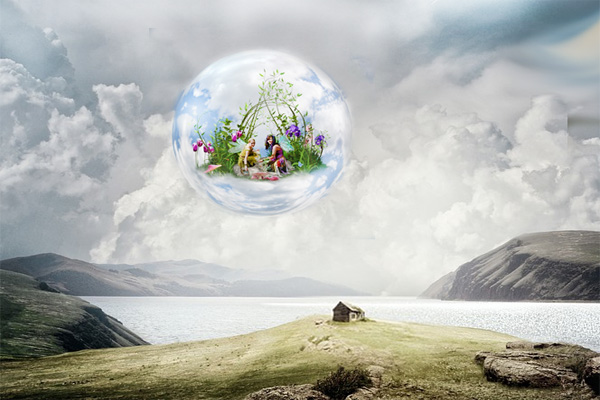
About Fairy Tales
The fairy tale is a poetic recording of the facts of life, an interpretation by the imagination of its hard conditions, an effort to reconcile the spirit which loves freedom and goodness and beauty with its harsh, bare and disappointing conditions. It is, in its earliest form, a spontaneous and instinctive endeavor to shape the facts of the world to meet the needs of the imagination, the cravings of the heart. It involves a free, poetic dealing with realities in accordance with the law of mental growth; it is the naïve activity of the young imagination of the race, untrammeled by the necessity of rigid adherence to the fact.
The oldest fairy stories constitute a fascinating introduction to the book of modern science, curiously predicting its discoveries, its uncovering of the resources of the earth and air, its growing control of the tremendous forces which work in earth and air.
It is significant that the recent progress of science is steadily toward what our ancestors would have considered fairy land; for in all the imaginings of the childhood of the race there was nothing more marvelous or more audaciously improbable than the transmission of accents and modulations of familiar voices through long distances, and the power of communication across leagues of sea without mechanical connections of any kind.
The faculty which created the fairy tale is the same faculty which, supplemented by a broader observation and based on more accurate knowledge, has broadened the range and activities of modern man, made the world accessible to him, enabled him to live in one place but to speak and act in places thousands of miles distant, given him command of colossal forces, and is fast making him rich on a scale which would have seemed incredible to men of a half-century ago. There is nothing in any fairy tale more marvelous and inherently improbable than many of the achievements of scientific observation and invention, and we are only at the beginning of the wonders that lie within the reach of the human spirit!
Read FREE Collection of Fairy Tales and Browse Related Links:
 A Timeless Wisdom of Aesop Collection
Classic Tales of Ancient Greece

Tea
Tea began as a medicine and grew into a beverage associated with comfort and...Did You Know?
Until a quite recent period botanists believed that the tea plant was a native of China, and that its growth was confined to China and Japan. But it is now definitely known that the tea plant is a native of India, where the wild plant attains a size and perfection which concealed its true character from botanical experts, as well as from ordinary observers, for many years after it had become familiar to them as a native of Indian forests.
The Encyclopedia Britannica concedes to the Dutch, the honor of being the first European tea-drinkers, and states that early English supplies of tea were obtained from Dutch sources.
While both the English and Dutch East India Companies exhibited in England small samples of tea as curiosities of barbarian customs very early in the 17th century, tea did not begin to be used as a beverage in England even by the Royalty until after 1650.