
The Ugly Duckling By Hans Christian Andersen - Part 3
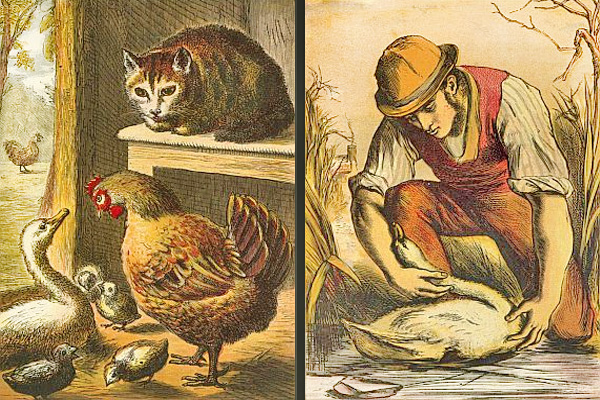
Towards evening the Duck came to a little miserable peasant's hut. This hut was so dilapidated that it did not itself know on which side it should fall; and that's why it remained standing. The storm whistled round the Duckling in such a way that the poor creature was obliged to sit down, to stand against it; and the wind blew worse and worse. Then the Duckling noticed that one of the hinges of the door had given way, and the door hung so slanting that the Duckling could slip through the crack into the room; and that is what it did.
Here lived a woman, with her Cat and her Hen. And the Cat, whom she called Sonnie, could arch his back and purr, he could even give out sparks; but to make him do it one had to stroke his fur the wrong way. The Hen had quite little, short legs, and therefore she was called Chickabiddy Short-shanks. She laid good eggs, and the woman loved her like her own child.
In the morning the strange Duckling was at once noticed, and the Cat began to purr and the Hen to cluck.
"What's this?" said the woman, and looked all round; but she could not see well, and therefore she thought the Duckling was a fat duck that had strayed. "This is a rare prize!" she said. "Now I shall have duck's eggs. I hope it is not a drake. We must try that."
And so the Duckling was admitted on trial for three weeks; but no eggs came. And the Cat was master of the House, and the Hen was the lady, and always said, "We and the world!" for she thought they were half the world, and by far the better half.
The Duckling thought one might have a different opinion, but the Hen would not allow it.
"Can you lay eggs?" she asked.
"No."
"Then will you hold your tongue!"
And the Cat said, "Can you curve your back, and purr, and give out sparks?"
"No."
"Then you will please have no opinion of your own when sensible folks are speaking."
And the Duckling sat in a corner and was melancholy; then the fresh air and the sunshine streamed in; and it was seized with such a strange longing to swim on the water, that it could not help telling the Hen of it.
"What are you thinking of?" cried the Hen. "You have nothing to do, that's why you have these fancies. Lay eggs, or purr, and they will pass over."
"But it is so charming to swim on the water!" said the Duckling, "so refreshing to let it close above one's head, and to dive down to the bottom."
"Yes, that must be a mighty pleasure, truly," quoth the Hen, "I fancy you must have gone crazy. Ask the Cat about it—he's the cleverest animal I know—ask him if he likes to swim on the water, or to dive down—I won't speak about myself. Ask our mistress, the old woman; no one in the world is cleverer than she. Do you think she has any desire to swim, and to let the water close above her head?"
"You don't understand me," said the Duckling.
"We don't understand you? Then pray who is to understand you? You surely don't pretend to be cleverer than the Cat and the woman—I won't say anything of myself. Don't be conceited, child, and thank your Maker for all the kindness you have received. Did you not get into a warm room, and have you not fallen into company from which you may learn something? But you are a chatterer, and it is not pleasant to associate with you. You may believe me, I speak for your good. I tell you disagreeable things, and by that one may always know one's true friends! Only take care that you learn to lay eggs, or to purr, and give out sparks!"
"I think I will go out into the wide world," said the Duckling.
"Yes, do go," replied the Hen.
And so the Duckling went away. It swam on the water, and dived, but it was slighted by every creature because of its ugliness.
Now came the autumn. The leaves in the forest turned yellow and brown; the wind caught them so that they danced about, and up in the air it was very cold. The clouds hung low, heavy with hail and snow-flakes, and on the fence stood the raven, crying, "Croak! croak!" for mere cold; yes, it was enough to make one feel cold to think of this. The poor little Duckling certainly had not a good time. One evening—the sun was just setting in his beauty—there came a whole flock of great, handsome birds out of the bushes. They were dazzlingly white, with long, flexible necks—they were swans. They uttered a very peculiar cry, spread forth their glorious great wings, and flew away from that cold region to warmer lands, to fair open lakes. They mounted so high, so high! and the ugly Duckling felt quite strangely as it watched them. It turned round and round in the water like a wheel, stretched out its neck towards them, and uttered such a strange loud cry as frightened itself. Oh! it could not forget those beautiful, happy birds; and so soon as it could see them no longer, it dived down to the very bottom, and when it came up again it was quite beside itself. It knew not the name of those birds, and knew not whither they were flying; but it loved them more than it had ever loved any one. It was not at all envious of them. How could it think of wishing to possess such loveliness as they had? It would have been glad if only the ducks would have endured its company—the poor, ugly creature!
And the winter grew cold, very cold! The Duckling was forced to swim about in the water, to prevent the surface from freezing entirely; but every night the hole in which it swam about became smaller and smaller. It froze so hard that the icy covering crackled again; and the Duckling was obliged to use its legs continually to prevent the hole from freezing up. At last it became exhausted, and lay quite still, and thus froze fast into the ice.
Early in the morning a peasant came by, and when he saw what had happened, he took his wooden shoe, broke the ice-crust to pieces, and carried the Duckling home to his wife. Then it came to itself again. The children wanted to play with it; but the Duckling thought they wanted to hurt it, and in its terror fluttered up into the milk-pan, so that the milk spurted down into the room. The woman clasped her hands, at which the Duckling flew down into the butter-tub, and then into the meal-barrel and out again. How it looked then! The woman screamed, and struck at it with the fire-tongs; the children tumbled over one another in their efforts to catch the Duckling; and they laughed and they screamed!—well it was that the door stood open, and the poor creature was able to slip out between the shrubs into the newly-fallen snow—there it lay quite exhausted.
But it would be too melancholy if I were to tell all the misery and care which the Duckling had to endure in the hard winter. It lay out on the moor among the reeds, when the sun began to shine again and the larks to sing. It was a beautiful spring.
Then all at once the Duckling could flap its wings. They beat the air more strongly than before, and bore it strongly away; and before it well knew how all this happened, it found itself in a great garden, where the elder-trees smelt sweet, and bent their long green branches down to the canal that wound through the region. Oh, here it was so beautiful, such a gladness of spring! and from the thicket came three glorious white swans; they rustled their wings, and swam lightly on the water. The Duckling knew the splendid creatures, and felt oppressed by a peculiar sadness.
"I will fly away to them, to the royal birds, and they will beat me, because I, that am so ugly, dare to come near them. But it is all the same. Better to be killed by them than to be pursued by ducks, and beaten by fowls, and pushed about by the girl who takes care of the poultry yard, and to suffer hunger in winter!" And it flew out into the water, and swam towards the beautiful swans; these looked at it, and came sailing down upon it with outspread wings. "Kill me!" said the poor creature, and bent its head down upon the water, expecting nothing but death. But what was this that it saw in the clear water? It beheld its own image; and, lo! it was no longer a clumsy dark-gray bird, ugly and hateful to look at, but a—swan!
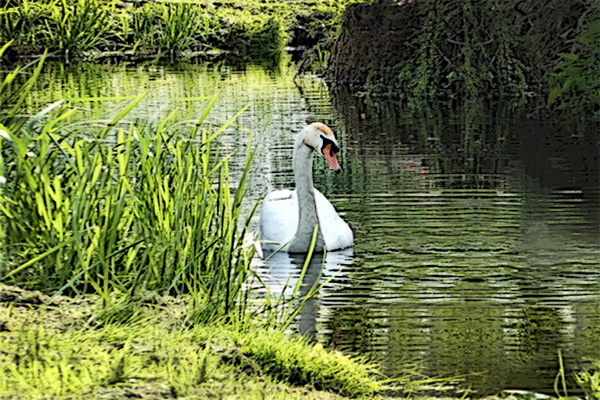
It matters nothing if one is born in a duck-yard if one has only lain in a swan's egg.
It felt quite glad at all the need and misfortune it had suffered, now it realised its happiness in all the splendour that surrounded it. And the great swans swam round it, and stroked it with their beaks.
Into the garden came little children, who threw bread and corn into the water; and the youngest cried, "There is a new one!" and the other children shouted joyously, "Yes, a new one has arrived!" And they clapped their hands and danced about, and ran to their father and mother; and bread and cake were thrown into the water; and they all said, "The new one is the most beautiful of all! so young and handsome!" and the old swans bowed their heads before him. Then he felt quite ashamed, and hid his head under his wings, for he did not know what to do; he was so happy, and yet not at all proud. He thought how he had been persecuted and despised; and now he heard them saying that he was the most beautiful of all birds. Even the elder-tree bent its branches straight down into the water before him, and the sun shone warm and mild. Then his wings rustled, he lifted his slender neck, and cried rejoicingly from the depths of his heart:
"I never dreamed of so much happiness when I was the Ugly Duckling!"
Tea
Tea began as a medicine and grew into a beverage associated with comfort and...Did You Know?
Until a quite recent period botanists believed that the tea plant was a native of China, and that its growth was confined to China and Japan. But it is now definitely known that the tea plant is a native of India, where the wild plant attains a size and perfection which concealed its true character from botanical experts, as well as from ordinary observers, for many years after it had become familiar to them as a native of Indian forests.
The Encyclopedia Britannica concedes to the Dutch, the honor of being the first European tea-drinkers, and states that early English supplies of tea were obtained from Dutch sources.
While both the English and Dutch East India Companies exhibited in England small samples of tea as curiosities of barbarian customs very early in the 17th century, tea did not begin to be used as a beverage in England even by the Royalty until after 1650.