
From: The Book of Tea by Kakuzo Okakura
Taoism and Zennism
The connection of Zennism with tea is proverbial. We have already remarked that the tea-ceremony was a development of the Zen ritual. The name of Laotse, the founder of Taoism, is also intimately associated with the history of tea. It is written in the Chinese school manual concerning the origin of habits and customs that the ceremony of offering tea to a guest began with Kwanyin, a well-known disciple of Laotse, who first at the gate of the Han Pass presented to the "Old Philosopher" a cup of the golden elixir. We shall not stop to discuss the authenticity of such tales, which are valuable, however, as confirming the early use of the beverage by the Taoists. Our interest in Taoism and Zennism here lies mainly in those ideas regarding life and art which are so embodied in what we call Teaism.
It is to be regretted that as yet there appears to be no adequate presentation of the Taoists and Zen doctrines in any foreign language, though we have had several laudable attempts.
Translation is always a treason, and as a Ming author observes, can at its best be only the reverse side of a brocade,—all the threads are there, but not the subtlety of colour or design. But, after all, what great doctrine is there which is easy to expound? The ancient sages never put their teachings in systematic form. They spoke in paradoxes, for they were afraid of uttering half-truths. They began by talking like fools and ended by making their hearers wise. Laotse himself, with his quaint humour, says, "If people of inferior intelligence hear of the Tao, they laugh immensely. It would not be the Tao unless they laughed at it."
The Tao literally means a Path. It has been severally translated as the Way, the Absolute, the Law, Nature, Supreme Reason, the Mode. These renderings are not incorrect, for the use of the term by the Taoists differs according to the subject-matter of the inquiry. Laotse himself spoke of it thus: "There is a thing which is all-containing, which was born before the existence of Heaven and Earth. How silent! How solitary! It stands alone and changes not. It revolves without danger to itself and is the mother of the universe. I do not know its name and so call it the Path. With reluctance I call it the Infinite. Infinity is the Fleeting, the Fleeting is the Vanishing, the Vanishing is the Reverting." The Tao is in the Passage rather than the Path. It is the spirit of Cosmic Change,—the eternal growth which returns upon itself to produce new forms. It recoils upon itself like the dragon, the beloved symbol of the Taoists. It folds and unfolds as do the clouds. The Tao might be spoken of as the Great Transition. Subjectively it is the Mood of the Universe. Its Absolute is the Relative.
It should be remembered in the first place that Taoism, like its legitimate successor Zennism, represents the individualistic trend of the Southern Chinese mind in contra-distinction to the communism of Northern China which expressed itself in Confucianism. The Middle Kingdom is as vast as Europe and has a differentiation of idiosyncrasies marked by the two great river systems which traverse it. The Yangtse-Kiang and Hoang-Ho are respectively the Mediterranean and the Baltic. Even to-day, in spite of centuries of unification, the Southern Celestial differs in his thoughts and beliefs from his Northern brother as a member of the Latin race differs from the Teuton. In ancient days, when communication was even more difficult than at present, and especially during the feudal period, this difference in thought was most pronounced. The art and poetry of the one breathes an atmosphere entirely distinct from that of the other. In Laotse and his followers and in Kutsugen, the forerunner of the Yangtse-Kiang nature-poets, we find an idealism quite inconsistent with the prosaic ethical notions of their contemporary northern writers. Laotse lived five centuries before the Christian Era.
The germ of Taoist speculation may be found long before the advent of Laotse, surnamed the Long-Eared. The archaic records of China, especially the Book of Changes, foreshadow his thought. But the great respect paid to the laws and customs of that classic period of Chinese civilisation which culminated with the establishment of the Chow dynasty in the sixteenth century B.C., kept the development of individualism in check for a long while, so that it was not until after the disintegration of the Chow dynasty and the establishment of innumerable independent kingdoms that it was able to blossom forth in the luxuriance of free-thought. Laotse and Soshi (Chuangtse) were both Southerners and the greatest exponents of the New School. On the other hand, Confucius with his numerous disciples aimed at retaining ancestral conventions. Taoism cannot be understood without some knowledge of Confucianism and vice versa.
We have said that the Taoist Absolute was the Relative. In ethics the Taoist railed at the laws and the moral codes of society, for to them right and wrong were but relative terms. Definition is always limitation—the "fixed" and "unchangeless" are but terms expressive of a stoppage of growth. Said Kuzugen,—"The Sages move the world." Our standards of morality are begotten of the past needs of society, but is society to remain always the same? The observance of communal traditions involves a constant sacrifice of the individual to the state. Education, in order to keep up the mighty delusion, encourages a species of ignorance. People are not taught to be really virtuous, but to behave properly. We are wicked because we are frightfully self-conscious. We nurse a conscience because we are afraid to tell the truth to others; we take refuge in pride because we are afraid to tell the truth to ourselves. How can one be serious with the world when the world itself is so ridiculous! The spirit of barter is everywhere. Honour and Chastity! Behold the complacent salesman retailing the Good and True. One can even buy a so-called Religion, which is really but common morality sanctified with flowers and music. Rob the Church of her accessories and what remains behind? Yet the trusts thrive marvelously, for the prices are absurdly cheap,—a prayer for a ticket to heaven, a diploma for an honourable citizenship. Hide yourself under a bushel quickly, for if your real usefulness were known to the world you would soon be knocked down to the highest bidder by the public auctioneer. Why do men and women like to advertise themselves so much? Is it not but an instinct derived from the days of slavery?
The virility of the idea lies not less in its power of breaking through contemporary thought than in its capacity for dominating subsequent movements. Taoism was an active power during the Shin dynasty, that epoch of Chinese unification from which we derive the name China. It would be interesting had we time to note its influence on contemporary thinkers, the mathematicians, writers on law and war, the mystics and alchemists and the later nature-poets of the Yangtse-Kiang. We should not even ignore those speculators on Reality who doubted whether a white horse was real because he was white, or because he was solid, nor the Conversationalists of the Six dynasties who, like the Zen philosophers, revelled in discussions concerning the Pure and the Abstract. Above all we should pay homage to Taoism for what it has done toward the formation of the Celestial character, giving to it a certain capacity for reserve and refinement as "warm as jade." Chinese history is full of instances in which the votaries of Taoism, princes and hermits alike, followed with varied and interesting results the teachings of their creed. The tale will not be without its quota of instruction and amusement. It will be rich in anecdotes, allegories, and aphorisms. We would fain be on speaking terms with the delightful emperor who never died because he had never lived. We may ride the wind with Liehtse and find it absolutely quiet because we ourselves are the wind, or dwell in mid-air with the Aged one of the Hoang-Ho, who lived betwixt Heaven and Earth because he was subject to neither the one nor the other. Even in that grotesque apology for Taoism which we find in China at the present day, we can revel in a wealth of imagery impossible to find in any other cult.
But the chief contribution of Taoism to Asiatic life has been in the realm of aesthetics. Chinese historians have always spoken of Taoism as the "art of being in the world," for it deals with the present—ourselves. It is in us that God meets with Nature, and yesterday parts from to-morrow. The Present is the moving Infinity, the legitimate sphere of the Relative. Relativity seeks Adjustment; Adjustment is Art. The art of life lies in a constant readjustment to our surroundings. Taoism accepts the mundane as it is and, unlike the Confucians or the Buddhists, tries to find beauty in our world of woe and worry. The Sung allegory of the Three Vinegar Tasters explains admirably the trend of the three doctrines. Sakyamuni, Confucius, and Laotse once stood before a jar of vinegar—the emblem of life—and each dipped in his finger to taste the brew. The matter-of-fact Confucius found it sour, the Buddha called it bitter, and Laotse pronounced it sweet.
The Taoists claimed that the comedy of life could be made more interesting if everyone would preserve the unities. To keep the proportion of things and give place to others without losing one's own position was the secret of success in the mundane drama. We must know the whole play in order to properly act our parts; the conception of totality must never be lost in that of the individual. This Laotse illustrates by his favourite metaphor of the Vacuum. He claimed that only in vacuum lay the truly essential. The reality of a room, for instance, was to be found in the vacant space enclosed by the roof and the walls, not in the roof and walls themselves. The usefulness of a water pitcher dwelt in the emptiness where water might be put, not in the form of the pitcher or the material of which it was made. Vacuum is all potent because all containing. In vacuum alone motion becomes possible. One who could make of himself a vacuum into which others might freely enter would become master of all situations. The whole can always dominate the part.
These Taoists' ideas have greatly influenced all our theories of action, even to those of fencing and wrestling. Jiu-jitsu, the Japanese art of self-defence, owes its name to a passage in the Tao-teking. In jiu-jitsu one seeks to draw out and exhaust the enemy's strength by non-resistance, vacuum, while conserving one's own strength for victory in the final struggle. In art the importance of the same principle is illustrated by the value of suggestion. In leaving something unsaid the beholder is given a chance to complete the idea and thus a great masterpiece irresistibly rivets your attention until you seem to become actually a part of it. A vacuum is there for you to enter and fill up the full measure of your aesthetic emotion.
He who had made himself master of the art of living was the Real man of the Taoist. At birth he enters the realm of dreams only to awaken to reality at death. He tempers his own brightness in order to merge himself into the obscurity of others. He is "reluctant, as one who crosses a stream in winter; hesitating as one who fears the neighbourhood; respectful, like a guest; trembling, like ice that is about to melt; unassuming, like a piece of wood not yet carved; vacant, like a valley; formless, like troubled waters." To him the three jewels of life were Pity, Economy, and Modesty.
If now we turn our attention to Zennism we shall find that it emphasises the teachings of Taoism. Zen is a name derived from the Sanscrit word Dhyana, which signifies meditation. It claims that through consecrated meditation may be attained supreme self-realisation. Meditation is one of the six ways through which Buddhahood may be reached, and the Zen sectarians affirm that Sakyamuni laid special stress on this method in his later teachings, handing down the rules to his chief disciple Kashiapa. According to their tradition Kashiapa, the first Zen patriarch, imparted the secret to Ananda, who in turn passed it on to successive patriarchs until it reached Bodhi-Dharma, the twenty-eighth. Bodhi-Dharma came to Northern China in the early half of the sixth century and was the first patriarch of Chinese Zen. There is much uncertainty about the history of these patriarchs and their doctrines. In its philosophical aspect early Zennism seems to have affinity on one hand to the Indian Negativism of Nagarjuna and on the other to the Gnan philosophy formulated by Sancharacharya. The first teaching of Zen as we know it at the present day must be attributed to the sixth Chinese patriarch Yeno(637-713), founder of Southern Zen, so-called from the fact of its predominance in Southern China. He is closely followed by the great Baso(died 788) who made of Zen a living influence in Celestial life. Hiakujo(719-814) the pupil of Baso, first instituted the Zen monastery and established a ritual and regulations for its government. In the discussions of the Zen school after the time of Baso we find the play of the Yangtse-Kiang mind causing an accession of native modes of thought in contrast to the former Indian idealism. Whatever sectarian pride may assert to the contrary one cannot help being impressed by the similarity of Southern Zen to the teachings of Laotse and the Taoist Conversationalists. In the Tao-teking we already find allusions to the importance of self-concentration and the need of properly regulating the breath—essential points in the practice of Zen meditation. Some of the best commentaries on the Book of Laotse have been written by Zen scholars.
Zennism, like Taoism, is the worship of Relativity. One master defines Zen as the art of feeling the polar star in the southern sky. Truth can be reached only through the comprehension of opposites. Again, Zennism, like Taoism, is a strong advocate of individualism. Nothing is real except that which concerns the working of our own minds. Yeno, the sixth patriarch, once saw two monks watching the flag of a pagoda fluttering in the wind. One said "It is the wind that moves," the other said "It is the flag that moves"; but Yeno explained to them that the real movement was neither of the wind nor the flag, but of something within their own minds. Hiakujo was walking in the forest with a disciple when a hare scurried off at their approach. "Why does the hare fly from you?" asked Hiakujo. "Because he is afraid of me," was the answer. "No," said the master, "it is because you have murderous instinct." The dialogue recalls that of Soshi (Chaungtse), the Taoist. One day Soshi was walking on the bank of a river with a friend. "How delightfully the fishes are enjoying themselves in the water!" exclaimed Soshi. His friend spake to him thus: "You are not a fish; how do you know that the fishes are enjoying themselves?" "You are not myself," returned Soshi; "how do you know that I do not know that the fishes are enjoying themselves?"
Zen was often opposed to the precepts of orthodox Buddhism even as Taoism was opposed to Confucianism. To the transcendental insight of the Zen, words were but an incumbrance to thought; the whole sway of Buddhist scriptures only commentaries on personal speculation. The followers of Zen aimed at direct communion with the inner nature of things, regarding their outward accessories only as impediments to a clear perception of Truth. It was this love of the Abstract that led the Zen to prefer black and white sketches to the elaborately coloured paintings of the classic Buddhist School. Some of the Zen even became iconoclastic as a result of their endeavor to recognise the Buddha in themselves rather than through images and symbolism. We find Tankawosho breaking up a wooden statue of Buddha on a wintry day to make a fire. "What sacrilege!" said the horror-stricken bystander. "I wish to get the Shali out of the ashes," calmly rejoined the Zen. "But you certainly will not get Shali from this image!" was the angry retort, to which Tanka replied, "If I do not, this is certainly not a Buddha and I am committing no sacrilege." Then he turned to warm himself over the kindling fire.
A special contribution of Zen to Eastern thought was its recognition of the mundane as of equal importance with the spiritual. It held that in the great relation of things there was no distinction of small and great, an atom possessing equal possibilities with the universe. The seeker for perfection must discover in his own life the reflection of the inner light. The organisation of the Zen monastery was very significant of this point of view. To every member, except the abbot, was assigned some special work in the caretaking of the monastery, and curiously enough, to the novices was committed the lighter duties, while to the most respected and advanced monks were given the more irksome and menial tasks. Such services formed a part of the Zen discipline and every least action must be done absolutely perfectly. Thus many a weighty discussion ensued while weeding the garden, paring a turnip, or serving tea. The whole ideal of Teaism is a result of this Zen conception of greatness in the smallest incidents of life. Taoism furnished the basis for aesthetic ideals, Zennism made them practical.
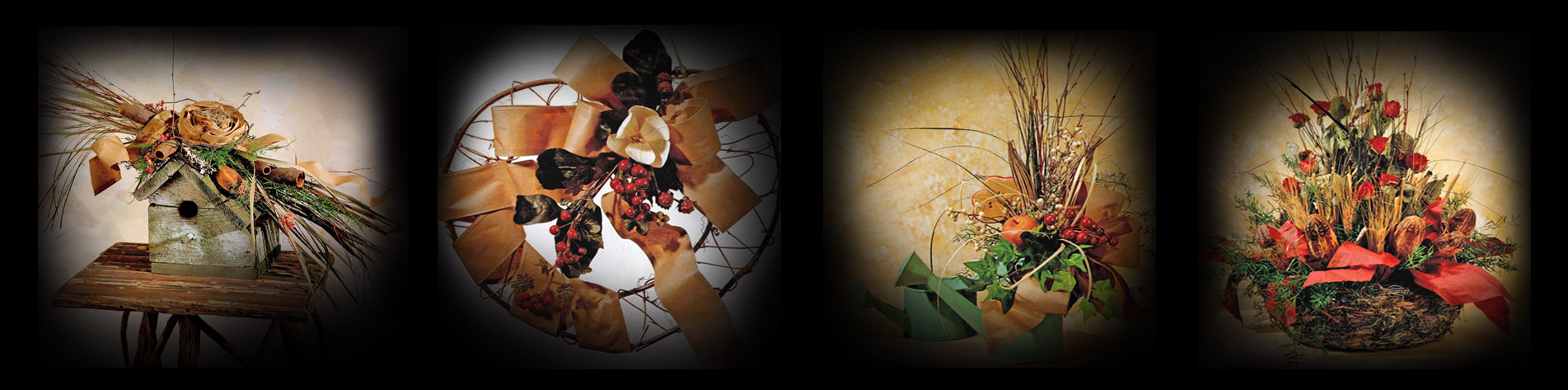
Great Craft Creations
Surprise your loved ones with great craft creations, decorate your house, or make unique gifts...Did You Know?
If you need some dry material instantly you can use your microwave oven for making what you need. To dry herbs or flowers in the microwave oven instantly you will need SILICA GEL. Silica gel is a substance used to dry delicate flowers too, such as roses or calendula, as it preserves their forms and colors well. Silica gel can usually be found in craft stores.
It is very simple to dry flowers with a silica crystals, just use microwave safe container with a 1" (2,5 cm) thick layer of the silica crystals and place your flowers on the top allowing about 1-inch of space around the sides and between each flowers. Put another 1-inch layer on the top of flowers and then microwave on cca 50 % power for approximately 2-3 minutes, depending on the type of your microwave and flowers. It is better to check the material progress an add some more times if needed. Flowers and leaves often have different drying times, microwave them separately for better result.
Never use silica gel containers for preparing food after you use them for drying flowers, because they often absorbs pesticides from plants as they dry.