
From: The Book of Tea by Kakuzo Okakura
The Schools of Tea
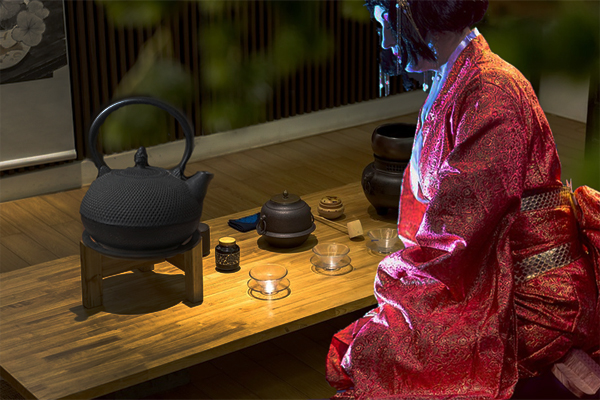
Tea is a work of art and needs a master hand to bring out its noblest qualities. We have good and bad tea, as we have good and bad paintings—generally the latter. There is no single recipe for making the perfect tea, as there are no rules for producing a Titian or a Sesson. Each preparation of the leaves has its individuality, its special affinity with water and heat, its own method of telling a story. The truly beautiful must always be in it. How much do we not suffer through the constant failure of society to recognise this simple and fundamental law of art and life; Lichilai, a Sung poet, has sadly remarked that there were three most deplorable things in the world: the spoiling of fine youths through false education, the degradation of fine art through vulgar admiration, and the utter waste of fine tea through incompetent manipulation.
Like Art, Tea has its periods and its schools. Its evolution may be roughly divided into three main stages: the Boiled Tea, the Whipped Tea, and the Steeped Tea. We moderns belong to the last school.
These several methods of appreciating the beverage are indicative of the spirit of the age in which they prevailed. For life is an expression, our unconscious actions the constant betrayal of our innermost thought. Confucius said that "man hideth not." Perhaps we reveal ourselves too much in small things because we have so little of the great to conceal. The tiny incidents of daily routine are as much a commentary of racial ideals as the highest flight of philosophy or poetry. Even as the difference in favorite vintage marks the separate idiosyncrasies of different periods and nationalities of Europe, so the Tea-ideals characterise the various moods of Oriental culture. The Cake-tea which was boiled, the Powdered-tea which was whipped, the Leaf-tea which was steeped, mark the distinct emotional impulses of the Tang, the Sung, and the Ming dynasties of China. If we were inclined to borrow the much-abused terminology of art-classification, we might designate them respectively, the Classic, the Romantic, and the Naturalistic schools of Tea.
The tea-plant, a native of southern China, was known from very early times to Chinese botany and medicine. It is alluded to in the classics under the various names of Tou, Tseh, Chung, Kha, and Ming, and was highly prized for possessing the virtues of relieving fatigue, delighting the soul, strengthening the will, and repairing the eyesight. It was not only administered as an internal dose, but often applied externally in form of paste to alleviate rheumatic pains. The Taoists claimed it as an important ingredient of the elixir of immortality. The Buddhists used it extensively to prevent drowsiness during their long hours of meditation.
By the fourth and fifth centuries Tea became a favourite beverage among the inhabitants of the Yangtse-Kiang valley. It was about this time that modern ideograph Cha was coined, evidently a corruption of the classic Tou. The poets of the southern dynasties have left some fragments of their fervent adoration of the "froth of the liquid jade." Then emperors used to bestow some rare preparation of the leaves on their high ministers as a reward for eminent services. Yet the method of drinking tea at this stage was primitive in the extreme. The leaves were steamed, crushed in a mortar, made into a cake, and boiled together with rice, ginger, salt, orange peel, spices, milk, and sometimes with onions! The custom obtains at the present day among the Thibetans and various Mongolian tribes, who make a curious syrup of these ingredients. The use of lemon slices by the Russians, who learned to take tea from the Chinese caravansaries, points to the survival of the ancient method.
It needed the genius of the Tang dynasty to emancipate Tea from its crude state and lead to its final idealization. With Luwuh in the middle of the eighth century we have our first apostle of tea. He was born in an age when Buddhism, Taoism, and Confucianism were seeking mutual synthesis. The pantheistic symbolism of the time was urging one to mirror the Universal in the Particular. Luwuh, a poet, saw in the Tea-service the same harmony and order which reigned through all things. In his celebrated work, the "Chaking" (The Holy Scripture of Tea) he formulated the Code of Tea. He has since been worshipped as the tutelary god of the Chinese tea merchants.
The "Chaking" consists of three volumes and ten chapters. In the first chapter Luwuh treats of the nature of the tea-plant, in the second of the implements for gathering the leaves, in the third of the selection of the leaves. According to him the best quality of the leaves must have "creases like the leathern boot of Tartar horsemen, curl like the dewlap of a mighty bullock, unfold like a mist rising out of a ravine, gleam like a lake touched by a zephyr, and be wet and soft like fine earth newly swept by rain."
The fourth chapter is devoted to the enumeration and description of the twenty-four members of the tea-equipage, beginning with the tripod brazier and ending with the bamboo cabinet for containing all these utensils. Here we notice Luwuh's predilection for Taoist symbolism. Also it is interesting to observe in this connection the influence of tea on Chinese ceramics. The Celestial porcelain, as is well known, had its origin in an attempt to reproduce the exquisite shade of jade, resulting, in the Tang dynasty, in the blue glaze of the south, and the white glaze of the north. Luwuh considered the blue as the ideal colour for the tea-cup, as it lent additional greenness to the beverage, whereas the white made it look pinkish and distasteful. It was because he used cake-tea. Later on, when the tea masters of Sung took to the powdered tea, they preferred heavy bowls of blue-black and dark brown. The Mings, with their steeped tea, rejoiced in light ware of white porcelain.
In the fifth chapter Luwuh describes the method of making tea. He eliminates all ingredients except salt. He dwells also on the much-discussed question of the choice of water and the degree of boiling it. According to him, the mountain spring is the best, the river water and the spring water come next in the order of excellence. There are three stages of boiling: the first boil is when the little bubbles like the eye of fishes swim on the surface; the second boil is when the bubbles are like crystal beads rolling in a fountain; the third boil is when the billows surge wildly in the kettle. The Cake-tea is roasted before the fire until it becomes soft like a baby's arm and is shredded into powder between pieces of fine paper. Salt is put in the first boil, the tea in the second. At the third boil, a dipperful of cold water is poured into the kettle to settle the tea and revive the "youth of the water." Then the beverage was poured into cups and drunk. O nectar! The filmy leaflet hung like scaly clouds in a serene sky or floated like waterlilies on emerald streams. It was of such a beverage that Lotung, a Tang poet, wrote: "The first cup moistens my lips and throat, the second cup breaks my loneliness, the third cup searches my barren entrail but to find therein some five thousand volumes of odd ideographs. The fourth cup raises a slight perspiration,—all the wrong of life passes away through my pores. At the fifth cup I am purified; the sixth cup calls me to the realms of the immortals. The seventh cup—ah, but I could take no more! I only feel the breath of cool wind that rises in my sleeves. Where is Horaisan? Let me ride on this sweet breeze and waft away thither."
The remaining chapters of the "Chaking" treat of the vulgarity of the ordinary methods of tea-drinking, a historical summary of illustrious tea-drinkers, the famous tea plantations of China, the possible variations of the tea-service and illustrations of the tea-utensils. The last is unfortunately lost.
The appearance of the "Chaking" must have created considerable sensation at the time. Luwuh was befriended by the Emperor Taisung (763-779), and his fame attracted many followers. Some exquisites were said to have been able to detect the tea made by Luwuh from that of his disciples. One mandarin has his name immortalised by his failure to appreciate the tea of this great master.
In the Sung dynasty the whipped tea came into fashion and created the second school of Tea. The leaves were ground to fine powder in a small stone mill, and the preparation was whipped in hot water by a delicate whisk made of split bamboo. The new process led to some change in the tea-equipage of Luwuh, as well as in the choice of leaves. Salt was discarded forever. The enthusiasm of the Sung people for tea knew no bounds. Epicures vied with each other in discovering new varieties, and regular tournaments were held to decide their superiority. The Emperor Kiasung (1101-1124), who was too great an artist to be a well-behaved monarch, lavished his treasures on the attainment of rare species. He himself wrote a dissertation on the twenty kinds of tea, among which he prizes the "white tea" as of the rarest and finest quality.
The tea-ideal of the Sungs differed from the Tangs even as their notion of life differed. They sought to actualize what their predecessors tried to symbolise. To the Neo-Confucian mind the cosmic law was not reflected in the phenomenal world, but the phenomenal world was the cosmic law itself. Aeons were but moments—Nirvana always within grasp. The Taoist conception that immortality lay in the eternal change permeated all their modes of thought. It was the process, not the deed, which was interesting. It was the completing, not the completion, which was really vital. Man came thus at once face to face with nature. A new meaning grew into the art of life. The tea began to be not a poetical pastime, but one of the methods of self-realisation. Wangyucheng eulogised tea as "flooding his soul like a direct appeal, that its delicate bitterness reminded him of the aftertaste of a good counsel." Sotumpa wrote of the strength of the immaculate purity in tea which defied corruption as a truly virtuous man. Among the Buddhists, the southern Zen sect, which incorporated so much of Taoist doctrines, formulated an elaborate ritual of tea. The monks gathered before the image of Bodhi Dharma and drank tea out of a single bowl with the profound formality of a holy sacrament. It was this Zen ritual which finally developed into the Tea-ceremony of Japan in the fifteenth century.
Unfortunately the sudden outburst of the Mongol tribes in the thirteenth century which resulted in the devastation and conquest of China under the barbaric rule of the Yuen Emperors, destroyed all the fruits of Sung culture. The native dynasty of the Mings which attempted re-nationalisation in the middle of the fifteenth century was harassed by internal troubles, and China again fell under the alien rule of the Manchus in the seventeenth century. Manners and customs changed to leave no vestige of the former times. The powdered tea is entirely forgotten. We find a Ming commentator at loss to recall the shape of the tea whisk mentioned in one of the Sung classics. Tea is now taken by steeping the leaves in hot water in a bowl or cup. The reason why the Western world is innocent of the older method of drinking tea is explained by the fact that Europe knew it only at the close of the Ming dynasty.
To the latter-day Chinese tea is a delicious beverage, but not an ideal. The long woes of his country have robbed him of the zest for the meaning of life. He has become modern, that is to say, old and disenchanted. He has lost that sublime faith in illusions which constitutes the eternal youth and vigour of the poets and ancients. He is an eclectic and politely accepts the traditions of the universe. He toys with Nature, but does not condescend to conquer or worship her. His Leaf-tea is often wonderful with its flower-like aroma, but the romance of the Tang and Sung ceremonials are not to be found in his cup.
Japan, which followed closely on the footsteps of Chinese civilisation, has known the tea in all its three stages. As early as the year 729 we read of the Emperor Shomu giving tea to one hundred monks at his palace in Nara. The leaves were probably imported by our ambassadors to the Tang Court and prepared in the way then in fashion. In 801 the monk Saicho brought back some seeds and planted them in Yeisan. Many tea-gardens are heard of in succeeding centuries, as well as the delight of the aristocracy and priesthood in the beverage. The Sung tea reached us in 1191 with the return of Yeisai-zenji, who went there to study the southern Zen school. The new seeds which he carried home were successfully planted in three places, one of which, the Uji district near Kioto, bears still the name of producing the best tea in the world. The southern Zen spread with marvelous rapidity, and with it the tea-ritual and the tea-ideal of the Sung. By the fifteenth century, under the patronage of the Shogun, Ashikaga-Voshinasa, the tea ceremony is fully constituted and made into an independent and secular performance. Since then Teaism is fully established in Japan. The use of the steeped tea of the later China is comparatively recent among us, being only known since the middle of the seventeenth century. It has replaced the powdered tea in ordinary consumption, though the latter still continues to hold its place as the tea of teas.
It is in the Japanese tea ceremony that we see the culmination of tea-ideals. Our successful resistance of the Mongol invasion in 1281 had enabled us to carry on the Sung movement so disastrously cut off in China itself through the nomadic inroad. Tea with us became more than an idealisation of the form of drinking; it is a religion of the art of life. The beverage grew to be an excuse for the worship of purity and refinement, a sacred function at which the host and guest joined to produce for that occasion the utmost beatitude of the mundane. The tea-room was an oasis in the dreary waste of existence where weary travellers could meet to drink from the common spring of art-appreciation. The ceremony was an improvised drama whose plot was woven about the tea, the flowers, and the paintings. Not a colour to disturb the tone of the room, not a sound to mar the rhythm of things, not a gesture to obtrude on the harmony, not a word to break the unity of the surroundings, all movements to be performed simply and naturally—such were the aims of the tea-ceremony. And strangely enough it was often successful. A subtle philosophy lay behind it all. Teaism was Taoism in disguise.

Great Beverages
Find delicious and easy to prepare beverages quite capable to satisfy your cravings...Did You Know?
Tea began as a medicine and grew into a beverage. In China, in the eighth century, it entered the realm of poetry as one of the polite amusements. The fifteenth century saw Japan ennoble it into a religion of aestheticism—Teaism. Teaism is a cult founded on the adoration of the beautiful among the sordid facts of everyday existence. It inculcates purity and harmony, the mystery of mutual charity, the romanticism of the social order. It is essentially a worship of the Imperfect, as it is a tender attempt to accomplish something possible in this impossible thing we know as life.
The earliest record of tea in European writing is said to be found in the statement of an Arabian traveller, that after the year 879 the main sources of revenue in Canton were the duties on salt and tea. Marco Polo records the deposition of a Chinese minister of finance in 1285 for his arbitrary augmentation of the tea-taxes. It was at the period of the great discoveries that the European people began to know more about the extreme Orient. At the end of the sixteenth century the Hollanders brought the news that a pleasant drink was made in the East from the leaves of a bush. The travellers Giovanni Batista Ramusio (1559), L. Almeida (1576), Maffeno (1588), Tareira (1610), also mentioned tea. In the last-named year ships of the Dutch East India Company brought the first tea into Europe. It was known in France in 1636, and reached Russia in 1638. England welcomed it in 1650 and spoke of it as "That excellent and by all physicians approved China drink, called by the Chineans Tcha, and by other nations Tay, alias Tee."
There is a subtle charm in the taste of tea which makes it irresistible and capable of idealisation.