
Travel Pages
RomWell Travel Advisory
Trinity Site - Jumbo
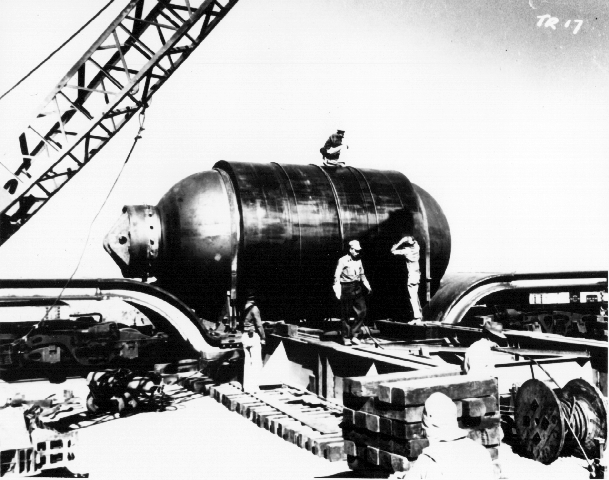
Lying next to the entrance of the chain link fence that still surrounds Trinity Site are the rusty remains of Jumbo. Jumbo was the code name for the 214-ton Thermos shaped steel and concrete container designed to hold the precious plutonium core of the Trinity device in case of a nuclear mis-fire. Built by the Babcock and Wilcox Company of Barberton, Ohio, Jumbo was 28 feet long, 12 feet, 8 inches in diameter, and with steel walls up to 16 inches thick.
The idea of using some kind of container for the Trinity device was based on the fact that plutonium was extremely expensive and very difficult to produce. So, much thought went into a way of containing the 15 lb. plutonium core of the bomb, in case the 5,300 lbs. of conventional high explosives surrounding the core exploded without setting off a nuclear blast, and in the process scattering the costly plutonium (about 250 million dollars worth) across the dessert. After extensive research and testing of other potential containment ideas, the concept of Jumbo was decided on in the late summer of 1944.
However, by the spring of 1945, after Jumbo had already been built and transported (with great difficulty) to the Trinity Site by the Eichleay Corporation of Pittsburgh, it was decided not to explode the Trinity device inside of Jumbo after all. There were several reasons for this new decision: first, plutonium had become more readily (relatively) available; second, the Project scientists decided that the Trinity device would probably work as planned; and last, the scientists realized that if Jumbo were used it would adversely affect the test results, and add 214 tons of highly radioactive material to the atmosphere.
Not knowing what else to do with the massive 12 million dollar Jumbo, it was decided to suspend it from a steel tower 800 yards from Ground Zero to see how it would withstand the Trinity test. Jumbo survived the approximately 20 kiloton Trinity blast undamaged, but its supporting 70-foot tall steel tower was flattened.
Two years later, in an attempt to destroy the unused Jumbo before it and its 12 million dollar cost came to the attention of a congressional investigating committee, Manhattan Project Director General Groves ordered two junior officers from the Special Weapons Division at Sandia Army Base in Albuquerque to test Jumbo. The Army officers placed eight 500-pound conventional bombs in the bottom of Jumbo. Since the bombs were on the bottom of Jumbo, and not the center (the correct position), the resultant explosion blew both ends off Jumbo. Unable to totally destroy Jumbo, the Army then buried it in the desert near Trinity Site. It was not until the early 1970s that the impressive remains of Jumbo, still weighing over 180 tons, were moved to their present location.
RELATED LINKS:
 Learn About Trinity - The First Atomic Test
Education
Discover where the capital of the United States has been located...Recommended Literature
100 Suns - By Michael Light - Between July 1945 and November 1962 the United States is known to have conducted 216 atmospheric and underwater nuclear tests. After the Limited Test Ban Treaty between the United States and the Soviet Union in 1963, nuclear testing went underground. It became literally invisible—but more frequent: the United States conducted a further 723 underground tests, the last in 1992. 100 Suns documents the era of visible nuclear testing, the atmospheric era, with 100 photographs drawn by Michael Light from the archives at Los Alamos National Laboratory and the U.S. National Archives in Maryland. It includes previously classified material from the clandestine Lookout Mountain Air Force Station based in Hollywood, whose film directors, cameramen and still photographers were sworn to secrecy.
The title, 100 Suns, refers to the response by J. Robert Oppenheimer to the world’s first nuclear explosion in New Mexico when he quoted a passage from the Bhagavad Gita, the classic Vedic text: “If the radiance of a thousand suns were to burst forth at once in the sky, that would be like the splendor of the Mighty One... I am become Death, the destroyer of worlds.” This was Oppenheimer’s attempt to describe the otherwise indescribable. 100 Suns likewise confronts the indescribable by presenting without embellishment the stark evidence of the tests at the moment of detonation. Since the tests were conducted either in Nevada or the Pacific the book is simply divided between the desert and the ocean. Each photograph is presented with the name of the test, its explosive yield in kilotons or megatons, the date and the location. The enormity of the events recorded is contrasted with the understated neutrality of bare data.
Interspersed within the sequence of explosions are pictures of the awestruck witnesses. The evidence of these photographs is terrifying in its implication while at same time profoundly disconcerting as a spectacle. The visual grandeur of such imagery is balanced by the chilling facts provided at the end of the book in the detailed captions, a chronology of the development of nuclear weaponry and an extensive bibliography. A dramatic sequel to Michael Light’s Full Moon, 100 Suns forms an unprecedented historical document.
The Day the Sun Rose Twice: The Story of the Trinity Site Nuclear Explosion, July 16, 1945 by Ferenc Morton Szasz - First published in 1984, this prize-winning history of the Manhattan Project was available in paperback for the first time, fifty years after the explosion of the first atomic bomb. "This tightly focused, lucidly written and thoroughly researched book... describes the events, personalities and scientific processes that led to the detonation of the first atomic bomb in an isolated stretch of New Mexican desert.... Mr. Szasz provides fascinating details.... The Day the Sun Rose Twice is concise and cogent, a valuable introduction to how our nuclear dilemma began." — New York Times Book Review
"May be the definitive account of the days and hours leading up to the first nuclear explosion in history and the legacy it left. He vividly reconstructs the story: the industrious atmosphere of the scientists and technicians; the grave considerations of those making key decisions; the sense of wonder, and twinges of conscience, at what had been achieved." — Los Angeles Times
RECOMMENDED MOVIES:
The Day After Trinity - This unique movie is a haunting journey through the dawn of the nuclear age, an incisive history of humanity's most dubious achievement and the man behind it -- J. Robert Oppenheimer, the principal architect of the atomic bomb. Featuring archival footage and commentary from scientists and soldiers directly involved with the Manhattan Project, this gripping film is a fascinating look at the scope and power of the Nuclear Age.
Nuclear Rescue 911 - Broken Arrows & Incidents (2001) - The U.S. government uses the phrase "broken arrow" to refer to an accident involving a nuclear weapon, and as Nuclear Rescue 911: Broken Arrows & Incidents makes chillingly clear, there have been many more such mishaps than the public realizes. Between 1950 and 1980, there were 32 accidents that involved a nuke, dire situations that featured crashing bombers, disappearing submarines, and even a deadly fiasco in Arkansas triggered when a hapless technician dropped a socket wrench down a missile silo. While some of these events were calamitous, none of them, thankfully, actually set off a nuclear explosion. This film, however, makes the point that some of these misfortunes came astonishingly close to wiping out millions of people. Using a combination of news footage and stock archival footage to portray real events, and a narration delivered by Adam West of Batman fame, the documentary is appropriately sober and tends not to be sensationalistic. Credibility is established by some interviews with participants in the various accidents, and a former Department of Energy spokesman appears throughout to provide details about particular events. An interesting DVD bonus item is an alarmingly upbeat 1950s vintage film short the U.S. Air Force made to showcase its safety procedures in handling nuclear weapons at the height of the cold war.
RomWell Craft Pages
Surprise your loved ones with great craft creations, decorate your house, or make unique gifts for any occasion and create ultimate gift giving experience. Save money, spend a quality time with your dearest ones, and have fun doing great craft for any occasion!
Find out more
Browse RomWell Real Cooking