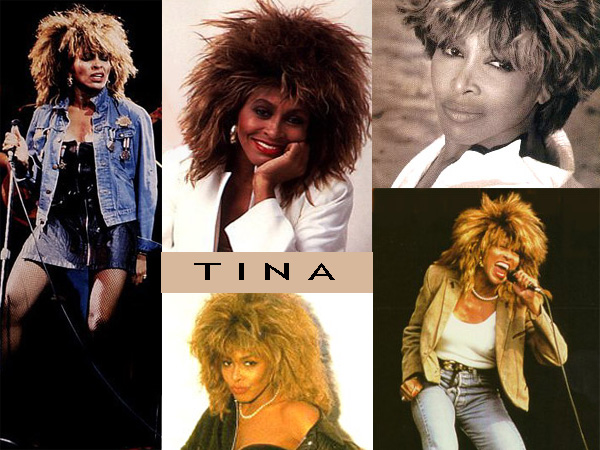
Tina Turner
The Queen of Rock 'n' Roll
Tina Turner Music
Tina Turner (born Anna Mae Bullock; November 26, 1939) started out her music career as an occasional vocalist in Ike's shows at the age of 18. Going by the name "Little Ann," Bullock was also the spotlight of a soul revue led by Ike Turner and his Kings of Rhythm band. Ike changed Bullock's name to Tina Turner and that of his band to The Ike & Tina Turner Revue.
In 1960, when a singer scheduled to record the song, "A Fool in Love", didn't appear, Tina stepped in and recorded the vocals instead. "A Fool in Love" was a huge R&B hit reaching #2, crossing over to the top 30 of the US pop chart.
Success followed with a string of hits including "River Deep, Mountain High" and the 1971 hit "Proud Mary".
By the mid-1970s, Tina's personal life and marriage began to fail. Ike's drug use led to increasingly erratic and physically abusive behavior. Their act was losing speed largely due to Ike's refusal to accept outside management of their recording or touring, as well as the cost of maintaining his allegedly voracious cocaine habit. Touring dates began to decline and record sales were low; their last success was "Nutbush City Limits", a song penned by Tina Turner about her home town, that reached #22 on the Hot 100 and #4 in the United Kingdom in 1973.
Having opened his own recording studio, Bolic Sound, following the lucrative success of "Proud Mary", Ike produced Tina's first solo album, Tina Turns the Country On in 1974. It failed to make an impact on the charts, as did the follow-up, Acid Queen (1975), which was released to tie in with Tina's critically acclaimed big-screen debut in the role of the same name in The Who's rock opera, Tommy.
After a violent argument before an appearance at the Dallas Statler Hilton in July 1976, Tina abruptly left Ike, fleeing with nothing more than thirty-six cents and a gas-station credit card. She spent the next few months hiding from him while staying with various friends.
By walking out on Ike in the middle of a tour, she learned she was legally responsible to tour promoters for the canceled tour. Needing to earn a living, she became a solo performer, supplementing her income with TV appearances on shows such as The Hollywood Squares and, Donny and Marie, The Sonny & Cher Show, and The Brady Bunch Hour.
Her divorce was finalized in 1978 after sixteen years of marriage. She parted ways with him, retaining only her stage name, and assuming responsibility for the debts incurred by the canceled tour as well as a significant IRS lien.
After virtually disappearing from the music scene for several years following her divorce from Ike, Tina Turner rebuilt her career, launching a string of hits beginning in 1983 with the single "Let's Stay Together" and the 1984 release of her fifth solo album Private Dancer.
In 1984, Turner staged what Ebony magazine called an "amazing comeback". The album "Private Dancer" was released in June 1984, and the first single, "What's Love Got to Do with It", peaked at number-one in the US and number three in the UK. It became, and still is, Turner's only number-one hit in either the US or UK.
The single hit the top ten in several other European countries. Private Dancer went on to sell five million copies in the US, and a total of 11 million copies worldwide, though some sources stated the album has sold over twenty million, making it her most successful album. Besides "Let's Stay Together" and "What's Love Got to Do With It", the album also yielded the hits "Better Be Good To Me" (US #5, UK #45) and "Private Dancer" (US #7, UK #26) Turner would later win an MTV Video Music Award, two American Music Awards and four Grammy Awards, confirming her year as "the comeback queen". In February 1985, Turner embarked on her first solo world tour, the Private Dancer Tour, which saw her performing in North America, Asia, Europe, and Australia. She also collaborated on the USA For Africa song "We Are The World" which helped famine victims in Africa.
Following her biggest years of her career, Turner continued her widely successful solo career releasing the album, Break Every Rule, in 1986. That same year, Turner published her autobiography, I, Tina, which she talked about her early life and volatile marriage to Ike Turner. Later that summer, the singer received a star on the Hollywood Walk of Fame. Turner's Break Every Rule yielded the hits, "Typical Male", "Two People", "Back Where You Started" and "What You Get Is What You See" and reportedly sold over nine million copies worldwide.
In March of the following year, Turner embarked on her Break Every Rule Tour in Munich. On January 16, 1988, Turner made history when she entered the Guinness World Records alongside with Paul McCartney performing in front of the largest paying audience (over 184,000) to see a solo artist in Maracanã Stadium, Rio de Janeiro. In April, Turner's double live album, Tina Live in Europe, was released. In late 1989, Turner released her seventh studio album, Foreign Affair, which included the international smash, "The Best". The single became one of Turner's signature singles. In 1990, she embarked on a hugely successful European tour to promote the album playing to nearly four million fans and touring over 121 shows in Europe, beating records set by The Rolling Stones' last tours.
In 1991, Turner released a compilation album, Simply the Best. Her modern dance-pop cover of "Nutbush City Limits" hit the top thirty in the UK.
In 1993, she recorded a cover of The Trammps' "Disco Inferno" and two newer songs, the Lulu cover, "I Don't Wanna Fight" and the R&B ballad, "Why Must We Wait Until Tonight" (written by Bryan Adams). The soundtrack went platinum in America and yielded Turner's final top ten U.S. single, "I Don't Wanna Fight", which peaked at number nine. Later that year, Turner went out on a sold-out U.S. tour, her first in seven years, to promote the soundtrack. Afterwards, Turner moved to Switzerland and took a year off from the road at the end of the tour.
In 1995, Turner returned to recording with the title track for the James Bond flick, Goldeneye, written by U2's Bono and The Edge. "Goldeneye" hit the top ten in several European countries. In 1996, Turner's Wildest Dreams album was released. Due to its later successful world tour and a commercial where she promoted Hanes hosiery, the album hit gold in the U.S. while it went platinum in Europe based on the success of singles such as "Whatever You Want", the cover of John Waite's "Missing You", "Something Beautiful Remains" and the Barry White duet, "In Your Wildest Dreams". In May 1996, Turner embarked on a year-long world tour which again broke concert ticket sales records. The tour lasted into April 1997 and grossed a combined total of $130 million in sales. At the end of the year, Turner and one of her musicians co-wrote an English version of the Italian ballad "Cose della vita" with Italian singer Eros Ramazzotti. Their duet became a European hit. In April 1999, Turner opened at the VH-1 special, Divas Live '99, performing several of her 1980s hits and performing with both Elton John and Cher to "Proud Mary". Turner later remarked that she was recording a new album. In November 1999, Turner released the dance single "When the Heartache Is Over", its parent album, "Twenty Four Seven", was released in Europe the following month. In February 2000, the album was released in America and was certified Gold by the RIAA. Later that year, Turner went out on one of her most successful tours of her career. By tour's end, the Twenty Four Seven Tour had become the highest-grossing tour of 2000 according to Pollstar grossing over $100 million. Later, Guinness World Records announced that Turner had sold more concert tickets than any other solo concert performer in music history.
Film Roles
Her musical career led to film roles, beginning with a prominent role as The Acid Queen in the 1975 film Tommy, and an appearance in Sgt. Pepper's Lonely Hearts Club Band. She starred opposite Mel Gibson as Aunty Entity in Mad Max Beyond Thunderdome for which she received the NAACP Image Award for Outstanding Actress in a Motion Picture, and her version of the film's theme, "We Don't Need Another Hero", was a hit single. She appeared in the 1993 film Last Action Hero.What the Critics Say:
When one magic formula works, there's little point in looking for another one, especially when new studio albums only turn up twice every decade. Your audience appeal doesn't get enough exposure to pall. Find out more...More About Tina Turner
Discover more...Did You Know?
The first time Tina Turner performed song "A Fool in Love" on national television was on the October 3, 1960 episode of American Bandstand, while she was nine months pregnant with Ike's child. Also Tina performed this song during her 2000 concert tour, and her performance of this song can be seen on the One Last Time concert DVD, from her Twenty Four Seven Tour.The song "A Fool in Love" originally wasn't supposed to include vocals by Tina, who was then pregnant with Ike's child. When he went to review the song before erasing her vocals out, however, he heard Tina's soulful interpretation of it and was so inspired that he left it in, in the process changing the course of both of their careers.
The album "River Deep: Mounain High" by Ike and Tina Turner is one of the most influential albums of all time and is a highlight of Phil Spector's career.
In 1991, Ike and Tina Turner were inducted into the Rock & Roll Hall of Fame. Phil Spector accepted the award on their behalf.

RomWell Travel Guide
It is quite true that the more you travel, the more interested in travel you are. No matter how many times you visited interesting places, there is always something new to be discovered. Learn more about your destination before your trip and make it even more enjoyable and practical.
Find out more
The Queen of Rock 'n' Roll