
Books
The Brontë Sisters
Editor's Preface to the New Edition of 'Wuthering Heights'
I have just read over ‘Wuthering Heights,’ and, for the first time, have obtained a clear glimpse of what are termed (and, perhaps, really are) its faults; have gained a definite notion of how it appears to other people - to strangers who knew nothing of the author; who are unacquainted with the locality where the scenes of the story are laid; to whom the inhabitants, the customs, the natural characteristics of the outlying hills and hamlets in the West Riding of Yorkshire are things alien and unfamiliar.
To all such ‘Wuthering Heights’ must appear a rude and strange production. The wild moors of the North of England can for them have no interest: the language, the manners, the very dwellings and household customs of the scattered inhabitants of those districts must be to such readers in a great measure unintelligible, and - where intelligible - repulsive. Men and women who, perhaps, naturally very calm, and with feelings moderate in degree, and little marked in kind, have been trained from their cradle to observe the utmost evenness of manner and guardedness of language, will hardly know what to make of the rough, strong utterance, the harshly manifested passions, the unbridled aversions, and headlong partialities of unlettered moorland hinds and rugged moorland squires, who have grown up untaught and unchecked, except by Mentors as harsh as themselves. A large class of readers, likewise, will suffer greatly from the introduction into the pages of this work of words printed with all their letters, which it has become the custom to represent by the initial and final letter only - a blank line filling the interval. I may as well say at once that, for this circumstance, it is out of my power to apologise; deeming it, myself, a rational plan to write words at full length. The practice of hinting by single letters those expletives with which profane and violent persons are wont to garnish their discourse, strikes me as a proceeding which, however well meant, is weak and futile. I cannot tell what good it does - what feeling it spares - what horror it conceals.
With regard to the rusticity of ‘Wuthering heights,’ I admit the charge, for I feel the quality. It is rustic all through. It is moorish, and wild, and knotty as a root of heath. Nor was it natural that it should be otherwise; the author being herself a native and nursling of the moors. Doubtless, had her lot been cast in a town, her writings, if she had written at all, would have possessed another character. Even had chance or taste led her to choose a similar subject, she would have treated it otherwise. Had Ellis Bell been a lady or a gentleman accustomed to what is called ‘the world,’ her view of a remote and unreclaimed region, as well as of the dwellers therein, would have differed greatly from that actually taken by the home-bred country girl. Doubtless it would have been wider - more comprehensive: whether it would have been more original or more truthful is not so certain. As far as the scenery and locality are concerned, it could scarcely have been so sympathetic: Ellis Bell did not describe as one whose eye and taste alone found pleasure in the prospect; her native hills were far more to her than a spectacle; they were what she lived in, and by, as much as the wild birds, their tenants, or as the heather, their produce. Her descriptions, then, of natural scenery are what they should be, and all they should be.
Where delineation of human character is concerned, the case is different. I am bound to avow that she had scarcely more practical knowledge of the peasantry amongst whom she lived, than a nun has of the country people who sometimes pass her convent gates. My sister’s disposition was not naturally gregarious; circumstances favoured and fostered her tendency to seclusion; except to go to church or take a walk on the hills, she rarely crossed the threshold of home. Though her feeling for the people round was benevolent, intercourse with them she never sought; nor, with very few exceptions, ever experienced. And yet she know them: knew their ways, their language, their family histories; she could hear of them with interest, and talk of them with detail, minute, graphic, and accurate; but with them, she rarely exchanged a word. Hence it ensued that what her mind had gathered of the real concerning them, was too exclusively confined to those tragic and terrible traits of which, in listening to the secret annals of every rude vicinage, the memory is sometimes compelled to receive the impress. Her imagination, which was a spirit more sombre than sunny, more powerful than sportive, found in such traits material whence it wrought creations like Heathcliff, like Earnshaw, like Catherine. Having formed these beings, she did not know what she had done. If the auditor of her work, when read in manuscript, shuddered under the grinding influence of natures so relentless and implacable, of spirits so lost and fallen; if it was complained that the mere hearing of certain vivid and fearful scenes banished sleep by night, and disturbed mental peace by day, Ellis Bell would wonder what was meant, and suspect the complainant of affectation. Had she but lived, her mind would of itself have grown like a strong tree, loftier, straighter, wider-spreading, and its matured fruits would have attained a mellower ripeness and sunnier bloom; but on that mind time and experience alone could work: to the influence of other intellects it was not amenable.
Having avowed that over much of ‘Wuthering Heights’ there broods 'a horror of great darkness'; that, in its storm-heated and electrical atmosphere, we seem at times to breathe lightning: let me point to those spots where clouded day-light and the eclipsed sun still attest their existence. For a specimen of true benevolence and homely fidelity, look at the character of Nelly Dean; for an example of constancy and tenderness, remark that of Edgar Linton. (Some people will think these qualities do not shine so well incarnate in a man as they would do in a woman, but Ellis Bell could never be brought to comprehend this notion: nothing moved her more than any insinuation that the faithfulness and clemency, the long-suffering and loving-kindness which are esteemed virtues in the daughters of Eve, become foibles in the sons of Adam. She held that mercy and forgiveness are the divinest attributes of the Great Being who made both man and woman, and that what clothes the Godhead in glory, can disgrace no form of feeble humanity.) There is a dry saturnine humour in the delineation of old Joseph, and some glimpses of grace and gaiety animate the younger Catherine. Nor is even the first heroine of the name destitute of a certain strange beauty in her fierceness, or of honesty in the midst of perverted passion and passionate perversity.
Heathcliff, indeed, stands unredeemed; never once swerving in his arrow-straight course to perdition, from the time when ‘the little black-haired swarthy thing, as dark as if it came from the Devil,’ was first unrolled out of the bundle and set on its feet in the farmhouse kitchen, to the hour when Nelly Dean found the grim, stalwart corpse laid on its back in the panel-enclosed bed, with wide-gazing eyes that seemed ‘to sneer at her attempt to close them, and parted lips and sharp white teeth that sneered too.’
Heathcliff betrays one solitary human feeling, and that is not his love for Catherine; which is a sentiment fierce and inhuman: a passion such as might boil and glow in the bad essence of some evil genius; a fire that might form the tormented centre - the ever-suffering soul of a magnate of the infernal world: and by its quenchless and ceaseless ravage effect the execution of the decree which dooms him to carry Hell with him wherever he wanders. No; the single link that connects Heathcliff with humanity is his rudely-confessed regard for Hareton Earnshaw - the young man whom he has ruined; and then his half-implied esteem for Nelly Dean. These solitary traits omitted, we should say he was child neither of Lascar nor gipsy, but a man’s shape animated by demon life - a Ghoul - an Afreet.
Whether it is right or advisable to create beings like Heathcliff, I do not know: I scarcely think it is. But this I know: the writer who possesses the creative gift owns something of which he is not always master - something that, at times, strangely wills and works for itself. He may lay down rules and devise principles, and to rules and principles it will perhaps for years lie in subjection; and then, haply without any warning of revolt, there comes a time when it will no longer consent to ‘harrow the valleys, or be bound with a band in the furrow’ - when it ‘laughs at the multitude of the city, and regards not the crying of the driver’ - when, refusing absolutely to make ropes out of sea-sand any longer, it sets to work on statue-hewing, and you have a Pluto or a Jove, a Tisiphone or a Psyche, a Mermaid or a Madonna, as Fate or Inspiration direct. Be the work grim or glorious, dread or divine, you have little choice left but quiescent adoption. As for you - the nominal artist - your share in it has been to work passively under dictates you neither delivered nor could question - that would not be uttered at your prayer, nor suppressed nor changed at your caprice. If the result be attractive, the World will praise you, who little deserve praise; if it be repulsive, the same World will blame you, who almost as little deserve blame.
‘Wuthering Heights’ was hewn in a wild workshop, with simple tools, out of homely materials. The statuary found a granite block on a solitary moor; gazing thereon, he saw how from the crag might be elicited a head, savage, swart, sinister; a form moulded with at least one element of grandeur - power. He wrought with a rude chisel, and from no model but the vision of his meditations. With time and labour, the crag took human shape; and there it stands colossal, dark, and frowning, half statue, half rock: in the former sense, terrible and goblin-like; in the latter, almost beautiful, for its colouring is of mellow grey, and moorland moss clothes it; and heath, with its blooming bells and balmy fragrance, grows faithfully close to the giant’s foot.
CURRER BELL
Related Links:
 Biographical Notice of Ellis and Acton Bell
Browse Quotes and Proverbs...

Cool Quotes Vol. 1
If silence is golden, then speech is platinum...
Cool Quotes Vol. 2
If you are too careful, you are so occupied in being...
Cool Quotes Vol. 3
The only time to eat DIET FOOD is while you're waiting...
Wise Old Sayings
One today is worth two tomorrows...
Browse Aesop's Fables...
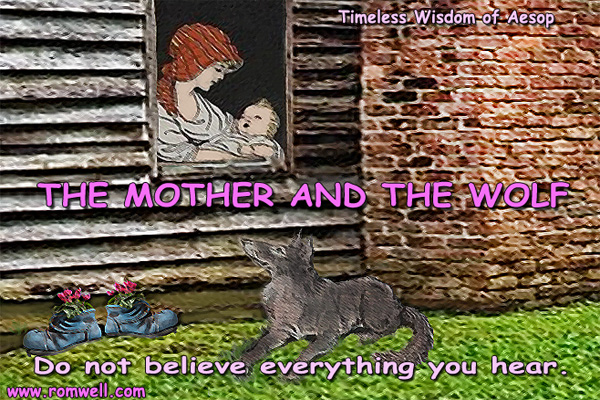
The Mother and the Wolf
Do not believe everything you hear.
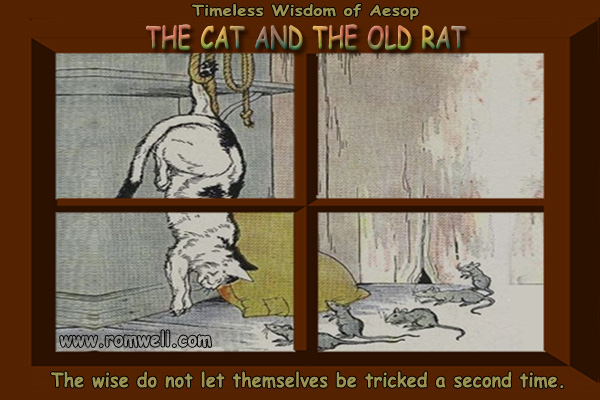
The Cat and the Old Rat
The wise do not let themselves be tricked a second time.
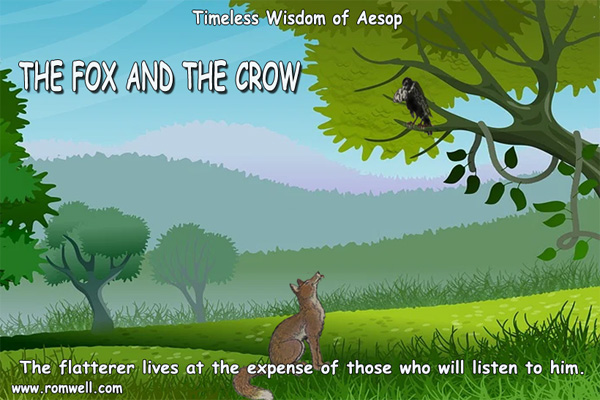
The Fox and the Crow
The flatterer lives at the expense of those who will...
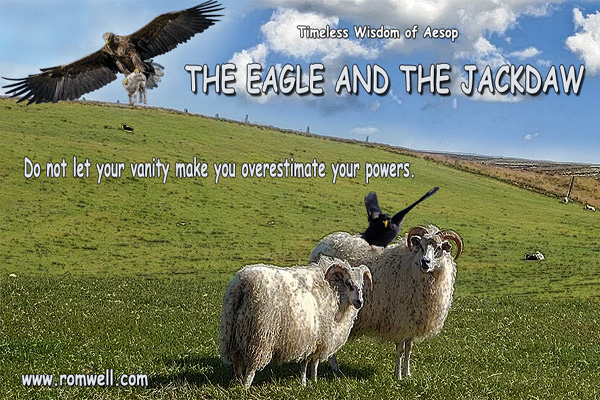
The Eagle and the Jackdaw
Do not let your vanity make you overestimate your powers.
Education Pages
We live in democratic and progressive society, so every student must be educated for leadership as well as for obedience. Every student must have power of self-direction and power of directing others, power of administration, ability to assume positions of responsibility. This necessity of educating for leadership is as great on the industrial as on the political side and gives opportunity for positive personal achievement. >>> Learn more...Binge Drinking
A “binge” is a pattern of drinking alcohol that brings blood alcohol concentration (BAC) to 0.08 gram percent or above. For the typical adult, this pattern corresponds to consuming 5 or more drinks (male), or 4 or more drinks (female), in about 2 hours. Binge drinking is clearly dangerous for the drinker and for society. For some individuals (e.g., older people or people taking other drugs or certain medications), the number of drinks needed to reach a bingelevel BAC is lower than for the "typical adult".
RomWell Craft Pages
Surprise your loved ones with great craft creations, decorate your house, or make unique gifts for any occasion and create ultimate gift giving experience. Save money, spend a quality time with your dearest ones, and have fun doing great craft for any occasion!
Find out more
Browse RomWell Real Cooking