
Books
The Brontë Sisters
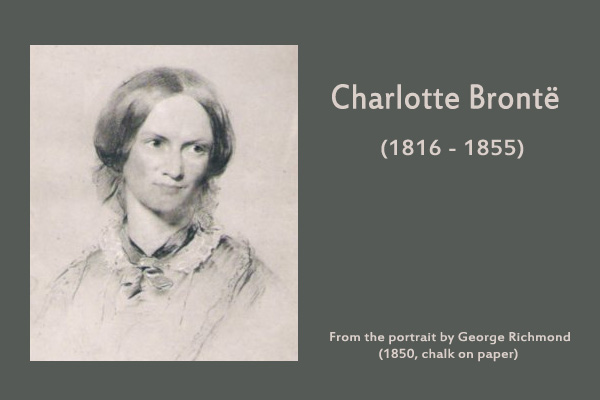
Charlotte Brontë (Currer Bell)
Charlotte Brontë was born at Thornton, in Yorkshire, England, the third of six children, to Patrick Brontë, an Irish Anglican clergyman, and his wife, Maria Branwell. In April 1820 the family moved to Haworth, where Patrick had been appointed Perpetual Curate. Maria Branwell Brontë died of cancer on 15 September 1821, leaving five daughters and a son to the care of her sister Elizabeth Branwell.
In August 1824, Charlotte was sent with three of her sisters to the Clergy Daughters' School at Cowan Bridge in Lancashire (which she would describe as Lowood School in Jane Eyre). Its poor conditions, Charlotte maintained, permanently affected her health and physical development, and hastened the deaths of her two elder sisters, Maria (born 1814) and Elizabeth (born 1815), who died of tuberculosis in 1825 soon after they were removed from the school.
Charlotte continued her education at Roe Head school in Mirfield from 1831 to 1832, where she met her lifelong friends and correspondents, Ellen Nussey and Mary Taylor. Charlotte returned as a teacher from 1835 to 1838. In 1839 she took up the first of many positions as governess to various families in Yorkshire, a career she pursued until 1841. In 1842 she and Emily travelled to Brussels to enroll in a pensionnat run by Constantin Heger (1809 - 1896) and his wife Claire Zoë Parent Heger (1804 - 1890). In return for board and tuition, Charlotte taught English and Emily taught music. Their time at the pensionnat was cut short when Elizabeth Branwell, their aunt who joined the family after the death of their mother to look after the children, died of internal obstruction in October 1842. Charlotte returned alone to Brussels in January 1843 to take up a teaching post at the pensionnat. Her second stay at the pensionnat was not a happy one; she became lonely, homesick, and deeply attached to Constantin Heger. She finally returned to Haworth in January 1844 and later used her time at the pensionnat as the inspiration for some of The Professor and Villette.
In May 1846, Charlotte, Emily, and Anne published a joint collection of poetry under the assumed names of Currer, Ellis, and Acton Bell. Although the book failed to attract interest (only two copies were sold) the sisters decided to continue writing for publication and began work on their first novels. Charlotte continued to use the name 'Currer Bell' when she published her first two novels.
Her novels are:
Jane Eyre, published 1847
Shirley, published 1849
Villette, published 1853
The Professor, published posthumously 1857
Her novels were deemed coarse by the critics. Much speculation took place as to who Currer Bell really was, and whether Bell was a man or a woman. Her novel The Professor was written before Jane Eyre and rejected by many publishing houses and was published posthumously in 1857.
Charlotte's brother, Branwell, the only son of the family, died of chronic bronchitis and marasmus exacerbated by heavy drinking, in September 1848, although Charlotte believed his death was due to tuberculosis. Emily and Anne both died of pulmonary tuberculosis in December 1848 and May 1849, respectively.
Charlotte and her father were now left alone. In view of the enormous success of Jane Eyre, she was persuaded by her publisher to visit London occasionally, where she revealed her true identity and began to move in a more exalted social circle, becoming friends with Harriet Martineau, Elizabeth Gaskell, William Makepeace Thackeray and G. H. Lewes. However, she never left Haworth for more than a few weeks at a time as she did not want to leave her aging father's side.
In June 1854, Charlotte married Arthur Bell Nicholls, her father's curate. She died nine months later during her first pregnancy. Her death certificate gives the cause of death as phthisis (tuberculosis), but there is a school of thought that suggests she may have died from her excessive vomiting caused by severe morning sickness in the early stages of pregnancy. There is also evidence to suggest that Charlotte died from typhus she may have caught from Tabitha Ackroyd, the Bronte household's oldest servant, who died shortly before her. Charlotte was interred in the family vault in The Church of St. Michael and All Angels, Haworth, West Yorkshire, England.
Related Links:
 Selection from Poems by Acton Bell
Poems by Charlotte, Emily and Anne Bronte
Biographical Notice of Ellis and Acton Bell
Browse Quotes and Proverbs...

Cool Quotes Vol. 1
If silence is golden, then speech is platinum...
Cool Quotes Vol. 2
If you are too careful, you are so occupied in being...
Cool Quotes Vol. 3
The only time to eat DIET FOOD is while you're waiting...

Wise Old Sayings
One today is worth two tomorrows...
Browse Aesop's Fables...
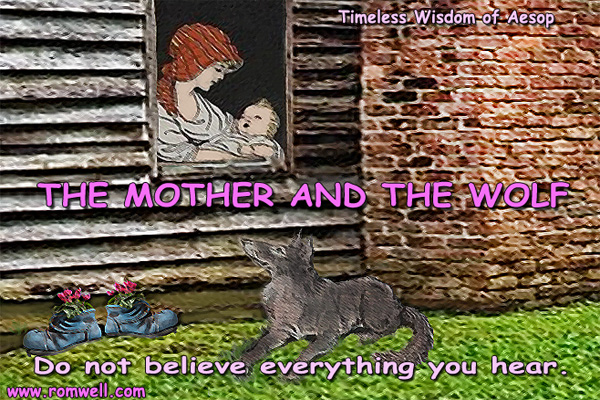
The Mother and the Wolf
Do not believe everything you hear.
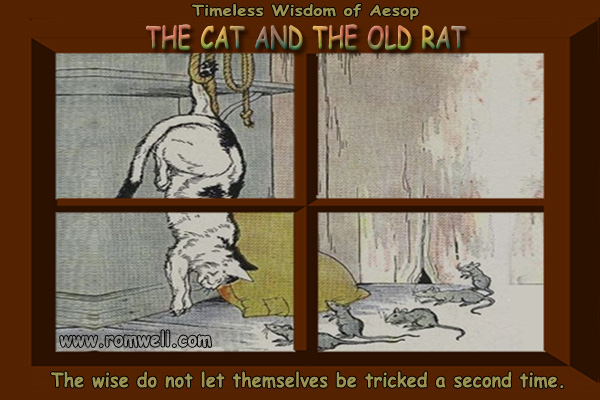
The Cat and the Old Rat
The wise do not let themselves be tricked a second time.
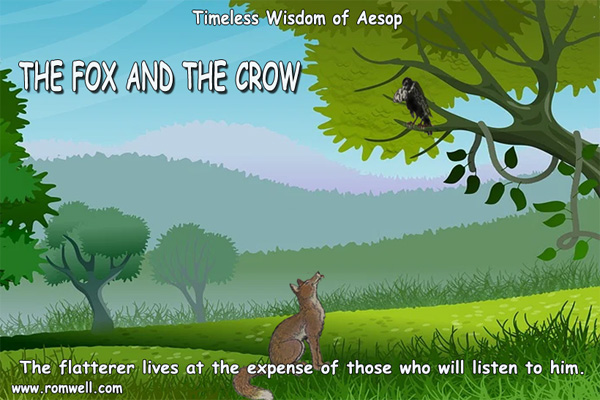
The Fox and the Crow
The flatterer lives at the expense of those who will...
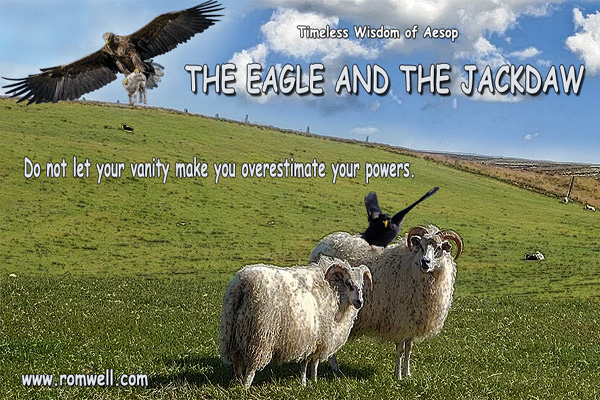
The Eagle and the Jackdaw
Do not let your vanity make you overestimate your powers.
Education Pages
We live in democratic and progressive society, so every student must be educated for leadership as well as for obedience. Every student must have power of self-direction and power of directing others, power of administration, ability to assume positions of responsibility. This necessity of educating for leadership is as great on the industrial as on the political side and gives opportunity for positive personal achievement. >>> Learn more...About Fats & Oils
Fats and oils are made up of basic units called fatty acids. All fats and oils are a mixture of saturated fatty acids and unsaturated fatty acids. Unsaturated fatty acids include monounsaturated and polyunsaturated fats. Fats and oils are categorized according to the number and bonding of the carbon atoms in the aliphatic chain. Fats that are saturated fats have no double bonds between the carbons in the chain. Unsaturated fats have one or more double bonded carbons in the chain. Within these categories, some specific fatty acids promote good health while others do not. Learn more about fats and oils...
RomWell Craft Pages
Surprise your loved ones with great craft creations, decorate your house, or make unique gifts for any occasion and create ultimate gift giving experience. Save money, spend a quality time with your dearest ones, and have fun doing great craft for any occasion!
Find out more
Browse RomWell Real Cooking